Taunting Tracy by A.M. Wagner | Book Review
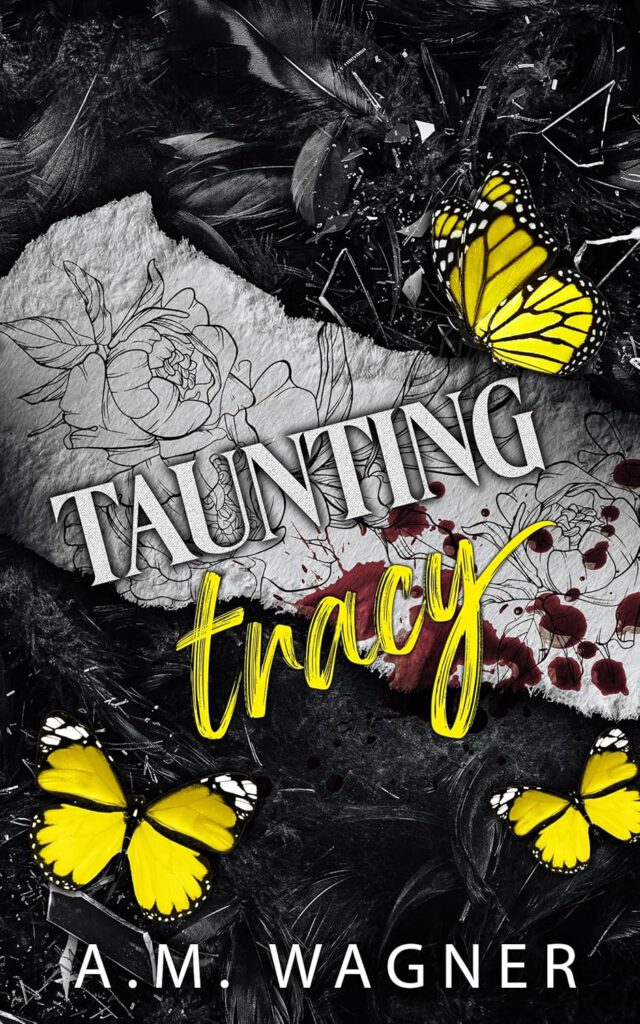
Blake Frenshaw is devastatingly handsome, successful, and a complete bully. He also happens to be my boss and is trying to blackmail me into marrying him. I thought the day I walked into his office, all those years ago, begging him to take a chance on me, was going to be the jumpstart to my career. As it turned out, it was the start of a tragic story that would see nothing but pain for us both. A part of him hates me. That cold, calculating side resents me for the way I've turned his life upside down. But an even larger part of him can't stay away, desperate to hold me close and chain me to him forever. He's out to make me miserable, and he's out to make me bend. Yet, this war waging between the two of us becomes the least of our worries. There are some fates worse than death, and I'm on the fast track to something far more painful than I could have ever imagined.
Plot Summary (spoiler-free)
Tracy Smith is very good at her job. She talks her way into one of the top real estate brokerages in the city and refuses to take no for an answer, even though the man signing off on her hire wants her gone. That man is Blake Frenshaw, and he is not a stranger. They have history, the kind that ended badly, and now he is her boss and he is holding that power over her head.
What starts as workplace friction curdles into something much worse. Blake cannot stay away from Tracy, and the part of him that wants her close wants to keep her there permanently, on his terms. The book moves between the present and the relationship they used to have, showing how something that once looked like love got turned into a weapon. On the surface Tracy has it together. Underneath, she is barely holding on, carrying grief and guilt she has never dealt with, and Blake knows exactly where those pressure points are.
Character Development
Tracy is the engine of the book. She is capable and driven and also genuinely damaged, and Wagner does not tidy that contradiction up. She wants independence and she needs other people. She wants to get through the day and she still has wants and feelings that complicate the survival math. Her anxiety, her self-destructive habits, the moments where she checks out entirely, all of it reads as honest rather than decorative. Her strength in this book is quiet and cracked and constantly being tested.
Blake does not get let off the hook. He is obsessive and controlling, and the book is clear that his fear and his warped sense of devotion do not excuse what he does. He tells himself he is protecting Tracy while he is doing things that hurt her. The relationship is not a relationship between equals. He has the money, the position, and the knowledge of how to get inside her head, and he uses all three. He is written to unsettle you, and he does.
Riley matters to Tracy as an anchor and a conscience, a reminder of loss and guilt even when she is not in the scene. Emery shows a glimpse of what gentleness could look like, which makes Tracy’s isolation land harder. The wider cast mostly exists to underline how alone Tracy is and how the structures around her help Blake keep his hold.
Themes
The book keeps asking where love ends and control begins, and it refuses to give an easy answer. Power and coercion run through everything: the professional hierarchy, the emotional leverage, the manipulation dressed up as care. Trauma and guilt shape how Tracy sees herself and what she believes she deserves. Her fight to hold onto her own autonomy is ongoing and unfinished by the last page. And nobody here is clean. Survival in this story means compromise, and the characters make choices they would rather not have made. Those threads wind together tightly enough that the whole book feels heavy and close.
Writing Style and Effectiveness
Wagner writes close to the skin. You are in Tracy’s head when the panic rises, and the dual point of view lets you into Blake’s thinking too, which makes the dread worse rather than better. The pacing alternates sharp frightening scenes with sudden emotional drops, and the dialogue often plays like a fight conducted in words. The atmosphere is deliberately claustrophobic and uncomfortable, which is the right call for this story. This is not darkness played for style points. It is the kind that is meant to be confronted.
Conclusion
Taunting Tracy is a deep, uncomfortable look at obsession and how badly it can distort love. Its strength is the psychological work: the interiority is detailed and it does not flinch. The cost is that it can be genuinely draining to read, and it offers very little closure or comfort. It sits alongside other dark office and stalker romances but goes further into what the characters are actually thinking than most of them do.
Evaluation
- Overall Rating: ★★★★☆ (4/5)
- Writing Style: ★★★★★ (5/5)
- Characters: ★★★★☆ (4/5)
- World-Building: ★★★☆☆ (3/5)
- Spice Rating: ★★★★☆ (4/5): explicit and charged, and tangled up with the power imbalance rather than separate from it.
Trigger warnings: obsession and stalking, coercion and blackmail, workplace power imbalance, emotional and psychological abuse, trauma, grief, guilt, self-destructive behaviour. The author includes a full content note at the front of the book.
Recommendation: for readers who want dark, psychologically dense romance with morally gray or openly unlikable leads, who are fine with a heavy power imbalance and an ending that does not resolve everything neatly. If you read dark romance for the character study rather than the fantasy, this delivers.