On Wings of Blood by Briar Boleyn | Book Review
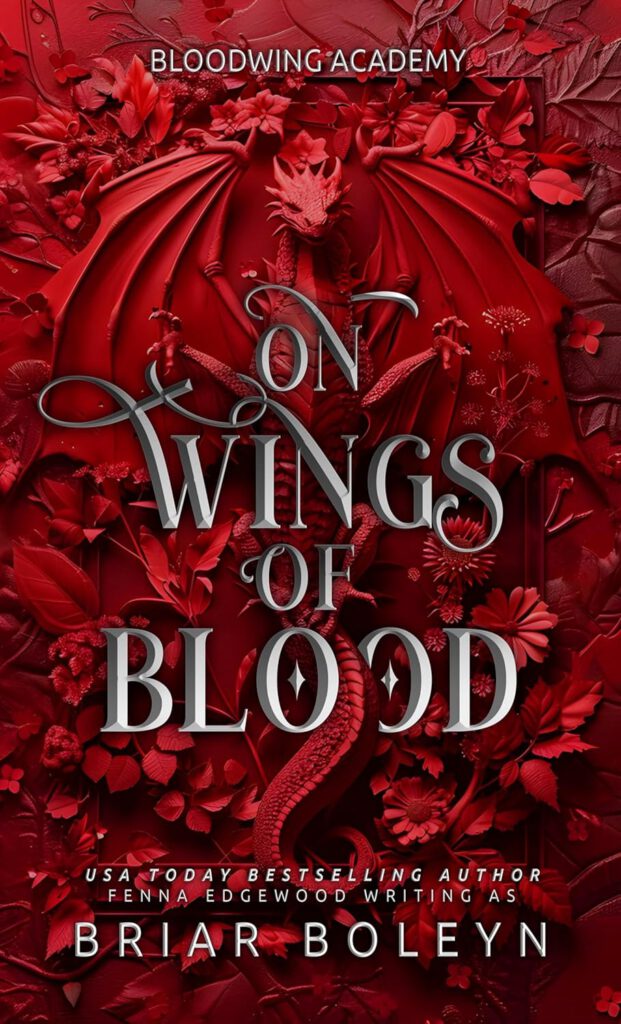
What do you get if you mix Harry Potter with Fourth Wing, Zodiac Academy, a dash of Arthurian legend, and lots and lots of vampires? Bloodwing Academy.
I didn’t sign up for this.
A half-fae in a school of highblood vampires? That’s a recipe for torment.
I’m Medra Pendragon, last of the dragon riders, or so they tell me. Funny thing is, there are no dragons left. Not a single one. But somehow, that hasn’t stopped the vampires from deciding I’m worth capturing. Now I’m stuck at Bloodwing Academy, where the highbloods run everything and blightborn like me? We’re just blood in their veins, pawns in their games.
But that’s not even the worst part. Enter Blake Drakharrow. Cold, arrogant, and way too gorgeous for his own good. He’s been tormenting me since the moment we met, and now, thanks to some ancient ritual, we’re betrothed. He acts like he owns me, but I’m not going down without a fight.
Bloodwing isn’t just a school, it’s a battlefield. Highbloods fight for power, and if you’re weak? You’re dead.
Between deadly competitions, lies that could get me executed, and a dragon-shaped secret looming over my head, all I have to do is survive. Easy, right? Except I’m starting to think the real danger isn’t the academy, it’s what I’m becoming in this twisted game of power.
And Blake? He might just be the one who pushes me over the edge.
They think they can control me. They think they can use me. But they have no idea what they’ve awakened.
Plot Summary (spoiler-free)
Medra is captured by Prince Blake Drakharrow, a cold, arrogant highblood whose reasons for wanting her stay hidden for most of the book. She is installed at Bloodwing Academy, where highbloods hold every advantage and blightborn like her are treated as blood supply and as pieces to be moved. An ancient ritual binds her to Blake as his betrothed, which gives him a claim over her that he is happy to act on and that she refuses to accept.
From there the book runs on two tracks. One is the academy itself, a place of deadly competitions where weakness gets people killed. The other is the politics of the vampire nobility, where Medra is valuable enough to be fought over and exposed enough to be executed if the wrong lie lands. She spends the book trying to survive both while working out what her supposed dragon-rider bloodline actually means. The ending turns on revelations about that bloodline and on where the binding ritual leaves her and Blake, and it closes on a hook clearly built to carry into book two.
Character Development
Medra is the book’s clearest strength. Her self-reliance was forged rather than chosen, and it holds up under pressure. She is dropped into a world whose rules she does not know, surrounded by people who want to use her, and she still finds her footing and carves out room to act on her own terms. She is quick-witted and stubborn to a fault, and Boleyn lets that stubbornness cost her as often as it saves her. Underneath the defiance there is real vulnerability and a running internal argument about who she is becoming in a place that rewards cruelty, and the book gives that argument room to breathe.
Blake is a genuine anti-hero rather than a misunderstood nice man. His pride and his flat, controlled surface cover a person pulled between duty, his family, and feelings for Medra that he does not want. He starts as her tormentor and does not get a quick redemption. What changes is slow: the chemistry between them builds through friction, sharp dialogue, and a handful of moments where one of them is genuinely exposed. The power imbalance between them is the engine of the relationship and the book never pretends otherwise. He holds a formal claim over her, he has status and physical power she does not, and the romance only works because Medra keeps refusing to let that claim define her. Their dynamic swings between open hostility and a wary, forced reliance on each other, and that swing is where most of the book’s tension lives.
The supporting cast is drawn with enough specificity to matter. Lord Drakharrow, Blake’s father, is the chilliest figure in the book, and his manipulation of everyone around him drives much of the central conflict. Regan Pansera, Blake’s first betrothed, brings aristocratic contempt and jealousy that sharpen every scene she shares with Medra and keep the court politics personal rather than abstract. Lucius, a nervous, clever court secretary loyal to Blake, is the ally who reads a room fastest and is worth remembering going into the sequels.
The romance is built on conflict and on the rare moments the two of them let their guard down, and it earns its slow burn. By the end of the book that burn has not fully paid off, which reads as deliberate setup for the series rather than a dropped thread.
Themes
The strongest thread is identity under pressure. Medra spends the book being told what she is, by people who each want her to be something different, and her real work is holding onto her own sense of herself while a whole society tries to reshape her. Self-discovery and resilience run right alongside that, and Boleyn keeps them tied to plot rather than letting them float as abstractions.
The second thread is power, specifically the rigid hierarchy of Sangratha’s vampire society and Medra’s refusal to accept where it places her. Her defiance of that hierarchy is not framed as automatically noble, it is framed as dangerous, and the book is honest about what it costs her.
The prophecy material does real work here rather than sitting as decoration. Being named a dragon rider forces the question of fate against free will onto Medra directly, and how she answers it shapes the person she becomes by the end.
Writing Style and Effectiveness
Boleyn’s prose is dense and highly descriptive, and it puts you inside Sangratha quickly. The atmosphere is gothic and consistent, and the vampire court and its politics come through in vivid, specific detail rather than broad strokes. The dialogue is a highlight: it is sharp, it carries the tension and the wit between Medra and Blake, and it rarely feels like filler.
The book uses a mostly single point of view anchored on Medra, with occasional chapters from Blake that open up what he is actually thinking. The pacing holds up well across a long page count, moving between high-stakes set pieces and quieter introspective stretches without stalling in either mode. The world-building is heavy and front-loaded in places, which is the main reason the reading experience lands at very good rather than effortless, but the density pays off as the court intrigue builds.
Conclusion
On Wings of Blood is a strong, confident series opener that does the hard parts well: a heroine with a real inner life, an anti-hero who earns his arc slowly, and a world detailed enough to hold a long series. The central themes of identity, resilience, and defiance of a fixed hierarchy are carried through the plot rather than stated and dropped.
It is not a flawless book. The world-building asks a lot of the reader up front, and this is very much book one of a larger story, so several threads close on deliberate hooks rather than resolution. What keeps it a notch below exceptional is craft rather than concept: the prose and structure are very good without being the kind you reread for the sentences. Set against other dark academia romantasy, it shares the school-plus-court framework and the hate-to-love spine with a lot of the shelf, and what it does differently is give the heroine a genuinely stubborn interior and refuse to soften the power imbalance at the heart of the romance.
Evaluation
- Overall Rating: 4 / 5
- Writing Style: 4 / 5
- Characters: 5 / 5
- World-Building: 5 / 5
Trigger warnings: Abduction, Assault, Blood & Gore, Blood Play, Bullying, Child Abuse, Death, Dubious Consent, Emotional Manipulation, Graphic Violence, Injury/Threat to Animals, Mental Health Issues, Murder, Non-Consensual Mind Control, Non-Consensual Blood Feeding, Physical Abuse, Power Imbalance, Psychological Abuse, Sexual Assault (Threat of), Strong Sexual Tension, Substance Abuse, Suicidal Ideation, Torture.
Recommendation: for readers who want dark fantasy with a tough, prickly heroine and a layered anti-hero, and who like their romance wrapped in court intrigue, deadly competition, and slow-building tension. Good fit for fans of Fourth Wing, Zodiac Academy, and the Crowns of Nyaxia books.