Of Inklings and Willowpillars by Brent K. Newcomb | Book Review
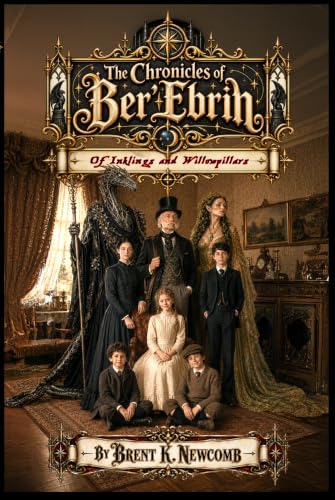
Vanover, New England, 1877. Five young adventurers and the eccentric Professor Peabody step through an impossible portal into the Polycosmos, where every realm has its own laws, and even a small mistake may carry dreadful consequences. When Jules is taken by slavers in the black sands of the Colorless Kingdoms, the Inklings must cross a world of pirate skiffs, ancient drakes, enchanted objects, strange fae creatures, dangerous bargains, and transformations that reveal more than appearances. Edgar becomes a furry willowpillar who insists he is still a grizzly. Charlotte sprouts butterfly-like wings. And fifteen-year-old Mary Doyle discovers that something far darker has crossed the threshold with them, and has chosen her not merely as prey, but as a soul to corrupt. Darkly whimsical and atmospheric, Of Inklings and Willowpillars blends the storytelling spirit of classic children's fantasy with historical detail, eccentric humor, fairy-tale wonder, peril, and darker YA/adult crossover stakes. It is Book One of The Chronicles of Ber'Ebrin, a 21-book historical portal-fantasy series spanning strange realms, generations, and changing eras.
Plot Summary (spoiler-free)
It’s a cold November in 1877, and five neighborhood children belong to a secret adventuring club called the Inklings. Mary is fifteen and half ashamed of still playing pretend. Her twin brothers Charles and Jules rough-house their way through every scene. Next door are ten-year-old Charlotte and her little brother Edgar, who is eight and spends most of the book insisting he’s a bear. Their favorite grown-up is Professor Peabody, a mutton-chopped inventor who has just come home from South America with a map nobody can read. Charlotte can read it, sort of, because she takes in sounds and smells instead of words.
The map points toward Ber’Ebrin, a legendary paradise the professor’s missing father spent his life chasing. Six clay key-coins, worn as necklaces, let the group slip into other realms as long as they imagine hard enough. They land in the Colorless Kingdoms, where everything native is black or gray, the sky is a white glare, and pirates sail skiffs across the sand. Someone goes missing within a day or two. From there the book follows the search and a string of other worlds, each with its own rulers, creatures and bad ideas.
I didn’t expect the Prologue to give so much away. Before Chapter One, a goddess hands a grumpy old-world spirit called the Beast a job, which is to corrupt Mary, and the Beast takes it. So you read the whole book knowing something is wrong, and you wait for the children to catch up. That gave the first hundred pages a little dread under all the silliness, and I liked it.
Character Development
Edgar has lost his clothes, his paper flower and most of his dignity by the end of Chapter Three, because the portal turned him into a foot-long ball of brown fur. He keeps his father’s top-hat. Whatever he meets, a pirate, a bloated talking head that wants to eat him, a mud imp, he tips the hat and asks how it does. I figured the gag would be spent by Chapter Five. It isn’t, because it turns out to be how he covers being scared. One night in the desert he whispers to his sister that he isn’t brave, not deep down, and she tells him he is. That exchange got to me more than I expected from a bear in a borrowed hat. Later he slips away alone on an errand he’s sure nobody would allow, and I was nervous for him the whole way.
Professor Peabody invents things nobody asked for, like spectacles for nearsighted cats and a sun-powered candle. His potion belt is a good example. A machine he built without knowing how it works fills the vials, so every cork he pulls is a coin toss. One gives off a skunk’s shriek, one floods a room with light, and one is a sip that makes a hungry group forget about dinner. It’s a joke about experts who build the horse-cart before they’ve found the horse. Under the clutter is a man whose mother died when he was a boy and whose father walked out of the house one day and never came back, and the “cracked pot” jokes read differently once you know that. He also spends a lot of the book reacting to what’s happening around him instead of steering it, and I kept wanting a scene where he was simply himself.
Mary is fifteen, and her mother is already measuring her for courtship. She keeps promising herself each outing is her last. That pull between pretending and growing up is real and I felt for her. But for long stretches she cries, stalls and gets handled by the men around her, and the one time she acts boldly I cheered out loud. A romance appears for her so suddenly that the narrator himself compares it to lightning from a clear sky, and it left me cold. Older men pressing her to give up her independence, sometimes with magic behind it, made me uncomfortable more than once for a girl her age.
Charlotte can read the map at all, by smell and sound, and she’s the first to look at a frightening thing and keep her head. She also can’t make her new wings work, and her embarrassment over that runs quietly through the book. At one point she throws her father’s pocketknife at something monstrous because she once practiced a boys’ game called mumblety-peg, and that made me grin. Jules is tucked away for most of the story, which is a shame because the twin rivalry with Charles is the most grounded relationship in it. Charles is mostly a quipper with a sword. The villains, a hissing drake lord and a vain, vengeful forest queen, are fun but cartoonish, and the drake’s drawn-out “sssss” speech got tiring fast.
Themes
The central idea is imagination against growing up. The professor says children have something adults have lost, and the whole portal system runs on it. This isn’t only a premise, because Mary’s mother’s voice in her head is literally the opposing force in her own story. The epigraph, “Goodness is not effortless. It is learned, chosen, practiced, and defended,” is what the book keeps coming back to. It shows up in small choices more than speeches. Edgar chooses courage when he’s frightened. The professor keeps going when he’s being steered somewhere he doesn’t want to go.
Ber’Ebrin itself is built on a paradox I enjoyed. A kind imp tells Edgar that it isn’t something you go looking for, because the more you chase it the more it slips away, and that you prove yourself worthy by not wanting it at all. She compares it to waiting for Christmas presents. It’s a neat idea to hang a twenty-one-book series on, and it gives the professor’s obsession a gentle irony I didn’t expect.
Power and corruption come in through the villains and the Beast, and so does an idea I found more interesting than the plot around it, which is how easily affection can be manufactured. A magic stone that makes people fall in love is a fun device for a romp. It’s also a real question about consent and free choice, and the book plays it mostly for comedy. I wanted the story to sit with that a bit longer than it does. Grief and fathers run underneath, in the professor’s search and in the children’s guilt over a missing brother, and they give the silliness a floor. I wish the book trusted that floor more.
Writing Style and Effectiveness
The narration is a Victorian storyteller who keeps leaning over your shoulder to explain things, joke about them, and occasionally apologize for the vices he’s about to describe. It reminds me of Lemony Snicket crossed with Douglas Adams, with a little Alice thrown in. The Prologue opens on a Beast with a sore throat who forgot his handkerchief, and it lists the powdered wig among the crimes of old spirits. Names and gags pile up constantly, from toad-goeblins to a pub called the Flatulent Unicorn, and about one in three made me laugh. Sound effects spelled out on the page, a fwap of snowballs or a fizzle-pop as someone tumbles through a portal, give the action a cartoon snap that suits it.
The trouble is the pile. This is a very long book for what it does, and I felt every page of the middle third, when the plot circled through a desert, a forest and a palace in turn, each with a full cast. Songs and poems show up every chapter or two, and a lot of them are filler. Running tics repeat to the point of irritation. Everyone harrumphs, wings flutter, handkerchiefs mop brows. The jokes about lice, dandruff and chamber pots stretch the same idea too far.
The structure adds to it. Chapters cut between groups, and the strand following Jules through captivity keeps pulling the energy down just as the main party starts building something. I understood why it was there, but I kept wanting to go back to the others. The dialect writing is another small drag. Street voices come out as heavy phonetic spelling, and a few of them took real effort to read.
Tone is the bigger problem. The book is whimsical until it isn’t, and then it’s slavery, beheadings, children chained at an auction and a run of killings, some of them played as jokes. The narrator keeps the same jaunty voice through all of it, and I never quite knew how to feel. It reads as a children’s story with some dark material, and the line between those two isn’t always clear. A young reader could be thrown, and so could a parent.
One more thing I noticed is that the story seems built for a long run. It has twenty-one planned volumes, and this first one ends on a cliffhanger. The ending works as a hook, but I wanted a bit more resolution before the page turned over.
Conclusion
I liked this a lot, and I’ll be honest that the middle third tested my patience. I’m rating it a 4 overall even though I score the writing and the characters a 3, because I enjoyed spending time in this world more than those craft scores alone would suggest. Edgar’s small, stubborn bravery and the narrator’s voice are what stayed with me. If portal fantasy is your thing, those two make it worth a look. The world has real invention in it, with a whole taxonomy of portal types, a realm drained of color, and creatures like willowpillars and toad-goeblins that feel specific instead of generic.
What holds it back is length, uneven tone, and a few choices I would flag for anyone buying it for a young reader. Slavery, killings and a pair of teenage romantic threads, one with magical coercion, sit next to bear jokes in a way that didn’t sit right with me. The writing is warm and funny, but it isn’t careful enough with the heavier material to be a safe pick for the youngest readers it seems to be aiming at.
I’ll read book two to see whether the series tightens up. It belongs on the shelf next to Alice in Wonderland and The Chronicles of Narnia in spirit, though it’s more digressive than either. If you grew up on those and want a chatty, old-fashioned adventure with a lot of heart and some real rough edges, it’s a charming read in small doses.
Evaluation
Overall Rating: ★★★★☆ (4/5): enjoyment holds it above the craft scores below
Writing Style: ★★★☆☆ (3/5): a funny, distinctive narrator held back by length, repeated tics and uneven tone
Characters: ★★★☆☆ (3/5): Edgar and the professor have real personality, Mary’s romance and the villains are thin
World-Building: ★★★★☆ (4/5): inventive realms, a real portal system and specific creatures, with some lore dumped in at once
Spice Rating: ★☆☆☆☆ (1/5): implied and fade-to-black only, nothing explicit on the page
Recommended for readers who love old-fashioned portal fantasy in the vein of Alice in Wonderland, Narnia and Lemony Snicket, and who don’t mind a chatty narrator and a very long book. It’s a good fit for adults looking for a whimsical, nostalgic adventure. Parents should read it first before handing it to younger children, because of the slavery, the violence and the romance threads. Skip it if you want a tight plot or a consistent tone.
Trigger warnings: fantasy violence and death, child abduction and enslavement, supernatural corruption and coercion, alcohol and gambling, peril involving children, and non-explicit older-teen romantic and sexual themes involving magical coercion.