Decadence by Soph Tang | Book Review
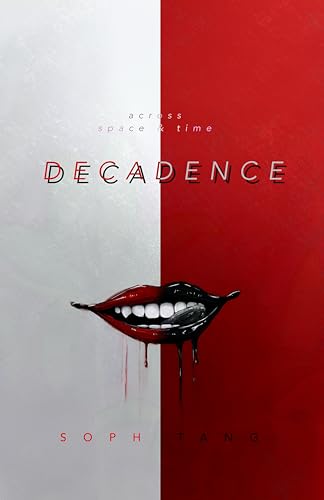
Driven by love. Haunted by shame. Consumed by desire. Indulge in something you can sink your teeth into. An unexpected text from her ex-girlfriend shatters the fragile peace of Elise's delicate life. Standing at the crossroads of her future, Elise succumbs to the dark desires of her heart, stumbling through the fog of uncertainty toward a past she had long since forsaken. What will she find in the bittersweet nostalgia of a town she hasn't seen for a decade? How will she survive the impossible decisions that await her? Decadence is a raw and devastating exploration of love in its many forms: the burning wrath of eros, the gentle kiss of agape, and everything in between.
Plot Summary (spoiler-free)
Elise has built a quiet, careful life, and it holds together until a single unexpected text from Lily, an ex-girlfriend she has not seen in a decade, arrives with a revelation that changes everything. Pulled back toward a town and a person she thought she had left behind for good, Elise finds herself standing between the love she lost and the love she still has: Viri, her steady partner, patient and constant in a way Lily never was.
The book is less about which person Elise chooses than about what she is willing to face in herself. It moves in and out of the past as freely as her memory does, following her through guilt, nostalgia, desire, and the slow, difficult work of self-forgiveness. Told in lyrical, restrained prose, Decadence is a raw look at love in several forms at once and at what we actually do with the people we have lost.
Character Development
Elise is an introspective, emotionally exposed heroine, flawed and painfully human, caught between past and present and both wanting closure and flinching away from what it would cost. Her internal monologues read like a mind at war with itself: she romanticises what is behind her while knowing, on some level, that nostalgia lies. That self-awareness makes her growth slow and genuinely uncomfortable to watch.
Lily is magnetic and evasive, carrying a quiet grief that makes her presence in Elise’s life both a pull and a danger. She never pushes Elise into anything; simply being near her is enough to loosen the restraint Elise has spent years building. Viri is the opposite pole: the anchor, the home, steady where Lily is volatile. She is not naive about what is happening, and her patience has a limit even if she keeps hoping Elise will choose their present. Jen, Lily’s stepmother, is a plain-spoken, warm figure who reads almost as a mother to both women, and Matty, Elise’s friend, grounds the book with humour and honesty.
Themes
The book works through several kinds of love at once: the wild, consuming kind, the steady and safe kind, the kind that heals and the kind that destroys. It asks whether you can love two people at the same time and, if you can, what that love actually is. Running alongside that is a hard look at nostalgia, the argument that the past is rarely as lovely as we remember and that idealising what is gone is its own trap. And it treats self-forgiveness as harder than forgiving anyone else, following Elise through guilt for staying, for leaving, for being fragile, for not being kind enough. Loss and mortality sit under all of it.
Writing Style and Effectiveness
Soph Tang’s prose is lovely, lyrical without being self-indulgent, and the imagery gives even ordinary moments extra weight. The narrative is non-linear, sliding between past and present in a way that mirrors the mess of Elise’s feelings and puts the reader as close to her memories as prose can manage. The whole book is soaked in a melancholy, dreamlike atmosphere: the city, the late-night phone calls, the long silences. Readers who want a plot-forward romance should know going in that this is a slow, interior book that lingers.
Conclusion
Decadence is a book that stays with you. It is about love and heartbreak, but really it is about being a person who wants, regrets, and tries to recover. It is raw and honest and built on moments that catch you off guard. Readers who loved the ache of Sally Rooney’s Normal People or André Aciman’s Call Me By Your Name will recognise the feeling, though Tang’s unusual structure and very self-analytical voice make this its own thing.
Evaluation
- Overall Rating: ★★★★★ (5/5)
- Writing Style: ★★★★☆ (4/5)
- Characters: ★★★★★ (5/5)
- World-Building: ★★★★☆ (4/5)
- Spice Rating: ★★☆☆☆ (2/5): desire is central to the book, but it is handled with restraint rather than explicit detail.
Trigger warnings: terminal illness and death, grief, heavy guilt and shame, infidelity and the moral fallout of it, self-destructive behaviour and references to suicide.
Recommendation: for readers who want a quiet, literary sapphic romance that puts feeling and interiority ahead of plot, who can sit with grief and moral ambiguity, and who like a non-linear structure. If Normal People or Call Me By Your Name wrecked you in a good way, this is for you.