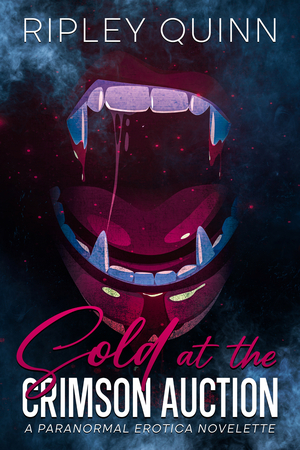
Sold At The Crimson Auction by Ripley Quinn | Book Review
Plot Summary (spoiler-free) Ruby Branstrom sneaks back into her father’s mansion on the night of her twenty-first birthday, fresh off her first real taste of freedom, and gets caught by something worse than her father’s usual coldness: a vampire shows up to collect on a decades-old debt, and Ruby is the payment. She’s dragged to a hidden manor, put up for auction in front of a room of wealthy, inhuman bidders, and won, not by the sadistic buyer everyone warned her about, but by the stranger, wealthier Lord Ezra. The rest of the novelette is Ruby’s first full day and night in Ezra’s household, learning the shape of her new life from his sharp, world-weary companion Elodie and from Ezra himself. I read it mostly wanting to know how much of herself she’d get to keep on the way from daughter to property. Character Development Ruby gets more interiority than a novelette this short really owes her. Her instinct to “handle” the men around her, learned from a lifetime of managing her father, is specific in a way distress usually isn’t in books this fast, and I liked that she names her own creeping Stockholm syndrome out loud instead of the narrative dancing around it. Elodie is the best-drawn character in the space available: a vampire who was human once, turned by Ezra himself, handing Ruby her pragmatic “make the best of it” advice with just enough weariness that you can tell she’s said it to herself first. Ezra never quite earns his own stakes. He’s got a taste for collecting, a claim that he doesn’t enjoy cruelty, and a habit of watching Ruby like she’s a puzzle he hasn’t solved, but the book never gives a real reason for his fascination beyond “she pleases him.” That leaves the whole relationship resting on attraction with nothing underneath it. Varis is pure menace, no interiority at all, there purely to make Ezra look like the reasonable option. Ruby’s father barely counts as a character past the coldness of the opening scene. Themes The real subject here is coerced consent dressed up as luxury, and to the book’s credit, it doesn’t pretend otherwise. Ruby calls herself a slave in her own head more than once. What the story doesn’t do is sit with that. It resolves the tension by having Ruby consciously choose to focus on the pleasure of her situation instead of its servitude, and that reads less like earned reconciliation than the book declining to look directly at the thing it raised. There’s a second theme underneath, never quite examined either: a woman traded between men to settle a debt she had no part in creating, first by her father, then by the auction’s whole economy, with her own preferences only entering the picture after ownership already changed hands. Writing Style and Effectiveness The prose stays close-third on Ruby the whole way through, which keeps Ezra and Elodie’s real motives at arm’s length and lets her fear and confusion do the work of your own uncertainty. The pacing is tight; nothing overstays its welcome, and the auction scene, two vampire lords driving a bidding war higher while Ruby stands frozen in the middle of it, is the best thing in the book. I noticed the italicized internal questions doing a lot of heavy lifting for Ruby’s inner conflict, and they work the first few times. By chapter two they’ve become a tic. Given how short this is, the two extended intimate scenes eat up a genuinely large share of the word count, which isn’t really a flaw for the genre so much as a fact worth knowing before you pick it up expecting a lot of plot. Conclusion Sold At The Crimson Auction reads exactly like what it probably is: the opening entry of a longer story, sold as a standalone novelette. It does that job fine, a strong hook, a genuinely vivid auction scene, a real psychological detail or two for Ruby, and enough of a threat in Varis to make you want the next installment. It has the same DNA as those short vampire-auction serials that live entirely on cliffhangers, and it doesn’t pretend to be more than that. Where it comes up short is everything a longer book would have room to grow: Ezra never becomes more than an attractive cipher, the coerced-consent premise gets named instead of actually grappled with, and the ending is a pause, not a resolution. On its own, it’s thin. As a first chapter, it does the job it’s there to do. Evaluation Overall Rating: ★★★☆☆ (3/5) Writing Style: ★★★☆☆ (3/5): tight pacing and a well-chosen single POV, undercut by an overused internal-question tic Characters: ★★★☆☆ (3/5): real specificity for Ruby and Elodie; Ezra, Varis, and Ruby’s father stay closer to archetype than person World-Building: ★★☆☆☆ (2/5): vivid isolated details (the manor, the auction ritual, feeding mechanics) without much sense of how the vampire-human economy or society actually works as a system Spice Rating: ★★★★★ (5/5): two extended, graphic scenes that together make up a large share of the novelette’s total length Recommended for readers who want a fast, explicit “sold to a vampire lord” premise with a clear owner/pet power dynamic, and who don’t need that dynamic’s coercion to be interrogated rather than simply lived through; readers happy to treat this as a series opener rather than a complete story. Not recommended for readers who want the male lead to have real interiority, or who want the story’s own uncomfortable premise to get a real reckoning rather than a chosen focus on pleasure over servitude. Trigger warnings: kidnapping and human trafficking, sexual slavery and ownership, coercion and dubious consent, blood-drinking, violence and threats of violence, familial betrayal, and explicit sexual content.
Plot Summary (spoiler-free)
Ruby Branstrom sneaks back into her father’s mansion on the night of her twenty-first birthday, fresh off her first real taste of freedom, and gets caught by something worse than her father’s usual coldness: a vampire shows up to collect on a decades-old debt, and Ruby is the payment. She’s dragged to a hidden manor, put up for auction in front of a room of wealthy, inhuman bidders, and won, not by the sadistic buyer everyone warned her about, but by the stranger, wealthier Lord Ezra. The rest of the novelette is Ruby’s first full day and night in Ezra’s household, learning the shape of her new life from his sharp, world-weary companion Elodie and from Ezra himself. I read it mostly wanting to know how much of herself she’d get to keep on the way from daughter to property.
Character Development
Ruby gets more interiority than a novelette this short really owes her. Her instinct to “handle” the men around her, learned from a lifetime of managing her father, is specific in a way distress usually isn’t in books this fast, and I liked that she names her own creeping Stockholm syndrome out loud instead of the narrative dancing around it. Elodie is the best-drawn character in the space available: a vampire who was human once, turned by Ezra himself, handing Ruby her pragmatic “make the best of it” advice with just enough weariness that you can tell she’s said it to herself first.
Ezra never quite earns his own stakes. He’s got a taste for collecting, a claim that he doesn’t enjoy cruelty, and a habit of watching Ruby like she’s a puzzle he hasn’t solved, but the book never gives a real reason for his fascination beyond “she pleases him.” That leaves the whole relationship resting on attraction with nothing underneath it. Varis is pure menace, no interiority at all, there purely to make Ezra look like the reasonable option. Ruby’s father barely counts as a character past the coldness of the opening scene.
Themes
The real subject here is coerced consent dressed up as luxury, and to the book’s credit, it doesn’t pretend otherwise. Ruby calls herself a slave in her own head more than once. What the story doesn’t do is sit with that. It resolves the tension by having Ruby consciously choose to focus on the pleasure of her situation instead of its servitude, and that reads less like earned reconciliation than the book declining to look directly at the thing it raised. There’s a second theme underneath, never quite examined either: a woman traded between men to settle a debt she had no part in creating, first by her father, then by the auction’s whole economy, with her own preferences only entering the picture after ownership already changed hands.
Writing Style and Effectiveness
The prose stays close-third on Ruby the whole way through, which keeps Ezra and Elodie’s real motives at arm’s length and lets her fear and confusion do the work of your own uncertainty. The pacing is tight; nothing overstays its welcome, and the auction scene, two vampire lords driving a bidding war higher while Ruby stands frozen in the middle of it, is the best thing in the book. I noticed the italicized internal questions doing a lot of heavy lifting for Ruby’s inner conflict, and they work the first few times. By chapter two they’ve become a tic. Given how short this is, the two extended intimate scenes eat up a genuinely large share of the word count, which isn’t really a flaw for the genre so much as a fact worth knowing before you pick it up expecting a lot of plot.
Conclusion
Sold At The Crimson Auction reads exactly like what it probably is: the opening entry of a longer story, sold as a standalone novelette. It does that job fine, a strong hook, a genuinely vivid auction scene, a real psychological detail or two for Ruby, and enough of a threat in Varis to make you want the next installment. It has the same DNA as those short vampire-auction serials that live entirely on cliffhangers, and it doesn’t pretend to be more than that. Where it comes up short is everything a longer book would have room to grow: Ezra never becomes more than an attractive cipher, the coerced-consent premise gets named instead of actually grappled with, and the ending is a pause, not a resolution. On its own, it’s thin. As a first chapter, it does the job it’s there to do.
Evaluation
Overall Rating: ★★★☆☆ (3/5)
Writing Style: ★★★☆☆ (3/5): tight pacing and a well-chosen single POV, undercut by an overused internal-question tic
Characters: ★★★☆☆ (3/5): real specificity for Ruby and Elodie; Ezra, Varis, and Ruby’s father stay closer to archetype than person
World-Building: ★★☆☆☆ (2/5): vivid isolated details (the manor, the auction ritual, feeding mechanics) without much sense of how the vampire-human economy or society actually works as a system
Spice Rating: ★★★★★ (5/5): two extended, graphic scenes that together make up a large share of the novelette’s total length
Recommended for readers who want a fast, explicit “sold to a vampire lord” premise with a clear owner/pet power dynamic, and who don’t need that dynamic’s coercion to be interrogated rather than simply lived through; readers happy to treat this as a series opener rather than a complete story. Not recommended for readers who want the male lead to have real interiority, or who want the story’s own uncomfortable premise to get a real reckoning rather than a chosen focus on pleasure over servitude.
Trigger warnings: kidnapping and human trafficking, sexual slavery and ownership, coercion and dubious consent, blood-drinking, violence and threats of violence, familial betrayal, and explicit sexual content.