Infernal Bindings by Loren Huxley | Book Review
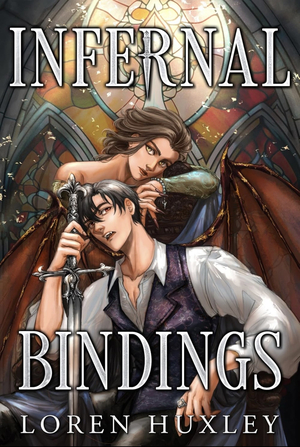
Annalise accidentally summoned a half-incubus named Daemon into her aunt's attic when she was eight and tied her soul to his. Thirteen years later she is a light witch about to be baptised into the coven her family belongs to, when a coven Regent turns up dead and every scrap of evidence points at Daemon. She has six days to find the real killer or Daemon is punished for eternity.
Plot Summary (spoiler-free)
Annalise, Annie to basically everyone who matters, accidentally summoned a half-incubus named Daemon into her aunt’s attic when she was eight years old, and in the process of trying to make a friend, she tied her soul to his instead. Thirteen years later, she’s a grown light witch about to go through her baptism, the ceremony that would make her immortal and lock her into the angel-aligned coven her whole family belongs to, except Daemon’s still around, still her best friend, and the coven elders have never forgiven her for it.
The baptism goes sideways fast. A coven Regent turns up dead, every scrap of evidence points at Daemon, and Annie strikes a bargain with the archdemon who governs incubi: find the real killer in six days or Daemon gets punished for eternity and her own soul transfers straight to a being who makes Daemon look tame by comparison. What follows is equal parts murder investigation and forced-proximity romance, with Annie bouncing between her freshly minted fated mate Christopher, a light-witch elder who’s genuinely kind to her in a way almost nobody in her life has been, and Daemon, who she’s spent thirteen years insisting is just a friend. I went in expecting a fairly straightforward “pick between two hot guys” setup and got something a little stranger: a book that’s just as interested in Annie learning she’s allowed to want things for herself as it is in who she ends up choosing.
The investigation takes her into actual incubus clubs in Hell, in progressively more elaborate disguises. Annie is a woman who has spent her whole life being polite, and watching her try to stroll into one of those clubs like she belongs there made me grin more than once. The six-day clock gives the middle of the book real urgency instead of letting the romance meander. It ends in a genuine happily-ever-after, not a cliffhanger, though getting there costs Annie more than she expects, and costs some of her relationships with her own family permanently.
Character Development
Annie’s whole personality, for most of this book, is built around not wanting to be a problem. She defers to her mother, defers to the coven, almost defers to a mate she just met over a demon she’s loved for thirteen years, and it’s frustrating to watch until you realize that’s the point. Her arc isn’t really “witch discovers she’s powerful,” even though that happens too. It’s her slowly figuring out that she’s allowed to want the thing she actually wants instead of the thing that would make everyone stop being disappointed in her. I rooted for her to say the plain thing out loud long before she did, and the wait made it land harder. I liked her more by the end than I did in the first third, and that’s a real accomplishment for a character who spends a lot of early chapters being talked over by everyone around her.
Daemon comes with thirteen years of “just friends” energy, a mother who calls Annie his bimbo to her face, and a real, ugly betrayal buried in the middle of the book that the story doesn’t entirely earn its way out of. When it lands, it should be a genuine relationship-ending revelation. For about two chapters it plays that way. Then the plot needs them back on the same side to survive Salios’s punishment, and the resolution comes faster than the violation deserved. I wanted more time in that discomfort than the book gave me. Still, everything else about Daemon, the loyalty that shows up as breakfast and pancakes rather than grand gestures, the fact that he’s never kissed anyone because he wanted the first one to mean something, makes him worth rooting for even with that unresolved weight sitting underneath him. The pancakes stayed with me longer than the big scenes did. Small, domestic, slightly stubborn gestures like that sell thirteen years of friendship better than any speech could.
Christopher deserves more credit than a love-triangle loser usually gets. He’s a hundred-year-old elder who’s kind to Annie in ways that cost him actual social standing, and he helps investigate a murder that could get him executed. The book gives him real dignity instead of using him as a disposable obstacle, and that’s a rarer choice than it should be in this genre. That stuck with me after I finished. Minerva, Daemon’s mother, gets a real redemption arc of her own, from openly hating Annie to being the person Annie needs most when it counts, and Annie’s own mother gets a late moment that reframes some of the coldest scenes earlier in the book without undoing how much damage was done getting there.
Themes
Consent and ownership, dressed up as romance and religion both, is the thread this book keeps circling back to. A spell cast at eight is why Annie’s soul belongs to Daemon at all. Angels, not Annie, decided the mate bond should exist. And the incubus feeding, framed as sexy and consequence-free for most of the book, takes one genuinely uncomfortable turn in the middle. I liked that the story lets that tension sit for a while instead of resolving it neatly. I liked it a lot less that the sharpest instance of it is also the one the plot resolves fastest.
There’s a real thread here about institutions using love as leverage. The angels use mating bonds to keep talented witches loyal. The coven murders members of a rival faction and calls it justice because a treaty says they’re allowed to. Even Salios, the archdemon running the whole game Annie’s forced to play, ends up closer to a cautionary tale than a cartoon villain by the book’s end.
Family, the found kind and the biological kind, gets weighed against each other constantly. Annie’s actual parents fail her over and over in ways that are specific and personal rather than generic “bad parent” shorthand, while Daemon’s mother, who spends the first half of the book openly hostile to her, becomes the person fighting hardest for both of them. It’s not a subtle theme, but it earns its landing anyway. I kept thinking about how quiet the family’s failures are, the kind you only see clearly once someone else points at them.
Writing Style and Effectiveness
Annie’s first-person, present-tense narration moves fast and never lets a tense moment sit for long before cracking a joke about it. That works for most of the book. In the couple of genuinely dark stretches, the fallout from that midpoint betrayal especially, I wanted the humor to back off for a page or two and let the moment actually land instead of getting deflected by a punchline three sentences later. The banter itself is a real strength regardless. Daemon and Annie’s back-and-forth is funny, dry and a little mean in the way old friends actually talk to each other, and it made me laugh out loud twice while reading it on the train, which isn’t nothing for a book this heavy on demonic sex.
The mystery structure is where the plot mechanics get weakest. Investigating mostly means checking suspects off a list with a magic stone that either buzzes or doesn’t, and the actual answer to who killed the Regent arrives through one conversation late in the book rather than anything a reader could piece together earlier. It works fine as an excuse to send Annie and Daemon back into Hell together. It works a lot less well as an actual whodunit, since there’s no real clue-laying for a reader to catch up on before the characters do. The middle section repeats its own shape once too, sending Annie back into the same club a second time to finish the same vetting job, and that second trip doesn’t bring enough new information or tension to earn covering the same ground twice.
The explicit content, frequent, inventive, and unwilling to shy away from kink most books in this genre only gesture at, is one of the book’s clearer strengths. Readers picking this up for the spice specifically won’t feel like the book teased them and cut away at the door. It also isn’t only shock for its own sake. The scenes keep circling trust, who has it and who is spending it, which is why they work for me when they work.
Conclusion
Infernal Bindings takes a setup that’s everywhere right now, morally grey demon love interest, forbidden bond, fated-mate complication, and mostly earns its place in that crowd through voice and through giving the “other man” real dignity instead of using him as a disposable obstacle. That’s not nothing. A lot of books in this exact lane don’t bother. If you want the spice, the banter and a hero who shows up with breakfast, it delivers all three.
Where it comes up short is craft rather than concept. The mystery plot is thin scaffolding dressed up as urgency, the club investigation repeats itself once too often, and the one moment of real, serious betrayal in the middle of the book gets resolved faster than it deserves, which softens what should have been the emotional gut-punch of the whole story. I finished it satisfied, entertained, and a little bit wishing the book had trusted its darker material to sit longer before rushing back to banter and heat.
Evaluation
Overall Rating: ★★★☆☆ (3/5)
Writing Style: ★★★☆☆ (3/5): a fast, funny, sardonic first-person voice that carries the banter well, undercut by a mystery structure that’s mechanically thin and a middle section that repeats its own beats
Characters: ★★★☆☆ (3/5): Annie’s growth into wanting things for herself is genuine, Christopher gets unusually generous treatment for a rejected love interest, and Daemon’s loyalty is compelling even where the plot lets him off easy
World-Building: ★★★☆☆ (3/5): the seven-kingdom demon hierarchy and the light witch/Septem treaty are interesting ideas that stay mostly gestured at rather than explored in depth in this single standalone
Spice Rating: ★★★★★ (5/5): frequent, highly explicit, and covers a wide range of kink content throughout, not just in isolated scenes
Recommended for readers who want their morally grey demon romance genuinely spicy rather than fade-to-black, who liked the incubus-bestie-turned-love-interest energy of CN Crawford’s fae books or Rebecca F. Kenney’s darker paranormal work, and who don’t mind a love triangle where neither man gets flattened into a strawman. Less of a fit if a tight, well-clued mystery matters to you as much as the romance does, or if you want the heavier moments to get more room before the banter returns.
Trigger warnings: CNC and dubcon scenes between the main characters, alcohol and drug use, anal sex, BDSM, blasphemy, degradation/humiliation, demonic sex, double penetration, double vaginal penetration, drowning, exhibitionism, gore, murder, psychological horror, religious motifs and themes, sexual assault (on screen and implied), somnophilia, torture, and voyeurism.