The Endless Dark by Rose R. Briar | Book Review
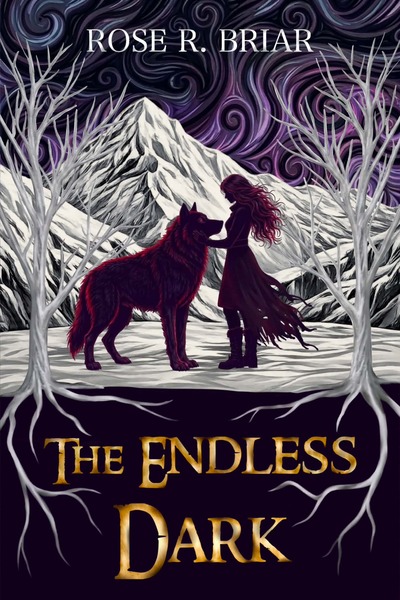
Six years ago, Amara did something drastic to stop a god from destroying the world, and it cost her almost everything, including the man she loved. Now her hiding place has fallen, and she's running for her life with her adopted son, whose magic is getting stronger and more dangerous by the day. The only safe place left is the territory of Rhordan, the werewolf king she left without a word of explanation.
Plot Summary (spoiler-free)
Six years ago, Amara did something drastic to stop a god from destroying the world, and it cost her almost everything, including the man she loved. Now her hiding place has fallen, and she’s running for her life with her adopted son Sevryn, whose magic is getting stronger and more dangerous by the day. The only safe place left is the territory of Rhordan, the werewolf king she left behind without a word of explanation, and the wounds between them are exactly as raw as you’d expect six years of silence to leave them.
From there the book turns into a chase: a sister-turned-monster hunting them on someone else’s orders, a boy who might be more than human, and a darkness spreading across the world that only one ancient being, hidden deep in a mountain, might know how to stop. I went in expecting a fairly standard “hidden royal returns to her old flame” setup and got a lot more plot than that, a real curse, a political mess, and a countdown clock in the form of a returning celestial event called the Dark Moon. It doesn’t wrap up. The book does not pretend to. It’s the first third of a bigger story, and it plays fair about that. The stakes are clear from the first chapter, and you always know what everyone is afraid of, which keeps a plot this big from feeling shapeless.
Character Development
Amara runs on guilt, and it works, mostly because the book keeps finding new, specific reasons for her to feel it. She sacrificed something enormous to save her people and has spent six years alone with the fallout, raising a child who isn’t biologically hers with a fierceness that never once reads as obligation. What got me is how much she keeps trying to leave the people who love her “for their own good,” and how the book actually calls that out instead of just rewarding it as noble self-sacrifice. I wanted to argue with her and hug her in the same chapter, which is a good sign for a heroine built on regret. Rhordan and his pack tell her, more than once, that her leaving hurt worse than any monster could, and I appreciated that the narrative lets that land instead of treating her martyr streak as automatically admirable.
Rhordan is the devoted-alpha-king type, and I won’t pretend that’s a new archetype, but his devotion has actual texture to it. He cut his hair short the moment he let himself believe she might be alive again, which is a small, specific detail that told me more about six years of grief than three pages of backstory could have. His relationship with his pack, especially the running, teasing warmth with Jerace and Nori, keeps him from being just a brooding wall of muscle waiting to be softened by the right woman. He has a real protective streak toward Sevryn too, one that isn’t about the boy’s parentage or his magic, just a straightforward “he’s mine to guard now,” and that unconditional claim is a sweet thread to follow.
Nori spent six years thinking her best friend was dead, and the book lets her stay angry about that for real, no tidy hug-it-out in chapter one. Her scene calling Amara out on the ice, admitting she still loves her stubborn ass anyway, got me more than most of the romance beats did. Vesna, Amara’s sister turned into an assassin against her will, is doing something sad underneath the villain posturing, a woman forced to hurt the people she loves and hating every second of it, and her arc has real momentum by the book’s midpoint. Linelle, the grizzled guide who lost his own family to the same catastrophe that shaped this whole world, gives the book a gut-punch moment, and I’m going to leave it there, because how his story actually lands is not something I’m willing to spoil. The kid himself comes across well: scared but never precocious in that grating way child characters sometimes get written, and his bond with Nori in particular is tender. The rest of Rhordan’s pack, Gara, Jonah, Jamison, blur together some. They get individual lines and individual jobs to do, but not individual personalities strong enough that I could always tell them apart without checking a name.
There’s also a real power imbalance running under the Amara and Rhordan relationship that the book doesn’t shy away from. He’s a king commanding an entire border kingdom, and for most of the book she’s a fugitive with nothing but a child, a sword, and a secret she won’t tell him. He could force answers out of her with a single alpha command and mostly doesn’t, and the moments where he almost does, demanding to know why she left, boxing her in against a wall until she finally talks, read as tense rather than as a romance-novel power fantasy, because the book keeps her agency intact even while she’s cornered. That restraint is what makes it work.
Themes
The book keeps circling the difference between protecting someone and controlling them, and it’s smart about applying that standard evenly. Amara’s whole survival strategy is disappearing “to protect” the people she loves, and the book treats that as a real flaw, not a romantic gesture, the same way it treats Rhordan’s instinct to guard her at all costs as something that needs her consent, not just his good intentions. Guilt and self-forgiveness run right alongside that. Almost every major character is carrying something they did that they can’t take back, and the book is more interested in whether they can live with it than in absolving anyone cleanly.
There’s also a real thread about inherited darkness versus chosen goodness, most visible in how Sevryn’s magic keeps threatening to consume him even as everyone insists what he does with it is what actually matters, not what he’s made of. It’s not a subtle theme, the book says versions of it out loud more than once, but I didn’t mind that. Found family runs underneath everything else, Nori and Sevryn’s sibling-like bond especially, and it’s the one theme that never gets undercut by a plot twist. That consistency counts for something. I kept noticing how many of these characters are trying to protect someone, and how rarely that goes the way they plan. By the end it reads less like a story about saving people and more like a story about learning to ask them first.
Writing Style and Effectiveness
Amara and Rhordan’s alternating close-third narration carries a lot of sensory weight, the smell of moonflowers and salt air that marks Amara’s presence to Rhordan comes back again and again as a kind of emotional shorthand, and it mostly earns its keep, though by the second half I noticed it enough to start anticipating it. The prose is strongest in its set pieces: the Weeping Forest full of walking regrets, the ice caves beneath the mountain, a floating, gravity-broken landscape near the book’s end that I genuinely didn’t expect from a story that opens as a fairly grounded court-and-chase plot. Those sequences have real atmosphere.
The polish is the real problem, though. This read a lot like an unedited ARC, typos on nearly every chapter (misplaced words, a few outright wrong ones, verb tenses that slip mid-sentence), and I’m hopeful a lot of that gets caught before the October release. More structurally, the book keeps returning to the same emotional beat between Amara and Rhordan, guilt offered, forgiveness given, love declared, more than once it’s almost word for word, and by the fourth round of it I found myself wishing the story trusted its readers to remember the first three. The worldbuilding is ambitious, Endless, Darken, Godprints, Auralis devices, at least four named kingdoms, but a lot of it arrives through characters explaining things to each other rather than through the story simply showing me, and I had to hold a fair number of proper nouns in my head without much grounding for some of them.
One small thing that stuck with me: the Auralis, Rhordan’s homemade magical walkie-talkie, charged with a flower petal instead of a battery. It’s a funny little bit of invented technology dropped into a very traditional fated-mates plot, and I liked it precisely because it wasn’t necessary. A six-year-old getting his own radio channel just so the grown-ups stop hogging the line is the kind of small, human detail that made this fractured world feel lived-in for a page or two, even while the plot around it was busy ending civilizations.
Conclusion
The Endless Dark is a big, ambitious debut that bites off more plot than a single book can chew, and mostly gets away with it because the emotional core, Amara’s guilt and Rhordan’s devotion, is genuinely strong enough to carry you through the parts where the worldbuilding gets ahead of itself. It sits on a crowded shelf of fated-mates, dual-species romantasy right now, and what sets it apart is the sheer scope, this isn’t a court intrigue plot or a monster-of-the-week plot, it’s building toward something civilization-ending, and it commits to that scale from the first chapter.
The typos and the repeated confession scenes are real problems, not nitpicks. A tighter edit would fix most of it. But the character work holds up, especially Amara, Nori, and the reveal I’m not spoiling, and the ending left me wanting the second book immediately, annoyed I didn’t already have it, which says something for a first novel built on this much ambition. If the second book tightens the prose and keeps the heart, I’ll be first in line.
Evaluation
Overall Rating: ★★★☆☆ (3/5)
Writing Style: ★★☆☆☆ (2/5): vivid, sensory prose in its best set pieces, undercut by frequent typos and a handful of emotional beats the book returns to so often they lose their punch
Characters: ★★★☆☆ (3/5): a genuinely strong emotional core in Amara, Rhordan, and Nori, though most of the secondary pack blurs together
World-Building: ★★★☆☆ (3/5): ambitious and imaginative, with real atmosphere in its best sequences, but overloaded with proper nouns and systems explained through dialogue rather than shown
Spice Rating: ★★★★☆ (4/5): frequent and fairly explicit once the romance turns physical, with two extended scenes
Recommended for readers who love a fated-mates, second-chance romance with real stakes attached to it, the kind of reader who’s into Carissa Broadbent’s scope or Raven Kennedy’s willingness to let a heroine’s guilt actually cost her something. It’s a strong, ambitious start to a trilogy, even with the rough edges an ARC pass tends to carry. Not the right pick if you want a tightly edited read or a book that resolves anything by the last page.
Trigger warnings: None listed.