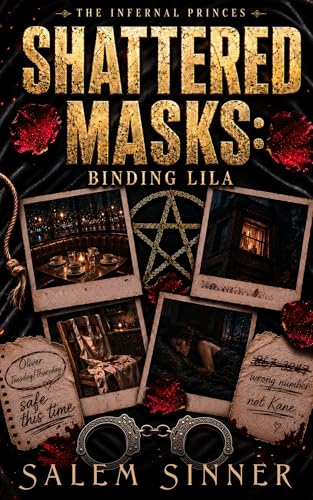
Claiming Lila by Salem Sinner | Book Review

Lila: Kane is everything I thought I wanted. He makes me feel safe, and he's way too patient. By the time he finally touches me, I'm climbing into his lap. He remembers what I like, checks I got home alive, and makes me believe I can finally relax. So why does it feel like someone is always watching? Kane: She keeps looking for the monster. The monster is already sleeping in her bed. Soon she'll realize what we have is inevitable. Soon she'll remember she was always mine. Claiming Lila is an explicit dark paranormal romance featuring obsession, manipulation, possessive devotion, and a morally black demon MMC. This gothic demon romance contains a possessive stalker hero, psychological tension, and a villainous love interest determined to claim the woman he believes belongs to him.
Plot Summary (spoiler-free)
Lila’s deep into something with the man she knows as Kane, warm, attentive, always exactly where she needs him to be, and for the first stretch of this book that’s presented as the good part. He remembers things she barely remembers telling him. He shows up at the right moment every time. Her best friend Maya starts saying the quiet part out loud pretty early: that “always there” and “always watching” aren’t actually different words for the same thing.
The early chapters are cozy on purpose. A dinner with an extra lava cake ordered just in case, a boyfriend who remembers a throwaway comment from ages ago, someone who is always there when she gets home. If this were any other romance you’d be rooting for him. The author lets you enjoy that for a few chapters, and then the small details start piling up in a way that made me put my e-reader down and look at my own front door.
I’ll say this much and no more, because it’s the same premise the author’s own note up front is upfront about: obsession, surveillance, and a partner who isn’t what he presents himself as. If you’ve read Marking Lila, you already know the shape of what Kane actually is. If you haven’t, the book plays fair with the genre label on its own cover.
What follows is Lila trying to name the thing that’s happening to her while it’s still happening, which is harder than it sounds when the person doing it also makes you feel more seen than anyone else ever has. She tries to end it. It doesn’t take. She tries again, differently, after something happens that finally gives her language sharp enough to act on. The book ends with a real escalation and a door left wide open, not a resting point. It’s the middle book of three and it reads like one: things get worse here, not better, and nothing about that back half made me comfortable.
Character Development
Lila is a psychology grad student with a Substack about coercive dynamics, which sounds like a gimmick until you watch what the book actually does with it: she keeps almost naming what’s happening to her in the exact clinical language she’d use for a stranger, then talking herself out of the thought a paragraph later. That’s not a flaw in her intelligence. It’s the whole point, and it’s genuinely well observed. Watching someone catch the pattern in real time and still not be able to act on it hit harder than a more oblivious heroine would have. I wanted to reach into the page and finish her sentence for her more than once.
Kane gets the harder assignment: make a man terrifying and magnetic in the same paragraph, and for a long stretch it works. His chapters are the book’s real engine. You get to watch him calculate every gesture that Lila reads as spontaneous devotion, the remembered coffee order, the surprise pickup, the birthday cake, and the gap between what she experiences and what he’s actually doing is where the dread lives. There’s a genuine, ugly tenderness underneath all of it too, something closer to real need than pure conquest, and the book doesn’t let him off the hook for it just because it’s real. I didn’t expect a stalker’s internal monologue to be the more compelling of the two POVs, but by the second half it was.
Maya does more work than a best-friend character usually gets asked to in this genre. She’s not comic relief and she’s not a plot obstacle either, she’s the one clear-eyed voice in the book, and the scenes where she lays out exactly what she’s been watching, calmly, without theatrics, are some of the sharpest writing here. Reign, a brother with a smirk and a drink, shows up for one club scene and mostly exists to needle Kane about getting attached, which reads as clean setup for later books rather than a character in his own right, and that’s fine, it doesn’t need more than that here.
Lila’s circle gets one more mention because the book is smart about it. Her friends aren’t villains for being busy or for liking the new boyfriend. They’re just people with their own lives, and the book shows how easy it is to let a few canceled plans slide when someone attentive is waiting at home. At one point Lila files a mental note to text Maya as soon as she has a free hand, and that tiny line says more about where her attention is going than any argument in the book does.
The power dynamic is the whole book, the same as it is across the trilogy. Kane doesn’t just want Lila, he engineers the entire shape of her life so that leaving him stops looking like a real option. What makes this one land is that Lila can see the engineering. She just can’t out-argue what her body wants from him, and the book is honest about how those two things can both be true in the same person at once.
Themes
Control dressed up as care is the whole argument here, and the book keeps circling the same question from different angles: at what point does knowing someone better than they know themselves stop being intimacy and start being a leash. Every gesture that reads as romantic on its surface, the remembered detail, the surprise, the gift, gets a second read from inside Kane’s head that reveals it as strategy, and the book trusts you to hold both readings at once rather than picking one.
There’s a real thread about the gap between analysis and agency that I found more interesting than the central romance. Lila has the vocabulary to describe exactly what’s happening to her. She’s built her whole intellectual identity around that vocabulary. And it doesn’t save her, not because she’s not smart enough, but because naming a thing and having power over it turn out to be two completely separate skills. That’s a sharper idea than most books in this specific corner of romance bother reaching for.
Isolation shows up too, mostly through what happens to Maya’s place in Lila’s life. It’s the theme I thought about longest after closing the book, because it’s so quiet. It’s never dramatic. It’s a study group skipped here, a text answered a beat later there, and the book is patient about showing how that adds up to something that looks, from outside, exactly like what it is.
Writing Style and Effectiveness
The dual first-person structure is doing real work here, more than in a lot of books that use the same device just to alternate perspective for its own sake. Kane’s chapters read like watching someone build a trap in slow motion while narrating why each piece is necessary, and Lila’s chapters carry the dread of someone standing inside that trap without the blueprint. That contrast is the book’s best trick, and it’s used well. The pacing is quick and the chapters flip back and forth fast enough that I kept saying one more and losing an hour. The quiet moments land best, a line about a cake or about who is waiting at home, because the reader sees the second meaning and Lila doesn’t.
The prose gets purpler the deeper into a sex scene it goes, and there are a lot of sex scenes. It wears thin. By the third or fourth extended one I found myself skimming for plot rather than reading for craft, which isn’t a complaint about explicitness so much as about repetition, the same handful of possessive phrases, the same physical beats, doing most of the emotional lifting chapter after chapter. The tighter dialogue scenes, especially anything with Maya in the room, are noticeably better controlled than the intimate ones. A shorter book, or a slightly harder edit on the middle stretch, would have kept the tension this genuinely earns from slackening in places.
One sequence pushed past what I found comfortable reading even inside a genre built on exactly this kind of intensity, involving a gift Lila accepts without knowing everything that went into making it. That’s a taste reaction more than a craft one, but it’s an honest one, and I’d rather say it plainly than pretend every reader will shrug it off the same way.
Conclusion
Claiming Lila earns its place as a middle book by actually functioning like one. It doesn’t stall. It escalates a premise instead of just marking time until the next installment, and Lila’s own analytical mind turned uselessly against her own situation is a genuinely smart choice that a lot of dark romance in this specific lane doesn’t bother attempting. Kane’s chapters are the more successful half of the book, which is a slightly odd thing to say about the person doing the harm, but the calculation on the page is compelling in a way the more repetitive spice scenes aren’t.
Where it comes up short is mostly in the back half, where the prose leans hard on a small rotation of possessive phrases and the plot slows to let another extended scene play out. It sits next to Netflix’s You in spirit more than any romance comp, another story that puts you inside a stalker’s justifications and dares you to keep reading anyway, though this one is explicitly a romance and asks you to want the outcome rather than just watch it unfold. I kept waiting for Lila to win one round outright, and the book isn’t interested in giving her one, which left me more unsettled than satisfied. If you’re already committed to this trilogy, this delivers exactly what the first book promised and pushes it further. If you haven’t read Marking Lila, don’t start here.
Evaluation
Overall Rating: ★★★☆☆ (3/5)
Writing Style: ★★☆☆☆ (2/5): the alternating POV structure is genuinely well used and does real tension-building work, undercut by spice scenes that repeat the same handful of phrases until they blur together
Characters: ★★★☆☆ (3/5): Lila’s clinical self-awareness turned against her own situation is a smart, well-executed choice, and Kane’s calculating internal voice makes him more compelling than a simpler villain-love-interest would be, but Reign barely registers beyond one scene
World-Building: ★★☆☆☆ (2/5): references to Hell royalty, covenants, and princes falling for mortals are dropped in without ever being built out, functioning as flavor rather than structure
Spice Rating: ★★★★★ (5/5): frequent and extremely explicit throughout, including content built around deception and a partner’s ignorance of exactly what he’s given her
Recommended for readers already following this trilogy, or anyone who wants a stalker-romance built around a genuinely clever dual-POV structure: fans of You who wondered what the same premise would look like filtered through a paranormal romance lens, or readers who like their possessive love interest’s manipulation shown in granular, uncomfortable detail rather than implied. Not the pick if you need a love interest whose devotion reads as safe rather than engineered, or if you haven’t read Marking Lila first. This one assumes you already know the shape of what Kane is.
Trigger warnings: obsession, surveillance, coercive control, captivity, possessive love interests, violence, and forced supernatural bonding.