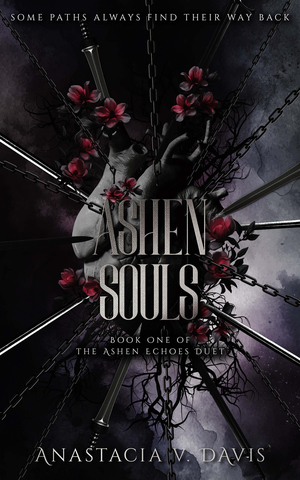
Ashen Souls by Anastacia V. Davis | Book Review
Aveline Hart has spent years dating men who bore her senseless and telling herself that's just what adulthood looks like. Then a car crash she has no business surviving cracks something open, and she starts waking up somewhere else: a candlelit chamber belonging to Daeren, an entity who's been watching her, or someone who looks exactly like her, for a very long time. At the same time, in the daylight part of her life, she starts something real with her new mythology professor. As the two worlds collide, Aveline must dig into her own family's buried history to figure out what she's become tangled up in, before the choice is made for her.
Plot Summary (spoiler-free)
Aveline Hart is a literature student in the gothic city of Vesbridge who’s spent years dating men who bore her senseless and telling herself that’s just what adulthood looks like. Then a car crash she has no business surviving cracks something open, and she starts waking up somewhere else: a candlelit chamber that belongs to Daeren, an entity who’s apparently been watching her (or someone who looks exactly like her) for a very long time. At the same time, in the very solid, very daylight part of her life, she starts something real with her new mythology professor.
I expected the demon-versus-professor hook to be the whole draw. It wasn’t. What actually kept me reading was Aveline digging into her own family’s buried history to figure out what she’s become tangled up in, and the book spends real time on that instead of treating it as a device to justify the romance. There’s an old family study, journals nobody’s opened in decades, a father who clearly knows more than he’s saying, all of it doled out slowly enough that I never felt like the book was rushing to get back to the demon’s chamber. The mundane half of the plot, the classes, the apartment, the friendships, gets just as much craft as the supernatural half, and that balance is a big part of why it works.
It’s the first half of a two-book story, and it plays fair about that. The ending genuinely doesn’t resolve the triangle or the curse, so go in knowing you’re getting half a book, on purpose, not a story that ran out of pages.
Character Development
Aveline is doing more work than she gets credit for at a glance. She opens the book as someone who’s decided passion is something that only happens in the books she reads, and who’s built a whole personality out of being fine with that. What I liked is that she doesn’t just get handed a supernatural love interest and call it growth. By the back third she’s the one making hard calls, refusing to say the words a very powerful being is trying to extract from her, and walking into his own domain to set terms instead of waiting to be summoned. That’s a real arc, not a rescue. Even in scenes where she’s genuinely overpowered, she keeps making choices instead of just reacting, and that distinction is doing a lot of the heavy lifting for how much I ended up liking her.
Daeren is the more familiar shape: centuries old, possessive to the point of violence, dangerous in ways the story is fully aware of and mostly interested in eroticizing rather than excusing. One real complication makes him more than a stock dark-romance love interest, and it recasts his cruelty without ever quite softening it. I appreciated that the book doesn’t ask you to forget what he’s capable of just because there’s a reason behind it, the reason explains him, it doesn’t excuse him, and that’s a distinction a lot of books in this genre blur on purpose. The power imbalance between them gets named plainly rather than dressed up as “intensity.” Whether that’s a satisfying trade-off depends entirely on a reader’s tolerance for a hero whose devotion is, structurally, a form of coercion. The story knows this about him and isn’t hiding it.
Harper is the warmest thing on the page, and she gets a real subplot of her own: a frightening night with a predatory classmate that the story treats with actual weight instead of pure escalation fuel for Aveline’s arc. I wanted more of her honestly, every scene she’s in makes the book feel less claustrophobic, which is a strange thing to say about a supporting character but it’s true. Ethan never quite catches up to her. He’s charming enough in the moment, but he’s defined mostly by what he isn’t next to Daeren, and I wanted more of him before the ending leans this hard on how much the reader trusts him. Right now he reads more like a placeholder for “the safe choice” than an actual person with his own interior life, and a duet needs its second lead to be more than that. Aveline’s father is a small, lovely surprise: a man who’s spent decades guarding a secret in his study, hoping he’d never have to hand his daughter this particular inheritance, and the handful of scenes he gets are quietly some of the best-written material in the book.
Themes
The smartest structural choice here is that Aveline’s mythology class spends its lectures on incubi, visitation myths, and the blurry line between a divine gift and a violation, and those discussions land right on top of what’s happening to her at night. It isn’t subtle, but it works. A professor lecturing about consent in ancient myth while standing a few feet from a student living out exactly that question is genuinely good craft, not just a cute parallel. I kept waiting for the book to drop the device once it had made its point, and it doesn’t, the lectures keep sharpening as the plot escalates instead of repeating the same beat.
Underneath that sits a harder question about wanting the wrong thing on purpose. Aveline spent years telling herself she craved a devastating, world-burning kind of love, and the book takes that fantasy completely seriously, then makes her live with its actual cost, including a stretch where someone else’s suffering becomes the proof of how far his possessiveness will go. That part isn’t comfortable to read. This genre often treats “he’d burn down the world for you” as pure romance. I respected that this book at least makes her flinch at what that promise really means once someone acts on it.
There’s also a quieter thread about inheritance, not money, but the specific kind of family history nobody talks about until it’s suddenly relevant to your own life. Aveline spends a good part of the book angry that this was kept from her, and the book doesn’t rush her past that anger just to get back to the romance. It lets her be furious at the people who loved her enough to try to protect her from something, and still be right to be furious. That’s a harder needle to thread than it sounds, and the book mostly threads it.
Writing Style and Effectiveness
This is a single first-person, present-tense POV, just Aveline throughout, which keeps the mystery of what Ethan and Daeren actually know tight since we never get inside either of their heads. That choice costs the book a little, I would’ve liked at least one Daeren chapter given how much weight his motivations end up carrying by the end, but I understand why the author didn’t want to give that up.
The prose leans hard into sensory excess. Ash, ember, smoke, and molten heat show up chapter after chapter, and by the midpoint I found myself noticing the vocabulary repeating rather than being swept up by it. It isn’t bad writing. It’s just a fairly narrow well drawn from often, and a harsher edit could’ve caught a good chunk of the repeats without losing any of the atmosphere they’re going for.
Where the pacing really works is the chapter-by-chapter dread build in the first half: something is wrong, then something is wrong and it touched her, then something is wrong and it left a mark, each beat escalating cleanly before the book widens out into family history and antique shops. It works. The extended sequences in Daeren’s realm are the most vivid writing in the book, visually and otherwise, full of specific, tactile detail that the daylight chapters don’t always match. The daylight chapters with Harper and Ethan have an easier, more natural rhythm that I actually preferred reading, if I’m honest, because that’s where Aveline sounds most like a person instead of a vessel for a plot. The dialogue in those scenes especially has a real, lived-in rhythm to it that the more heightened supernatural chapters don’t always manage.
Conclusion
Ashen Souls delivers exactly what it promises on the cover: a dark, kink-forward fated-mates setup with real narrative teeth in its heroine and a villain interesting enough to survive also being, by definition, the threat. I picked this up expecting a fairly disposable read and ended up genuinely invested in whether Aveline would hold her line. That’s not nothing. The prose leans on the same handful of images too often, though, and Ethan needed more room to be a full person instead of a foil for the demon.
If you’ve read your way through Rina Kent’s darker fated-bond books, or anything in the cursed-bloodline-and-ancient-obsession vein, the shape here will feel familiar, but the mythology-class framing device dresses it up in something genuinely fresh, and the family-secrets thread gives it a backbone a lot of comparable books skip entirely. It’s the first half of a story, and it reads like one. Don’t go in expecting closure, go in expecting a real setup that earns a second book instead of stalling for one.
Evaluation
Overall Rating: ★★★★☆ (4/5)
Writing Style: ★★★☆☆ (3/5): a tight, effective single-POV structure and a genuinely clever mythology-lecture framing device, undercut by repetitive sensory vocabulary that wears thin well before the ending
Characters: ★★★☆☆ (3/5): a heroine with a real, earned arc and a villain whose one good complication gets him past the trope, set against a human love interest who doesn’t get enough interiority to carry his half of the triangle
World-Building: ★★★☆☆ (3/5): an intriguing lost-empire backstory that mostly arrives through characters reading old journals aloud rather than being felt on the page
Spice Rating: ★★★★★ (5/5): frequent and highly explicit throughout, with a real range of kink dynamics rather than one repeated scenario
Recommended for readers who want a fated-mates dark romance with real stakes for its heroine, a villain worth being a little afraid of, and a genre-savvy structural gimmick that actually pays off. Less recommended for readers who want tightly varied prose or a love triangle where both men feel equally real by the last page.
Trigger warnings: psychological abuse, mind games, emotional manipulation, extreme possessiveness, stalking, violence, murder, hallucinations, sleep paralysis, alcohol consumption leading to blackouts, explicit sexual content, dubious consent, somnophilia, sexual harassment and attempted assault, and kink dynamics including bondage, branding/marking, biting, blood play, breath play, and degradation.