Vicious Demon’s Possession by Jane Wild | Book Review
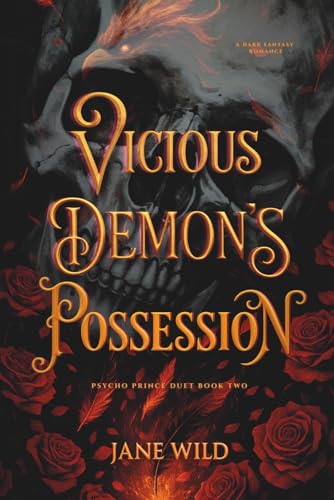
The Lost Queen: falling in love with a psycho demon, what could be worse? Being torn from my world and dragged into his demonic realm, where humans are nothing but slaves. To love him is to burn. To leave him is to die. The Vicious King: you'll follow me home, into my kingdom. You'll bleed for me. You'll scream for me. Even death cannot tear you from me. In Hell or in flesh, you will always be mine.
Plot Summary (spoiler-free)
George picks up right where the first book left off, dragged back to his demon father’s court in the kingdom of Lucifer to face the throne he’s spent years avoiding. Ana, the human psychologist who loved him through his worst, follows him there, and the book wastes no time reminding you what that actually costs a human. In Lucifer, humans are property, full stop, and Ana spends most of this book finding out exactly how far that rule gets enforced, by people who have every reason to want her gone.
What surprised me is how much bigger the canvas gets. This isn’t just “will the king’s family accept her.” It’s a genuine court intrigue: a cousin with his own claim on the throne, an engagement forced on George for political reasons, a whole cast of new royal players from a neighboring kingdom, and a murder that Ana has to actually investigate rather than just grieve. The book keeps raising the stakes past the point where I expected it to plateau, and by the second half it’s operating as a real palace-politics thriller with a war attached, not just a couple fighting the world to stay together.
It’s still a story about ownership, though, underneath all the plotting. Ana keeps getting handed titles that are really just different shapes of the same cage, and watching her figure out how much of that she’ll accept and how much she’ll fight is the throughline holding the bigger, messier plot together. This is the second half of the duet, so it does resolve, genuinely, by the end. No cliffhanger here, whatever you think of how it gets there.
Character Development
Ana’s still the reason I kept reading. She spends the first stretch of this book losing agency in ways that are genuinely hard to sit with, and the book doesn’t rush her back to being fine. What I respected is that her recovery isn’t linear or quiet. She gets furious. She makes reckless choices to protect people she loves, some of which blow up in her face. By the book’s back half she’s picking up a sword she has no business wielding and walking straight at armed soldiers because someone she loves needs her, and I believed every step that got her there. She’s not magically competent, she’s just done being handled.
George/Mikael is trickier to talk about honestly, and I want to be straightforward about why. His chapters are almost entirely obsession, jealousy, and a running justification of how his possessiveness is actually love, and that’s consistent with book one, so nothing here is a bait and switch. What’s new is a real scene with his father near the book’s end that finally gives George some interiority beyond “I want Ana and I hate everyone who threatens that.” It’s a good scene, one of the best-written stretches in the whole book, and it made me wish the rest of his chapters spent even a fraction of that same effort on him as a person instead of him as an engine of desire and rage. He gets one real moment of growth. The rest of the time, he’s exactly who he was in book one, just with a crown now.
Nadia is where the book’s side-character work is strongest, honestly. She’s Ana’s best friend from the first book, dragged into this world through no fault of her own, and every scene she gets carries real weight, whether she’s cooking a meal to coax Ana out of a hunger strike or just sitting with her at the end of an exhausting day. What happens to her mid-book hit harder than almost anything else in the story, and I mean that as real credit to how the book built the friendship first.
David, the crown prince of a neighboring kingdom, is the character I didn’t see coming. He’s introduced as a potential complication and turns into something closer to the moral center of the book: the one demon of royal blood who actually listens to Ana, actually helps her instead of using her, and does it without ever expecting anything back. He’s also positioned as an obstacle to George’s own engagement, which makes his decency land even harder, since the easy version of this story would’ve made him a rival or a threat instead of an ally. He’s the best new addition to this cast, full stop.
The shaman, an old woman Ana and George meet early on, gives the book something it badly needs: a voice of actual wisdom that isn’t dressed up as either romantic devotion or political scheming. She’s blunt, a little grim, occasionally very funny, and she becomes something close to a grandmother figure by the book’s end. I wanted more of her every time she was on the page.
The antagonists are where the book gets uneven. George’s uncle and cousin, and later a lieutenant who’s been a menace since book one, escalate into genuinely dangerous threats, but they mostly read as obstacles rather than people, cruelty without much underneath it. The queen, George’s own mother, is the most purely hateful figure in the book and never gets a single beat of complication. She’s consistent, at least. She’s just flat.
Themes
Possession is the loudest theme, and the book is completely unembarrassed about it. George doesn’t just act possessive, he narrates himself as possessive, over and over, framing ownership as the truest form of love he’s capable of. The book never really interrogates that claim so much as it lets Ana push back against it in the moment while still choosing to stay. If you want a book that examines that dynamic from the outside, this isn’t it. If you want a book that commits fully to depicting it and lets the heroine keep some agency inside it anyway, it delivers exactly that.
Underneath that runs a real thread about what a title is actually worth when the person handing it to you still doesn’t see you as a person. Ana gets given increasingly grand names across this book, and every single one comes with new rules about her body and her freedom attached. The book is smarter than I expected about noticing that a fancier cage is still a cage, even when it does eventually let her earn something closer to real standing by the end.
Found family runs quietly under everything else. Ana loses more blood family across this book, and what replaces it, Nadia, David, the shaman, isn’t people she chose out of comfort, it’s people who actually showed up for her when it counted. That’s not a new idea for this genre, but the book gives it enough specific, lived-in detail (the shaman’s dry humor, David’s stubborn decency, Nadia’s cooking) that it earns its emotional weight instead of just gesturing at “chosen family” as a concept.
Writing Style and Effectiveness
The dual first-person, present-tense structure from book one continues here, now occasionally interrupted by short third-person interludes from other characters’ perspectives, mostly the villains plotting off-page. Those interludes are a mixed bag: useful for dramatic irony, since you often know a threat is coming before Ana or George do, but they also break the intimacy that made the first-person chapters work in the first place.
Where the prose really struggles is repetition. George’s internal monologue in particular leans hard on rhetorical questions stacked three and four in a row (“Why does she do this to me? Why can’t I stop thinking about her? Why does loving her hurt so much?”), and by the book’s middle stretch I found myself skimming those passages rather than feeling them. Dialogue often restates the same emotional beat within the same conversation instead of moving it forward, and there’s a persistent quality throughout the prose that reads like it was written by someone more comfortable in another language, formal and stiff in places where a native English idiom would sit looser.
The spice scenes are frequent, extremely explicit, and lean hard into the same dominant/possessive dynamic the first book established, with real range across kink (spanking, anal, breath play, restraint), all tied to George’s stated belief that hurting Ana is how he shows he loves her. That’s consistent with the character, not a tonal surprise, but readers who found that framing uncomfortable in book one won’t find it softened here.
What the book does well, genuinely, is momentum. Short chapters, constant escalation, a real willingness to keep raising the stakes rather than settling into a comfortable middle. I read this faster than the prose quality alone would justify, because I kept needing to know what happened next.
Conclusion
This is a messier, more ambitious book than its predecessor, and it doesn’t fully earn every plot turn it reaches for. The prose is rougher than I’d like, and George gets exactly one real scene of growth in an otherwise static, possession-obsessed characterization. But Ana’s arc genuinely lands, Nadia and David are real additions to this cast, and the book commits fully to its own premise instead of softening the possessive dynamic to make it more palatable.
It reminded me a little of the messier stretches of a Rina Kent duet, the kind where book two suddenly triples the cast and the political stakes because book one’s central conflict got resolved too early to fill a second volume on its own. Set against other dark royal-demon romances chasing the same “human falls for possessive prince” shape, what actually distinguishes this one is how far it lets its heroine’s world expand past the central relationship, into court politics, war, and a found family that exists independently of George. That’s a real strength most books in this specific corner of the genre don’t bother with. It’s not a clean or tidy book. It’s not supposed to be.
Evaluation
Overall Rating: ★★★☆☆ (3/5)
Writing Style: ★★☆☆☆ (2/5): real narrative momentum undercut by heavy repetition, stacked rhetorical questions, and dialogue that often restates the same beat within a single scene
Characters: ★★★☆☆ (3/5): a genuinely earned arc for Ana and real standout additions in David and the shaman, set against a static, one-note villain roster and a hero who gets one real scene of growth in an otherwise unchanging characterization
World-Building: ★★☆☆☆ (2/5): a wider cast of kingdoms and magic systems than book one, but most of it arrives through characters explaining rules to each other rather than being felt on the page
Spice Rating: ★★★★★ (5/5): frequent, extremely explicit, and consistent with the possessive dynamic the duet has built from the start, with real range across kink dynamics
Trigger warnings: graphic violence and war-related death; noncon and dubcon sexual content, including between the main characters; sexual assault; forced public sexual humiliation; kidnapping and forced confinement; slavery and human trafficking; suicide attempt; poisoning; torture; domestic and psychological abuse; alcohol abuse; explicit sexual content including choking, spanking, restraint, and anal play; knife and gun violence; grief and loss; and a major character death.
Recommended for readers who finished Vicious Demon’s Obsession and want the possessive dynamic pushed further, wrapped in real court-politics stakes and a genuine ensemble cast. This is not a jumping-on point, book one sets up too much of the central relationship for this to land cold. Not the pick if the possessive-as-love framing already didn’t work for you, or if you want a hero whose growth extends past a single late scene.