Ruin Has Sharp Fangs by M. R. Pritchard | Book Review
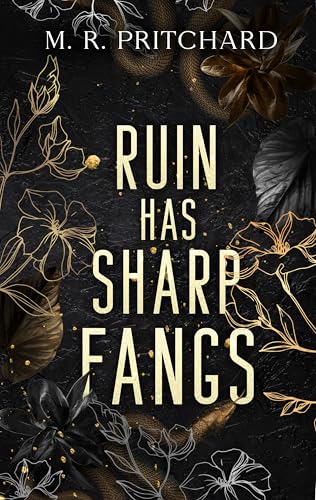
Ivy Calder never meant to bargain with Hell. Drowning in debt and on the brink of losing her flower shop, Ivy signs what she thinks is a Valentine's delivery contract, only to discover she has summoned a Ledger Demon, a creature forged to enforce infernal law and collect what is owed. Thorn is precise. Controlled. Lethal. And bound by the contract, by the shop, and soon by Ivy herself. As Valentine's Day approaches, Ivy and Thorn are forced into close proximity, long hours, and an intimacy neither of them anticipated. Thorn was never meant to want. Ivy was never meant to be collateral. But when desire crosses into blood and blood crosses into law, the Ledger takes notice.
Plot Summary (spoiler-free)
Ivy Calder has run her flower shop alone for eight years, and Valentine’s week is the only thing standing between her and losing it for good. Buried in a stack of bills she can’t pay, she signs what she thinks is a routine settlement offer. It isn’t. She’s just summoned a Ledger Demon, an enforcer whose entire job is collecting on debts that Hell considers unpaid, and the debt in question is her soul.
Thorn shows up expecting a straightforward collection. What he gets instead is a contract that goes sideways the moment Ivy tries to tear it up, binding him to the shop itself rather than letting him walk out with what he came for. Neither of them planned on that, and neither of them planned on what happens next: a week spent working side by side through the worst rush of Ivy’s year, during which a demon built to enforce consequence without mercy starts learning, however reluctantly, what mercy actually looks like.
I went in expecting a fun, low-stakes fling of a premise and came out more invested than I planned to be. I won’t get into how their situation eventually gets resolved. I’ll just say it doesn’t end in tragedy and it doesn’t end in a cliffhanger. It’s a full, earned happily-ever-after, closed out with a one-year-later epilogue that shows exactly how much both of them, and the shop, have changed.
Character Development
Ivy’s the kind of protagonist who’s easy to root for specifically because her flaw isn’t cute. She checks the deadbolt three times, every time, because once isn’t enough to quiet the part of her brain that’s convinced everything’s about to collapse. That’s not framed as an endearing quirk. It’s framed as what eight years of running a small business completely alone actually does to a person. I also liked that her competence is ordinary. She’s good at flowers, deadlines and difficult customers, and that quiet skill is what keeps her standing when a demon walks in. I appreciated that the book lets her be genuinely, sometimes stubbornly, bad at accepting help even when it’s standing right next to her cutting ribbon.
Thorn is where this book gets genuinely interesting, and it’s not subtle about it: he’s a creature explicitly built to have no wants, told outright that wanting anything gets him “corrected,” and the entire arc is watching him want things anyway. Coffee made a specific way. To keep cooking dinner. Ivy, obviously, but the smaller wants land harder for me than the romantic ones, because they’re the ones that cost him actual pain every time the Ledger notices. There’s a real, uncomfortable logic to a being who has to relearn “don’t kill people over small things” from scratch, because in his own world that response was never wrong. Watching Ivy hold that line with him, over and over, without softening it into something gentler than it needs to be, is the backbone of the whole book.
James, the teenage would-be thief who shows up early trying to steal flowers, ended up being my favorite thread in the whole thing, and he barely gets any page time. Ivy shows him mercy once, and the book keeps coming back to what that one choice costs her and what it changes. That’s more character arc than a lot of named leads get in books twice this length, and it earns every beat of it in maybe four total scenes.
Evan the delivery driver mostly stays comic relief and a mild, one-sided source of jealousy for Thorn, though he gets one good moment on Valentine’s Day when Thorn actually puts him to work and he rises to it. Remington gets a single scene, clearly there to connect this book to the wider series, but he’s the one character who treats Thorn’s situation as genuinely novel rather than a rule violation, and that one conversation does more worldbuilding than anything else in the book. Neither one gets much page time, but neither one needed it.
The power dynamic under all of it is Hell’s own logic about ownership: Thorn’s contract literally designates the shop as “collateral,” a word the book keeps returning to on purpose. It’s not subtle, but I don’t think it’s meant to be. The whole point is that a system built entirely on claims and property doesn’t have a category for a relationship chosen freely, and that gap is where the entire plot lives.
Themes
Mercy versus enforcement is the theme the book is actually about, and it never lets up on it. Every single time Thorn wants to answer a problem with death, and he wants to a lot, Ivy refuses, and the book treats that refusal as the actual plot engine rather than a side moral. It would’ve been easy to make this abstract. Instead it’s concrete and specific: a scared kid stealing flowers, a broken window, a demon who genuinely cannot understand why “give a warning instead” is the correct response. That specificity is what keeps it from feeling like a lecture. It’s a small book with one clear idea, and it doesn’t pad that idea out. Everything in the plot, from the contract to the shop to the teenage thief, points back at the same question, which is what you owe someone who has no way to repay you.
There’s a second, quieter theme about desperation being exploitable, which is honestly the sharpest idea in the whole book. Ivy doesn’t summon a demon because she’s careless. She summons one because she’s exhausted and broke and signs something she doesn’t fully read, and the book is upfront that this is exactly how the Ledger survives: “most do not read,” Thorn tells her, “that is why the Ledger persists.” Reading a demon-contract story as a none-too-subtle metaphor for predatory lending and small-business burnout probably wasn’t the intended pitch, but it’s sitting right there in the text and I liked that it was.
Ownership versus choice runs under both of those, most clearly in how the book treats “collateral” as a dirty word by the end. Whatever gets protected by ownership stays a possession. Whatever gets protected by choice becomes something else entirely, and the ending is built entirely around proving that difference matters, without me spelling out how it proves it.
Writing Style and Effectiveness
The dialogue is genuinely the strongest thing here. Thorn’s clipped, literal way of talking, “I am not an invalid,” “I am observing,” “Compassion is inefficient,” works as both a running joke and a real signal of how far he still has to go, and Ivy’s exhausted deadpan is a solid match for it. Their scenes together move fast and read easily, and more than once I actually laughed, which isn’t something I say often about a paranormal romance novella. Even the small jokes carry character. Thorn’s refusal to understand sarcasm, and Ivy’s habit of answering him as if he were a difficult customer, tells you most of what you need to know about both of them.
The book is less careful outside the dialogue. There’s real repetition here that a next editing pass should catch, most obviously a delivery-truck scene in chapter ten that reappears almost word for word in chapter twenty-two, same phrasing, same beats, clearly meant to be a callback but landing more like a duplicated paragraph nobody caught. There are also typos and a handful of tangled sentences scattered through the read, which tracks with the book’s own ARC note admitting this isn’t the final pass. None of it broke the story for me, but it’s noticeable enough to flag.
Where the pacing works best is the Valentine’s Day chapters themselves, which genuinely convey the chaos of a small business getting slammed all at once, phone ringing, line out the door, an impossible restaurant order landing with four hours’ notice. The trip to Hell slows things down too much. It explains real things about how this world works, but it reads thinner than everything happening back at the shop, mostly because Remington is interesting and everything around him is still pretty vague.
Conclusion
Ruin Has Sharp Fangs takes a genuinely fun premise, a burned-out small-business owner accidentally summoning Hell’s debt collector, and builds something warmer and more specific out of it than the premise alone promises. I liked it more by the end than I expected to going in. The mercy-versus-enforcement thread actually lands, because it’s tied to one recurring kid rather than staying an abstract moral, and the Ivy-Thorn banter is worth the read on its own. I’d happily spend more time in this shop with these two.
What keeps it from landing higher is mostly craft. A real duplicated scene, a handful of typos, a Hell-side world that stays gestured-at rather than built out. That’s understandable for a novella this length, but it’s noticeable all the same. It sits comfortably next to the lighter end of the demon-romance shelf, closer to a smaller, cozier cousin of Good Omens in tone than the grimmer end of the genre, and if you’ve read any small-business-owner-meets-supernatural-enforcer setup before, you basically know the shape here. What earns it a look anyway is how specifically it commits to its own theme instead of just gesturing at one.
Evaluation
Overall Rating: ★★★☆☆ (3/5)
Writing Style: ★★☆☆☆ (2/5): sharp, genuinely funny dialogue undercut by a duplicated scene, scattered typos, and a Hell-side act that drags compared to the shop-set chapters
Characters: ★★★☆☆ (3/5): Ivy and Thorn both get real, earned arcs, and a barely-there teenage side character gets a better redemption arc than most full subplots manage, though Evan stays mostly flat
World-Building: ★★☆☆☆ (2/5): the Ledger Demon/soul-economy concept is a genuinely clever idea, but it stays thin and a little inconsistent about its own rules even by the end
Spice Rating: ★★★☆☆ (3/5): one explicit scene plus a couple of charged blood-feeding scenes that do a lot of the same work, not frequent enough to push higher
Recommended for readers who want their demon romance on the lighter, funnier end of the genre: fans of a grumpy, literal-minded love interest slowly unlearning his own programming, or anyone who likes a heroine who holds her ground on mercy even when the person she loves keeps arguing for the opposite. It’s a quick read, closer to a long short story than a full novel, and a good fit if you want something cozy and low-stakes once the initial demon-shows-up hook lands. Not the pick if you want deep worldbuilding behind the Hell side of the equation, since that stays mostly a backdrop for the relationship in front of it.
Trigger warnings: threats of violence and death, property destruction and vandalism, blood-drinking and consensual blood-letting, brief mention of a teenager being taken into police custody, and one explicit sexual content scene.