One Way Ticket to Earth by Daniele Vaccaro | Book Review
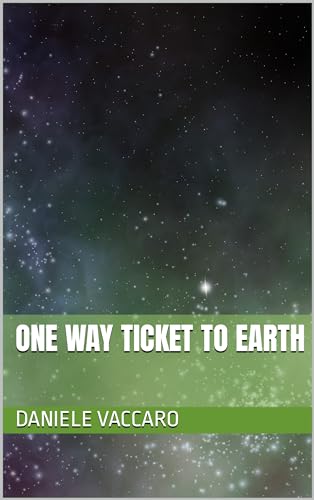
A young boy named Max dies, and his death breaks his parents. Max is then reborn as an alien being called Sveern on a distant planet, Anturn, where he grows up insisting his real name is Max and his real home is Earth. The short story follows his long, lonely effort to get anyone on Anturn to believe him and let him go home, and the rare, timeless connection he finds that reaches across lifetimes. A short work that pairs real emotional weight with a science-fiction frame, about love, loss, and the bonds that outlast death.
Plot Summary (spoiler-free)
Ten-year-old Max dies in a hospital bed, a four-leaf clover his mother once gave him clutched against his chest, promising her he’ll find his way back. Grief breaks his parents in different directions: his mother Elizabeth refuses to let go of the belief that he’s still out there somewhere, and his father Paul, unable to bear the loss, takes his own life not long after.
Light-years away, on a utopian alien world called Anturn where children are born from the fruit of a great tree rather than to a mother, a newborn arrives already fussy and strange, and grows into a boy named Sveern who insists, against everyone’s gentle correction, that his real name is Max and his real home is a planet called Earth. The bulk of the story follows Sveern’s long, lonely campaign to get anyone in Anturn’s government to believe him and let him go home, with only one Anturnian child, Blily, willing to take his claims seriously. What Max finds when he finally does make it back to Earth, and what that four-leaf clover turns out to mean twice over, is the story’s real payoff, and it’s worth encountering without it spoiled here.
Character Development
Max/Sveern is the story’s clear emotional center, and the story leans on a real, effective hook: a child who has died and been reborn somewhere unimaginably foreign, still aching for parents he can’t get back to. His stubbornness in the face of an entire planet telling him gently that he’s mistaken is the most engaging thread in the book, and his grief over leaving Blily behind once he finally gets his wish carries real weight. But his interiority mostly stays at the level of stated emotion rather than felt experience: “a whirlwind of emotions took over him,” “he felt an uncontrollable need to hug his Mum and Dad.” The reader is told what Max feels far more often than shown it happening in the moment.
Elizabeth gets the story’s most affecting scene, the doorway reunion nine years and more into her grief, still holding out hope in a way her late husband couldn’t. But she otherwise exists mostly to receive Max’s story rather than to have her own arc on the page; her grief between the hospital scene and the reunion is summarized rather than dramatized.
Blily is doing real structural work the story doesn’t spell out until its final pages, and once the reveal lands, his earlier scenes (his loyalty, his insistence on using Max’s real name, his own quiet sense of not fully belonging on Anturn) reread as considerably more meaningful than they felt the first time through. That’s a genuine piece of craft. The problem is that up until the reveal, Blily reads as a fairly generic, chipper best-friend character, all curiosity and enthusiasm with little texture of his own, so the payoff depends entirely on recontextualizing a character who wasn’t given much to work with in the moment.
The Government Master and Space Centre Master are functionally identical, both existing to deliver exposition about Anturn’s rules, technology, and worldview (its stance on Earth’s violence, its shuttle physics, its “everyone gets what they wish for, except when it’s dangerous” bureaucracy) rather than to be people in their own right. Their dialogue does a lot of heavy lifting for the worldbuilding but very little for character.
Themes
The story’s guiding idea, that love and family bonds persist and find each other across death, distance, and even species, is stated plainly rather than left to emerge from the plot: Paul’s letter spells it out almost in full (“we always find each other… sometimes as a family, sometimes as siblings, sometimes as friends, but we always stick together”). That directness makes the theme legible but leaves little for a reader to discover on their own. A secondary thread, contrasting Earth’s real, flawed, painful love against Anturn’s clean but love-less utopia (the Government Master’s “I love my drone” line is the story’s sharpest piece of writing), is more interesting than the main reincarnation conceit and arguably underused. The suicide subplot sits inside this same framework, treated as a reunion made possible by faith rather than as a tragedy in its own right, which is a genuine tonal choice worth naming directly rather than glossing over: a reader who has lost someone to suicide may find the letter’s framing (his death read, within the story’s own logic, as a decision that reunites him with his son rather than one that devastates the family he left) more troubling than comforting, even though the story clearly intends it as the latter.
Writing Style and Effectiveness
The prose is plain and functional rather than stylized, which suits a short piece built around a strong central idea, but the writing repeats itself in ways that flatten Anturn rather than build it: nearly every interior space (Sveern’s bedroom, the meeting room, the shuttle) gets the same catalog of holographic displays, ergonomic furniture, and ambient glowing light, in close to the same sentence rhythm each time, so the descriptions blur together instead of accumulating into a distinct world. Dialogue tags occasionally tell rather than trust the line itself (“Max said with an emotional voice”), and a few small errors (the planet’s own name misspelled once as “Arturn,” a missing space in “Max!Max!”) suggest the draft didn’t get a final proofreading pass. The five-year space voyage is compressed into two paragraphs of summary rather than scene, which is a reasonable choice for a story this short, but it does mean the book’s biggest structural gap, what changed on Earth while Max was gone, gets waved past rather than explored.
Conclusion
One Way Ticket to Earth has a genuinely moving idea at its core, the notion that the people we love find their way back to us across lifetimes, and its ending recontextualizes an otherwise ordinary best-friend character into something quietly devastating. That’s real, earned craft, and it’s the reason the story is worth reading despite its rough edges. Those rough edges are real too: repetitive, boilerplate description of Anturn’s technology, characters who mostly exist to explain the world rather than inhabit it, and emotional beats that are announced (“a whirlwind of emotions”) more often than they’re dramatized. Set against other reincarnation/afterlife fiction like Matt Haig’s The Midnight Library, it shares that book’s interest in what makes a life, and a love, worth returning for, but it doesn’t have The Midnight Library’s polish or its patience with its own premise; this reads like a promising early draft of a much longer, richer version of itself rather than a fully realized short story.
Evaluation
- Overall Rating: ★★★☆☆ (2/5)
- Writing Style: ★★☆☆☆ (2/5): a strong premise delivered through repetitive description and frequent tell-not-show emotional beats
- Characters: ★★★☆☆ (2/5): Max and the Blily reveal genuinely land; everyone else, including both authority figures, is mostly a mouthpiece for exposition
- World-Building: ★★★☆☆ (3/5): real specific effort (day length, lifespan, the tree-birth system) undercut by copy-pasted descriptive passages across scenes
- Spice Rating: ☆☆☆☆☆ (0/5): no sexual content
Trigger warnings: death of a child (terminal illness), parental grief, and suicide, including a description of the method and a suicide note that frames the death within the story’s reincarnation logic.
Recommended for readers who enjoy short, emotionally direct speculative fiction about grief and reincarnation, in the vein of Matt Haig’s The Midnight Library, and anyone drawn to soft sci-fi that uses an alien setting mainly as a lens on very human loss. Less recommended for readers sensitive to suicide being framed, even gently, as a path back to a lost loved one.