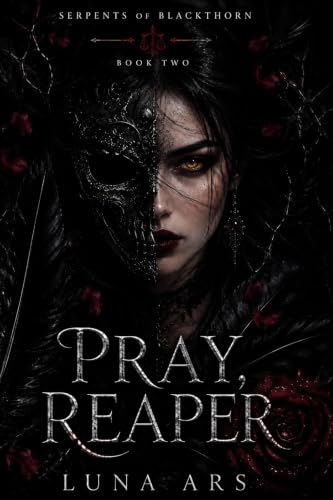
Pray, Reaper by Luna Ars | Book Review
Plot Summary (spoiler-free) Pray, Reaper picks up right after Book One’s court sentence, with Maggie recovering at Blackthorn under the care of the man who marked her back and can’t stop touching it like it means something sacred. As her body heals, so does her resolve. She chooses to stay. She chooses him, and starts settling into the full weight of who she’s becoming, including a growing comfort with violence that unsettles the people who love her most. A visiting professor shows up whose lectures on art, judgment, and crowned killers feel far too pointed to be coincidence, and the man she left broken in the last book comes back into her orbit under circumstances neither of them picked. Underneath all of it sits an old document, sealed by a dead man, waiting to test whether the Reaper she’s chosen still deserves the crown he wears. Character Development Maggie spends this book finishing what Book One started, and I appreciated that the novel doesn’t pretend that transformation is comfortable for anyone around her. Her insistence that her capacity for violence belongs to her, not to the man who “waters it,” is the clearest statement of her arc, tested directly when she takes a knife to a campus bully’s hand defending another student, and again later in a much darker moment the book doesn’t let her, or you, look away from. Zayn gets the best growth of the whole duology here. His motivation shifts from wanting Maggie back to wanting her genuinely free to choose, and his final act, exposing a truth that will almost certainly cost him her trust and his life, actually reads as sacrifice instead of a grand gesture dressed up to look like one. Alister is the best-developed character in the book, full stop. His unspoken love for Lucian, only implied in Book One, gets said plainly here, and his choice to risk everything to force a reckoning he believes Lucian needs is more morally messy and more consequential than anything given to the new antagonist. Lucian becomes harder to root for by design. Confronted with the truth about what he did, he offers no justification, no mitigating context, just a flat, repeated “yes” to every accusation. It’s a real, consistent choice, but it leaves the romance with no escape hatch. The new professor, clearly tied to a mystery from Maggie’s past the book never fully unpacks, is compelling in his scenes and functions as pure unresolved thread by the time the book ends. Themes The book’s central question, whether Maggie’s embrace of her own darkness is actually hers or something Lucian’s been quietly cultivating for his own benefit, gets real airtime through Zayn’s repeated pushback. I liked that the book never lets Maggie’s own answer go unchallenged. But the climax pivots away from that question toward something narrower and sharper, tied to a devastating discovery about Lucian’s own past that forces a real legal reckoning inside the order’s own code. I won’t spoil what that discovery is. That pivot gives the back half real teeth, turning years of “love as control” subtext into something literally, legally actionable. It also means the broader question about Maggie’s own character, the one that occupied the whole middle of the book, never gets a clean answer of its own. Writing Style and Effectiveness The novel keeps Book One’s rotating first-person present tense across Maggie, Lucian, and Zayn, and adds a chapter narrated directly by Alister that lands well, delivering his most vulnerable material without filtering it through someone else’s eyes. The courtroom sequence in the final chapters is the best sustained writing across both books. Watching a legal document planted way back in Book One finally pay off here is genuinely satisfying long-game plotting. The prose itself carries the same rough, self-edited quality as its predecessor, more noticeably this time: single-word emphasis paragraphs show up again and again, characters wince and swallow in nearly every tense scene, and supporting characters keep landing jokes in moments that would hit harder without them. The new-professor subplot is atmospheric and completely unresolved by the end, no confirmed identity, no consequence, no follow-through, and with no third book to pick it back up, it reads less like intentional ambiguity and more like something that got dropped. Conclusion Pray, Reaper builds a genuinely well-constructed trap for its central couple, turning two books’ worth of “love as control” subtext into an explicit legal mechanism with real teeth, and gives Zayn and Alister their best material in the whole duology. It reminded me of how Ana Huang handles her ensemble casts, letting a supporting romance do more emotional work than the main one in the back half. Where it falls short is the ending: a true, unresolved cliffhanger, the dagger literally still raised as the book closes, with no announced sequel waiting to catch it, plus a mystery subplot it spent real time building and then just walked away from. Read as the back half of a duology, it’s a strong second act let down by an ending that never becomes a third. Evaluation Overall Rating: ★★★☆☆ (3/5) Writing Style: ★★★☆☆ (3/5): a genuinely strong courtroom climax and effective use of a new narrator, undercut by the same rough editing as Book One and a habit of defusing tense scenes with banter Characters: ★★★★☆ (4/5): real, earned growth for Zayn and Alister and a harder, more morally compromised Lucian by deliberate design, though Maggie’s central question is displaced rather than resolved by the ending World-Building: ★★★☆☆ (3/5): a genuinely clever long-game payoff connecting both books’ central document, weighed down by a mystery antagonist thread that never pays off Spice Rating: ★★★★★ (5/5): frequent, explicit scenes throughout, consistent with Book One Recommended for readers who finished Kneel, Little Crow and want the emotional and legal stakes of that book’s ending paid off with real consequence, plus meaningful growth for its two best secondary characters. Less recommended for readers who need a story to actually close by its final page: this is the last published book in the series, and it ends mid-decision with no resolution in sight. Trigger warnings, per the book’s own content page: obsessive and possessive behavior, stalking and controlling behavior, coercion and power imbalance, dubious consent, forced marriage and binding-vow themes, explicit sexual content including consensual rough sex, choking, and knife play, physical and graphic violence, blood and gore, torture, corporal punishment and whipping, restraint and imprisonment, murder and attempted murder, death of a parent, grief, medical trauma, emotional and psychological manipulation, religious trauma, organized crime, human and drug trafficking references, weapons, strong language, morally corrupt characters, and an explicit cliffhanger ending.
Plot Summary (spoiler-free)
Pray, Reaper picks up right after Book One’s court sentence, with Maggie recovering at Blackthorn under the care of the man who marked her back and can’t stop touching it like it means something sacred. As her body heals, so does her resolve. She chooses to stay. She chooses him, and starts settling into the full weight of who she’s becoming, including a growing comfort with violence that unsettles the people who love her most. A visiting professor shows up whose lectures on art, judgment, and crowned killers feel far too pointed to be coincidence, and the man she left broken in the last book comes back into her orbit under circumstances neither of them picked. Underneath all of it sits an old document, sealed by a dead man, waiting to test whether the Reaper she’s chosen still deserves the crown he wears.
Character Development
Maggie spends this book finishing what Book One started, and I appreciated that the novel doesn’t pretend that transformation is comfortable for anyone around her. Her insistence that her capacity for violence belongs to her, not to the man who “waters it,” is the clearest statement of her arc, tested directly when she takes a knife to a campus bully’s hand defending another student, and again later in a much darker moment the book doesn’t let her, or you, look away from. Zayn gets the best growth of the whole duology here. His motivation shifts from wanting Maggie back to wanting her genuinely free to choose, and his final act, exposing a truth that will almost certainly cost him her trust and his life, actually reads as sacrifice instead of a grand gesture dressed up to look like one.
Alister is the best-developed character in the book, full stop. His unspoken love for Lucian, only implied in Book One, gets said plainly here, and his choice to risk everything to force a reckoning he believes Lucian needs is more morally messy and more consequential than anything given to the new antagonist. Lucian becomes harder to root for by design. Confronted with the truth about what he did, he offers no justification, no mitigating context, just a flat, repeated “yes” to every accusation. It’s a real, consistent choice, but it leaves the romance with no escape hatch. The new professor, clearly tied to a mystery from Maggie’s past the book never fully unpacks, is compelling in his scenes and functions as pure unresolved thread by the time the book ends.
Themes
The book’s central question, whether Maggie’s embrace of her own darkness is actually hers or something Lucian’s been quietly cultivating for his own benefit, gets real airtime through Zayn’s repeated pushback. I liked that the book never lets Maggie’s own answer go unchallenged. But the climax pivots away from that question toward something narrower and sharper, tied to a devastating discovery about Lucian’s own past that forces a real legal reckoning inside the order’s own code. I won’t spoil what that discovery is. That pivot gives the back half real teeth, turning years of “love as control” subtext into something literally, legally actionable. It also means the broader question about Maggie’s own character, the one that occupied the whole middle of the book, never gets a clean answer of its own.
Writing Style and Effectiveness
The novel keeps Book One’s rotating first-person present tense across Maggie, Lucian, and Zayn, and adds a chapter narrated directly by Alister that lands well, delivering his most vulnerable material without filtering it through someone else’s eyes. The courtroom sequence in the final chapters is the best sustained writing across both books. Watching a legal document planted way back in Book One finally pay off here is genuinely satisfying long-game plotting. The prose itself carries the same rough, self-edited quality as its predecessor, more noticeably this time: single-word emphasis paragraphs show up again and again, characters wince and swallow in nearly every tense scene, and supporting characters keep landing jokes in moments that would hit harder without them. The new-professor subplot is atmospheric and completely unresolved by the end, no confirmed identity, no consequence, no follow-through, and with no third book to pick it back up, it reads less like intentional ambiguity and more like something that got dropped.
Conclusion
Pray, Reaper builds a genuinely well-constructed trap for its central couple, turning two books’ worth of “love as control” subtext into an explicit legal mechanism with real teeth, and gives Zayn and Alister their best material in the whole duology. It reminded me of how Ana Huang handles her ensemble casts, letting a supporting romance do more emotional work than the main one in the back half. Where it falls short is the ending: a true, unresolved cliffhanger, the dagger literally still raised as the book closes, with no announced sequel waiting to catch it, plus a mystery subplot it spent real time building and then just walked away from. Read as the back half of a duology, it’s a strong second act let down by an ending that never becomes a third.
Evaluation
Overall Rating: ★★★☆☆ (3/5)
Writing Style: ★★★☆☆ (3/5): a genuinely strong courtroom climax and effective use of a new narrator, undercut by the same rough editing as Book One and a habit of defusing tense scenes with banter
Characters: ★★★★☆ (4/5): real, earned growth for Zayn and Alister and a harder, more morally compromised Lucian by deliberate design, though Maggie’s central question is displaced rather than resolved by the ending
World-Building: ★★★☆☆ (3/5): a genuinely clever long-game payoff connecting both books’ central document, weighed down by a mystery antagonist thread that never pays off
Spice Rating: ★★★★★ (5/5): frequent, explicit scenes throughout, consistent with Book One
Recommended for readers who finished Kneel, Little Crow and want the emotional and legal stakes of that book’s ending paid off with real consequence, plus meaningful growth for its two best secondary characters. Less recommended for readers who need a story to actually close by its final page: this is the last published book in the series, and it ends mid-decision with no resolution in sight.
Trigger warnings, per the book’s own content page: obsessive and possessive behavior, stalking and controlling behavior, coercion and power imbalance, dubious consent, forced marriage and binding-vow themes, explicit sexual content including consensual rough sex, choking, and knife play, physical and graphic violence, blood and gore, torture, corporal punishment and whipping, restraint and imprisonment, murder and attempted murder, death of a parent, grief, medical trauma, emotional and psychological manipulation, religious trauma, organized crime, human and drug trafficking references, weapons, strong language, morally corrupt characters, and an explicit cliffhanger ending.