Bleed, Monarch by Luna Ars | Book Review
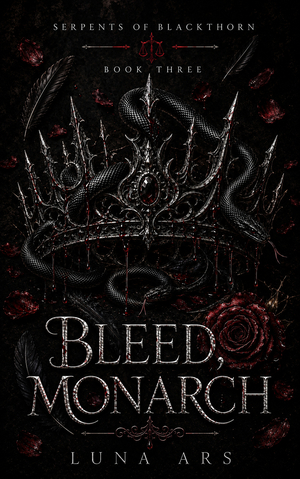
Book three picks up right after Maggie judged Lucian in front of his whole organization and spared him anyway, even knowing what he did to her father. She's still dealing with that fallout when the book piles on more: grief, a rival coming after the Order, and a legal complication tied to her own place inside Blackthorn's power structure. Old threads get picked up and closed out as the trilogy heads toward its ending, and it actually acts like a final book instead of just running out the clock.
Plot Summary (spoiler-free)
Book three picks up right after Maggie judged Lucian in front of his whole organization and spared him anyway, even knowing what he did to her father. She’s still dealing with that fallout when the book piles on more: grief, a rival coming after the Order, and a legal complication tied to her own place inside Blackthorn’s power structure. All at once. It’s a lot, honestly. The first stretch is heavy on aftermath, funerals and silence and people not looking at each other, before it opens back up into the wider plot, and I actually liked that pacing choice. It let the grief sit instead of rushing past it to get to the next set piece.
I liked that the book trusted its readers to sit in that discomfort for a while before handing them the next plot beat, rather than rushing everyone straight back into action mode the way a lot of series openers-of-the-final-book tend to. Once it does open back up, the book runs two tracks side by side. One is external: an outside threat closing in on the Order, methodical and patient in a way that makes it scarier than a straightforward attack would’ve been. The other is internal: questions about Maggie’s own standing inside Blackthorn that neither she nor Lucian can just will away, no matter how much either of them wants to. Watching those two tracks eventually collide is most of what makes the back half work.
It’s the last book and it actually acts like one. Old threads get picked up and closed out instead of just mentioned in passing. I went in a little braced for it to fizzle out the way book two’s loose ends sometimes made me worry it would. It didn’t.
Character Development
Maggie’s just a different person than she was in book one. She’s not sitting around reacting to Lucian anymore, she’s actually holding power herself, and I liked that the book doesn’t make it feel easy for her. There’s a whole training stretch early on where she’s learning to actually fight and handle a weapon instead of just surviving on nerve, and it’s a small thing but it grounds everything that comes after. When she has to judge other people later on, it’s messy. She second-guesses herself, changes her mind mid-scene, actually asks questions instead of assuming someone’s guilty. She gets things wrong sometimes and corrects course out loud instead of the book quietly pretending she was right all along. That’s the version of her I wanted the whole series.
Lucian’s still Lucian. Possessive to an unhinged degree, feral about her safety, none of that changed. He still tracks her location like it’s a full-time job and still can’t sit still in a room she isn’t in. But there’s real growth in him this time too. He asks before he touches her now instead of just doing it, and when she tells him no, he actually stops instead of arguing his way around it. It’s a small thing but it actually reads as change, not just a line thrown in to say he’s changed. The book also finally lets him exist outside the Reaper role for stretches at a time, and I liked seeing who he is without the title propping him up. There’s a version of this character in a lot of dark romance who never has to actually earn his softer moments, they just get handed to him because the plot needs a breather. This one doesn’t get that. Every inch of restraint from him is shown costing him something, and I respected that the book made him work for it instead of just telling us he’d grown.
Alister’s the one who got me, though. His arc is easily the best thing in this book. He spends most of the trilogy as the steady, controlled one, the guy who cleans up everyone else’s mess and never raises his voice, and watching that composure crack here is genuinely unsettling in the best way. Watching his loyalty rot into something uglier, and watching him try to talk himself into believing it’s fine the whole way down, was the strongest writing in the whole trilogy for me. There’s a real difference between a character who’s always been the villain and one who convinces himself every terrible choice is still the responsible one, and this book plays that second version perfectly. Every scene from his perspective, you can feel him narrating his own justifications to himself in real time, and it’s uncomfortable in exactly the way it should be. I did not expect a side character to end up being the emotional center of book three, but by the last third I was more invested in what happened to him than in the main romance.
Nikolai actually works as a villain, which surprised me. He’s unsettling instead of cartoonish. His whole thing is using lectures like a weapon, dressing menace up as academic detachment, needling at people through questions instead of threats until you realize he’s already three steps ahead of everyone in the room. It doesn’t get old, and it also doesn’t feel like a rehash of the kind of scenery-chewing villain this genre usually hands you.
Themes
Choice is all over this book. Not just as a word people keep saying, it’s actually what the plot turns on. Every big decision comes down to someone either getting to choose for themselves or having that choice taken away by someone who swears they love them. Even the sentencing scenes, where Maggie has to decide what happens to people who’ve done genuinely terrible things, keep circling back to the same question: whether taking a choice away, even a guilty person’s choice, is ever actually justice or just easier for whoever’s holding the power. For a series this violent, that’s a surprisingly solid backbone.
There’s also this tension between law that keeps power in check and power that just eats whatever’s in front of it. Some people in this book can be trusted with authority because they still ask questions. Some can’t, because they stopped being able to hear “no” a long time ago. The book draws that line pretty consistently across almost every character, not just the obvious villain, which is what makes it feel like an actual theme instead of a moral stated once and dropped.
Grief sits under all of it too, showing up differently in how each character carries their own guilt. Nobody in this book grieves the same way. Some people go quiet, some people get worse at controlling themselves, some people turn it into a reason to do something they’d never have justified otherwise. I found that more honest than most books in this genre bother to be, where grief usually just means one sad scene and then everyone’s fine.
Writing Style and Effectiveness
There’s a curated playlist stuck in the front matter before the story even starts, eighteen songs, mostly Sleep Token and Bad Omens, that whole moody-metalcore thing. I put it on while reading the back half and it fit way too well. Small detail, but it told me she knew exactly what mood she was going for before a single chapter even started.
The book alternates first-person present-tense chapters between Maggie, Lucian, and Alister, and honestly that’s the best decision in the whole book. You get the same stretch of plot from someone who’s clearly hiding something, then their own chapter shows you exactly what. That trick works, and it’s used well here, especially once Alister’s sections start carrying more weight than his role in the first two books would’ve suggested. Having three narrators also means the same event gets read completely differently depending on whose head you’re in, which sounds obvious on paper but actually lands here instead of feeling like a gimmick.
The prose leans hard on one-line paragraphs for drama, and it works, for a while. By the second half I caught myself skimming right past them instead of feeling anything, because it gets used so often it stops being emphasis and starts being a habit. It’s the kind of thing an editor should’ve flagged around the sixtieth instance, not because any single one is bad, but because repetition wears the tool down. The dialogue holds up better than the narration does. There’s a dry, sniping back-and-forth between a couple of the characters that genuinely made me laugh more than once, which this genre doesn’t always manage without the humor feeling tacked on.
The spice scenes are frequent and very explicit, same possessive energy the series has had since book one. If that wasn’t your thing already, this one doesn’t back off it, it leans in harder, and the scenes stay tied to what’s actually happening emotionally between the characters instead of just existing as a break from the plot. The violence stays graphic too, no flinching, and the interrogation-style scenes in particular are written with a level of specific, clinical detail that I wasn’t fully braced for even after two earlier books in this series.
Conclusion
This one sticks the landing. Every major thread actually gets an ending, not just a vague nod toward one, and Alister’s arc alone is worth the read if you’ve come this far with the series. The ending itself goes for something quieter and more hopeful than the rest of the book earns you to expect, and normally that kind of tonal swing bothers me, but here it worked because the book had already put in the work to get everyone there. I closed it feeling like the whole trilogy had been building toward this, not just running out the clock to hit three books.
It’s not a clean or comfortable ending. It’s not supposed to be. There’s still wreckage in it, still people who don’t get let off the hook just because the story’s wrapping up, and I respected that it didn’t try to smooth everything over for the sake of a tidy finale. If you’ve read the first two, this is a good, bloody place to leave it.
Evaluation
Overall Rating: ★★★★☆ (4/5)
Writing Style: ★★★☆☆ (3/5): a strong multi-POV structure undercut by a one-line-paragraph tic that wears thin by the second half
Characters: ★★★★☆ (4/5): Alister’s arc is genuinely the best thing in the book, Maggie’s growth into someone who actually wields power is well-earned, and Nikolai works as a villain without tipping into cartoonish
World-Building: ★★★★☆ (4/5): the Order’s internal law and succession structure stays coherent and gets meaningfully expanded on in this final book
Spice Rating: ★★★★★ (5/5): frequent, extremely explicit, and fully in line with the possessive dynamic the series has built since book one
Recommended for anyone already in the Serpents of Blackthorn trilogy, or readers who want a dark mafia-adjacent romantasy with a genuinely good power-struggle plot and don’t mind it going hard on the graphic content. It’s not a jumping-on point, don’t start here, book one sets up too much for this to land without it. Not the pick if you need something clean or gentle, or if book one’s possessive-love dynamic already wasn’t for you. Book three doesn’t ease up on any of it.
Trigger warnings: obsessive and possessive behavior; stalking and controlling behavior; coercion and power imbalance; dubious consent themes; explicit sexual content; consensual rough sex; choking and breath play; blood play and biting; anal play; physical and graphic violence; blood, gore and graphic injuries; torture; mutilation and broken bones; murder and execution; gun and knife violence; restraint, imprisonment and isolation; organized crime and secret societies; human trafficking, including women and children; references to sexual exploitation and abuse; child endangerment; emotional and psychological manipulation; emotional and verbal abuse; grief and complicated bereavement; death of a loved one; assisted death/euthanasia themes; suicide and suicidal ideation; religious trauma and religious imagery; strong language; morally corrupt characters.