The Stitch Witches by Krissie K. Williams | Book Review
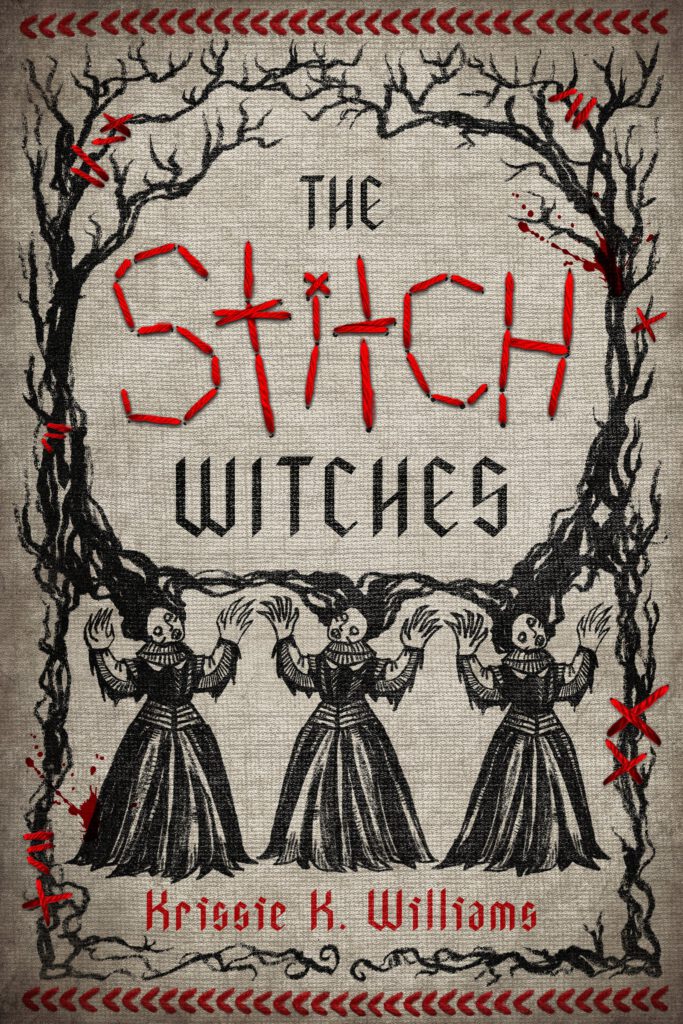
Thirty years after the Salem Witch Trials, a string of sinister deaths plagues Promise Land, Massachusetts. The villagers first suspect a madman, then something worse. Orphelia Dudley, whose family's fortune comes from the slave trade, and Settie, the woman her family enslaves, are drawn together as the town starts another witch hunt and the two of them try to stop the killings.
Plot Summary (spoiler-free)
Promise Land, Massachusetts, 1723. It’s a freezing winter in a Puritan village where everybody watches everybody else, and a man is found dead in his bed with his tongue stitched shut in red yarn. A letter has been sewn into it. The window is open, there’s no blood, and the elders would very much like the town to call it an illness. Then it happens again.
That’s the front door, and the cover gives you the rest. The title witches are three women from the town’s buried past, and the book opens with a short prologue spoken by all three of them at once. I’ll admit that’s where I sat up. A ghost chorus that says “we” is a risky way to start a historical novel, and it worked on me right away.
After that the story is handed around. Orphelia Dudley is the daughter of one of the town’s respected families, red-haired, sharp, and caught up in a courtship she isn’t supposed to have. Settie is enslaved in the Dudley house and sees everything the family would rather she didn’t. Master Dudley is Orphelia’s father, a man with a lot of standing and a lot he isn’t saying. Goody Audley is the town’s social climber, and she narrates a few chapters of her own that were more fun than I expected. Each chapter is labelled with whoever is telling it, so you always know whose head you’re in.
The mystery is the engine. Who is stitching these tongues, why these victims, and why does a children’s rhyme about the Stitch Witches suddenly start spreading through the village? The elders try to handle it quietly. The town wants a witch to blame, and in 1723 Massachusetts that never ends well for the people with the least power. I kept thinking about how fast the room turns on someone once the word “witch” is said out loud.
There’s a lot of snow, a lot of candlelight and a lot of screeching at windows. If you like your gothic with a real historical backbone instead of a vague “olden times” setting, the first third sets that up well. I wasn’t bored, but I did start waiting for the plot to move faster than the meetings.
Character Development
Settie is the one I’d read the whole book for. She’s enslaved, she can read and write because Mistress Charity taught her, and she has spent her whole life learning how to look harmless while she watches the room. Her chapters have a calm, careful edge that the other narrators don’t have. When she says that every time a crime happens in this town it only puts her in more danger than she was already in, it didn’t feel like a speech. It felt like a fact she lives with. I trusted her more than anyone else in the book.
The relationship between Settie and Orphelia is the best thing here. Orphelia calls her a sister and means it. Settie loves her back, and also knows exactly how far that sisterhood stretches, because Orphelia can leave the house and Settie can’t, and one of them gets to choose what to do with a secret. The book doesn’t treat that gap as a footnote. You feel it in who gets to say no, who gets sent out at night, and who has to pretend to be asleep. I’d have happily had more of the two of them and fewer of the town meetings.
Orphelia herself is brave, clever, and impatient, with a temper that shows more than she thinks it does. I liked her best when she was out in the dark doing something she shouldn’t. I liked her less when her narration stopped to tell me what she was feeling. More on that in a minute.
Master Dudley is a more interesting man than he first looks. He’s a respectable Puritan who also profits from the slave trade, and he knows exactly how that sits against the sermons he listens to on Sunday. He’s haunted, quite literally, by something, and I found the way he talks to Settie both kind and chilling at the same time. He says things that sound like care and still keep her in her place. That’s a power imbalance written plainly, and it’s the part of his character that made me want to keep reading.
Mistress Charity, Orphelia’s mother, has fits, trembles, and gets dosed with laudanum by whoever is in charge of her that day. She gets pitied by the town and handled by her own household, and there’s something quietly awful about how normal that is. Mama, Settie’s mother, lives at the edge of the forest and knows older ways than the church would allow. She’s only in a few scenes and she made the biggest mark.
The Audleys are the other side of the town. Goody Audley is proud, spiteful and absolutely sure she’s on the right side of God, and her sewing circle scenes are some of the sharpest in the book. Her son Steadfast is a charming drinker and gambler who spends money the family doesn’t have. Amity of No Sorrows is Orphelia’s rival, and I found her too one-note. She’s meant to be the girl everyone loves to hate, and she reads more like a villain from a school play than a person. Josiah, the boy Orphelia loves, is a similar problem. We’re told he matters enormously, but I never felt why.
Everyone else gets a clause. Pastor Obedience thunders. Goody No Fornication, with a name like that you can guess. Bet, a fellow enslaved woman, and Jupiter, the Dudleys’ other slave, give Settie someone to whisper to, and I wanted more of that.
Themes
The main one is hypocrisy, and the book isn’t shy about it. These are people who call themselves God’s chosen and then trade in human beings, hang each other for whispers, and punish women who are hungry. The pillory scene is the clearest example. A poor woman is put on display for stealing to feed her child, the crowd throws rotten food, a man in the back shouts “pilferer,” and the pastor quotes the Bible at her while she shivers in the wind. Nobody in that scene thinks they’re cruel. That’s the point, and it stuck with me longer than any of the murders.
Slavery in the North is the second big theme. The author’s own note at the back says she grew up in New England being taught a gentler version of the Puritans, and wrote the novel as a warning. You can feel that. The Dudleys’ household has the Bible at the table and Black servants in chains by the end of the day. Settie’s chapters make the point that being “kindly treated” is still being owned, and the book doesn’t let anybody off the hook for it. I’d say it’s the thing the novel does better than most gothic historicals I’ve picked up.
Witch hysteria and scapegoating run underneath everything. The memory of Salem hangs over every meeting, and the elders spend as much time worrying about what the governor will think as about the dead. When the town starts rounding up enslaved people to be questioned, it’s almost a relief to see the book say out loud what everyone is already thinking. Who gets blamed when something frightening happens? The person nobody will defend.
Smaller themes run alongside. Secrets kept inside families, what women are allowed to say and where, grief that doesn’t get a place to go, and the cost of staying silent when you know better. A few of those get brief, honest moments and not much more. Revenge is in there too, and I’ll leave it there.
Writing Style and Effectiveness
The prose is clear and easy to read, and it sets the mood quickly. Snowed-in houses, creaking floorboards, an owl screeching just as someone says something they shouldn’t, a children’s rhyme that gets creepier every time you hear it. That gothic atmosphere is the real strength, and I enjoyed it more than I thought I would.
The format is rotating first person, with a name at the top of each section. The idea is good, since the town looks different through Settie’s eyes than through Master Dudley’s or Goody Audley’s. Late in the book there’s a letter and an epilogue diary set in a handwriting font, and I liked how that changed the texture of the page.
The dialogue is where I struggled most. Everyone speaks in a loose mix of “thee,” “thou,” “ye” and “dost,” and the rules slip around a lot. Sometimes the same speaker uses all three in a paragraph. Then the narration drops straight back into modern phrasing, so a character will say “thou art” in speech and “I felt a wave of panic wash over me” in the next line. It pulled me out more than once.
That second habit is my bigger complaint. The narrators explain their feelings plainly and often. “I was beside myself.” “My heart sank.” “I felt a wave of fear.” After a while I wanted a gesture or a silence to do that job. The same goes for exposition by dialogue. Whole chapters have one character tell another a story, and a lot of the lore comes in as someone sitting down at a table to explain it. It works for a while and then it stops being tense.
The middle is the weakest stretch. Another meeting, another body, another retelling of the same rhyme, and I could feel the book circling. If it had been fifty pages shorter in the middle, I think the end would have hit harder. Still, the final stretch moves, and the last chapters pull their threads together in a way that made me glad I stuck with it. I won’t say more than that.
Conclusion
The Stitch Witches has a great premise, a strong sense of place, and a point of view I’m glad exists. It’s a story about how a frightened town treats the people it owns and the people it doesn’t understand, set in a place most readers only know from a sanitised Thanksgiving. Settie alone would be enough reason to read it. The stitched-tongue murders give it a hook, and the last chapters made me want to flip back and reread a few earlier scenes.
It also has real problems. The narrators say too much about their feelings, the thee/thou dialogue is inconsistent, a couple of side characters are cartoonish, and the middle repeats itself. Those things keep it from being as sharp as it could be.
Next to The Crucible, it’s less compressed and more openly angry about who gets left out of the story. Next to I, Tituba, Black Witch of Salem, it’s gentler in voice and more of a mystery than a reckoning. If you want a witch-trial-era novel where the enslaved woman is the most trustworthy person on the page, this does something that most don’t. It’s a solid, honest 3 for me, with a lot of heart in the right places.
Evaluation
Overall Rating: ★★★☆☆ (3/5)
Writing Style: ★★★☆☆ (3/5): clear, atmospheric prose and distinct narrators, held back by loose thee/thou dialogue, feelings stated outright, and a repetitive middle
Characters: ★★★☆☆ (3/5): Settie and her bond with Orphelia carry the book, while a few side characters like Amity and Josiah stay one-note
World-Building: ★★★★☆ (4/5): a vivid, historically grounded Puritan village with real texture and creepy ghost lore, though a lot of the backstory arrives as dialogue explanation
Spice Rating: ☆☆☆☆☆ (0/5): no sex scenes, nothing beyond brief mentions and courtship
Recommended for readers who like gothic historical fiction with a political edge, anyone who read The Crucible and wanted to hear from the people left out of it, and readers who enjoy rotating narrators and a slow-burn village mystery. If you like Maryse Condé’s I, Tituba or want a witch story that actually deals with slavery in the North, put it on your list. Not the right pick if you want fast, tightly plotted horror, modern-sounding dialogue, or romance.
Trigger warnings: death, domestic violence, and historical accounts of slavery and racism; murder, child death, sexual violence (told in a character’s account), poisoning, and fire.