Binding Lila by Salem Sinner | Book Review
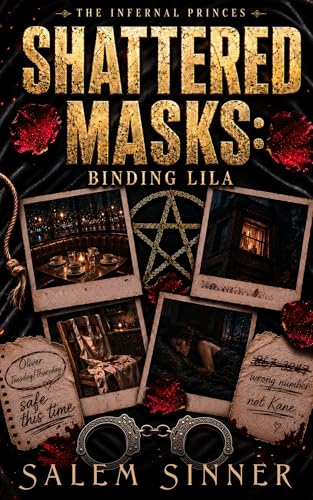
Lila: Kane is gone and for the first time in months, I can breathe. My friends are trying to set me up with new men, I'm building a life that belongs to me, and then I meet Oliver. He's thoughtful, calm and wholesome. Everything Kane wasn't. Except, the more I fall for him, the harder it becomes to forget the monster I left behind. Malrek: She wanted a better man. Someone safer. A man she could trust. So I gave her one. Now she smiles when she sees me. Laughs at my jokes. Looks for me when she walks in a room. Soon she'll realize she never escaped me. Binding Lila is an explicit gothic demon romance featuring obsession, manipulation, possessive devotion, a villainous love interest, and a dark hero who will become anyone his mate needs him to be.
Plot Summary (spoiler-free)
Lila’s trying to move on from Kane, the intense ex who vanished from her life as suddenly as he arrived, when a violent scare at her apartment throws her right back into his orbit. Around the same time she’s also getting close to Oliver, a steady, funny guy from her volunteer shifts at a soup kitchen, and neither man seems to know the other exists. I won’t spell out how those two threads connect. I’ll just say the book’s whole premise depends on you not seeing it coming if you haven’t read the first two books, and I hadn’t, so it landed the way it was built to.
The opening stretch is slow and very deliberate. It’s mostly Lila’s days, a seminar, a shift at the soup kitchen, a late-night text she knows she shouldn’t answer, with each chapter labelled Lila or Malrek so you always know whose head you’re in. The gap between what the two of them know is where the dread comes from, and I was tense well before anything overtly supernatural shows up.
What follows is a book about a woman losing control of her own life in the most literal sense possible, her body responding to a demand she never agreed to, her choices narrowing by the page. It’s not subtle about what it’s doing. The author’s own note up front is blunt that this is a story about obsession, surveillance, and forced bonding, and it delivers exactly that, at full volume, for the whole back half.
The ending gives Lila and Malrek a real resolution, not a cliffhanger. It’s not a clean, comfortable one. I’ll leave it there.
Character Development
Lila is a psychology grad student who writes a Substack about coercive control, and the book puts her inside exactly the dynamic she’s built her academic identity around dissecting. That’s a genuinely sharp choice. She names what’s happening to her in real time, in the language she’d use in her own writing, and it doesn’t save her. Watching someone apply the correct diagnosis to her own life and still be powerless to act on it is more unsettling than a more oblivious heroine would have been, and I respected that the book trusted her intelligence instead of writing around it.
Malrek gets the harder job, because the book wants you to find him seductive and horrifying at the same time, and for a good stretch it actually pulls that off. His chapters make the calculation visible: the surveillance, the burner identities, the actual pleasure he takes in controlling every variable in Lila’s life. What surprised me is that underneath all of it, the book also gives him something closer to real longing than pure predation, a genuine two-hundred-year loneliness that the possessiveness is standing in for. I didn’t fully buy the redemption angle it wants to sell in the last chapter, where his methods get recast as romance, but I bought his obsession completely, right up until that point.
Reign, Malrek’s brother, gets a handful of scenes and does more with them than most side characters in this genre manage. He’s cruel and funny and treats the entire situation as an amusing social experiment, and there’s a real edge underneath the jokes, a hint that he’s about to run the same playbook on someone of his own. That’s clearly setup for the next book, and it works as a tease without needing more space here. Everyone else, Maya, Jessica, Chelsea, James, and the men Lila briefly dates or nearly dates, exist mostly to move Malrek’s jealousy along. None of them get more than a scene or two of real personality, and I don’t think the book wanted them to.
Oliver deserves a mention because the book leans on him hard early on. He volunteers at the same soup kitchen as Lila, he laughs easily, he asks questions and then actually waits for the answers, and he’s written as the opposite of Kane in nearly every way. Their scenes together are warm and a little awkward, and they’re the only stretch of the book where Lila’s shoulders visibly come down. I liked him, and I think that’s the point. The book needs you to want that ordinary, easy life for her so that losing it stings. I won’t say more than that.
The power dynamic is, bluntly, the entire book. Malrek doesn’t just love Lila, he engineers every relationship in her life so that he’s the only real option left standing, and the bond he eventually forces onto her makes that control literal instead of psychological. The book knows exactly what it’s depicting. It even lets Lila say so out loud, more than once. Whether that self-awareness makes the fantasy more interesting or just more honest about what it is depends entirely on what you came here for.
I kept waiting for a scene where Lila’s own analytical voice actually changed the outcome of something, not just named it accurately after the fact, and it mostly doesn’t come. That’s a real gap. Naming a cage is not the same as finding the door, and by the back half she’s mostly stopped looking for one.
Themes
Consent, or the total absence of it, is what the whole book is actually about, and it never pretends otherwise. Every escalation gets framed the same way: Malrek deciding what’s best for Lila and then removing her ability to refuse it, first through manipulation, then through magic that overrides her body directly. The book doesn’t ask you to believe this is healthy. It asks you to feel the pull of it anyway, which is a different and more honest kind of provocation than most books in this space attempt.
There’s a real thread running underneath about the gap between analyzing something and surviving it. Lila has spent years writing about exactly the dynamics she gets pulled into here, and the book keeps circling back to how useless that expertise turns out to be once she’s the one inside it. Knowing the name for a thing doesn’t free you from it. I found that the most genuinely interesting idea in the whole book, more than the demon mythology or the romance itself.
Inherited cruelty shows up too, mostly through Reign, whose offhand talk of finding a “consort” of his own mirrors everything Malrek does to Lila. The characters treat it as a joke and the book clearly doesn’t. It’s a smart way to gesture at a cycle repeating itself without spending pages explaining it.
Writing Style and Effectiveness
The alternating first-person structure earns its keep in the first half, where Lila’s chapters carry real dread and Malrek’s carry the quiet horror of watching someone rationalize surveillance as devotion. That’s the book’s strongest stretch, and it’s genuinely well constructed, the kind of dramatic irony that makes you want to yell at the page. I found myself doing that more than once.
The chapters are short, each one cuts hard on a line built to make you read one more, and I got through the first half in two sittings because of that.
Once the bond takes hold, the prose narrows hard into a repeating loop: possessive pet names, the same handful of commands, the same “doll” and “babydoll” and “mine” doing most of the emotional lifting for chapter after chapter. That’s clearly a deliberate choice, mirroring how Lila’s own world has narrowed down to just him, but I still found the back third a slog to get through even with that generous reading in mind. Atmosphere doesn’t need every line to vary. It does need more than a handful of phrases repeated dozens of times.
The sex scenes are frequent, extremely explicit, and escalate into territory (duplication, somnophilia, a scene played for arousal despite Lila’s own dissent moments earlier) that some readers will find the whole point and others will find genuinely hard to sit with. I’ll say plainly that a few stretches pushed past what I personally find comfortable to read, even inside a genre that trades on exactly this kind of intensity. That’s a taste reaction more than a craft one, but it’s an honest one.
Conclusion
Binding Lila commits fully to a premise a lot of dark romance only gestures at: total, literal loss of bodily autonomy, dressed up as devotion. It works best when it’s letting Lila’s own clinical eye narrate her own entrapment, because that’s a genuinely clever angle that most books in this specific corner of the genre don’t bother reaching for. Malrek’s centuries of loneliness under all the manipulation gives him more shape than the average possessive love interest, at least until the ending asks you to accept his methods a little too easily.
Where it falls short is mostly in the back half, where the plot slows into repetition and the prose leans on the same small set of phrases instead of finding new ground. It sits closest to Raven Kennedy’s Plated Prisoner series, another captivity romance built around a bond that removes the heroine’s choice entirely, though this one pushes further into overt non-consent and gives its ending far less room to breathe before calling it a happy one. It also leaned hardest into content I don’t usually rate highly, which is worth naming plainly rather than pretending my reaction is purely a craft assessment. If you’re already reading this trilogy, or you specifically want the most extreme end of the forced-bond shelf, this delivers precisely what it promises. If you haven’t read the first two books, start there. This one assumes you already know who Malrek is.
Evaluation
Overall Rating: ★★★☆☆ (3/5)
Writing Style: ★★☆☆☆ (2/5): a genuinely tense first half undercut by a repetitive back third that leans on the same small set of pet names and commands
Characters: ★★★☆☆ (3/5): Lila’s professional expertise turned against her own situation is a real, smart choice, and Malrek’s loneliness gives him more shape than the average possessive lead, but the side cast stays thin
World-Building: ★★☆☆☆ (2/5): the demon hierarchy, the bond magic, and the covenant Reign mentions are all gestured at rather than built out in any real depth
Spice Rating: ★★★★★ (5/5): frequent, extremely explicit, and escalating throughout, including content built around dubious and outright absent consent
Recommended for readers already committed to this trilogy, or anyone specifically looking for the most extreme end of the possessive, forced-bond demon-romance shelf: fans of Raven Kennedy’s Plated Prisoner books who want the concept pushed further into explicit non-consent, or anyone who likes their morally bankrupt love interest genuinely lonely underneath the monstrous behavior rather than just cruel for its own sake. Not the pick if dubious consent and somnophilia are hard limits, or if you haven’t read Marking Lila and Claiming Lila first. This one isn’t built to be a starting point.
Trigger warnings: obsession, surveillance, coercive control, captivity, possessive love interests, violence, and forced supernatural bonding.