Grieving Gold by Daniel McDaniel | Book Review
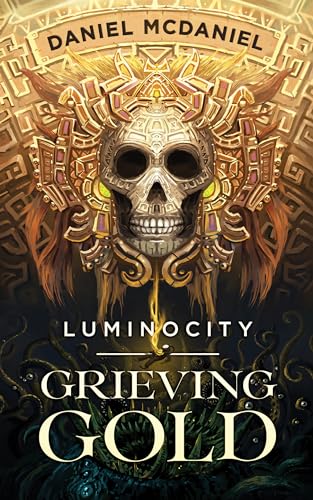
Three sun gods bathe the city of legends, Luminocity, in their blessed light. The city stands on the decaying ruins of an ancient civilization; skeletal skyscrapers guard their solemn secrets of forgotten technology and past tragedies. But under the surface the light dies and shadows begin. It is a dark god's domain, even caged, and he holds his grudges through the eons. Five fates intertwine, thrown onto the currents of destiny, played like puppets. Will they be able to tear free from their strings? Laxerion Tama, a disowned noble and heist-crew mastermind, finds his leisurely life turned upside down. His brother Val-Gustus, general and golden son, is forced to take responsibility for the threats to the city as war brews. Ilumi, a young scientist from the far north, carries a dark secret and pushes the boundaries of morality. Aiana, a huntress of the depths, struggles with her inner demons; and Dawb, a grieving young urchin, searches for the monsters prowling the short nights.
Plot Summary (spoiler-free)
Luminocity is a city of legends, bathed in the light of three sun gods and built on the decaying ruins of an ancient civilisation. Skeletal skyscrapers keep the secrets of forgotten technology and old tragedies, and beneath the surface, where the light fails, a caged dark god holds grudges that have lasted eons.
The book follows five characters whose fates are tangled together. Laxerion Tama is a disowned noble and the mastermind of a heist crew whose comfortable life gets upended when his estranged family and an old enemy both come for him, testing his strange ability to see lies in the light. His brother Val-Gustus is the golden son and a general, forced to shoulder responsibility for the threats closing in as war brews. Ilumi is a young scientist newly arrived from the far north, carrying a dark secret and inventing technologies that push at the edges of conscience. Aiana is a huntress of the depths fighting her own demons and her past, and Dawb is a grieving young urchin hunting the monsters that prowl the short nights. Their strands wind together around political scheming, a hunt for a mysterious artifact, and the stirring of the god below.
Character Development
The five points of view each come with their own troubles and agendas, and the contrasts are the strong part: Laxerion the elegant rogue against Val-Gustus’s duty-bound rigidity, Ilumi’s forbidden brilliance, Aiana’s haunting, Dawb’s grief. There is a lot of potential here, though the characterisation occasionally feels forced, pushed along to set up later books rather than fully earned in this one. This is a first volume, and it reads like one, with several arcs still being assembled.
Themes
Light is the book’s central image, and McDaniel does something interesting with it: light here can carry truth or deception, and the power system is built on that ambiguity. Grief runs through the cast, from Dawb outward, and the buried dark god works as a literal version of the past refusing to stay put. The Aztec-mythology influence gives the magic and the city a texture that feels fresher than a lot of the genre.
Writing Style and Effectiveness
The world-building is the headline. Luminocity, with its skeletal skyscrapers whispering of forgotten glories, is vividly drawn, and the light-based magic is a genuinely novel idea. The trade-off is pacing: the book leans so hard into the world that the central narrative thrust feels underpowered through the first half, and the story meanders as it slowly unwraps the secrets binding the characters. The hard light can also get relentless, and a stronger counterweight from the city’s dark underside would have helped the balance. The magic mostly stays in reserve here, held back behind the political machinations, with clear room to open up in later books.
Conclusion
Grieving Gold is an ambitious epic fantasy with deep world-building and a refreshingly different magic system, drawing on Aztec myth to give a tired genre a new coat of light. The pacing drags and the characterisation is uneven, but the potential in the setting is real. This is straight epic fantasy with no romance element, so it sits outside Bloodthorn’s usual lane. Readers who want dense world-building and unusual magic, and who enjoy Brandon Sanderson or Patrick Rothfuss, should give it a look, with the caveat that it can feel slow.
Evaluation
- Overall Rating: ★★★★★ (5/5)
- Writing Style: ★★★★☆ (4/5): vivid prose, but pacing sags under the weight of the world-building.
- Characters: ★★★☆☆ (3/5): strong contrasts, but the characterisation can feel forced.
- World-Building: ★★★★★ (5/5): the standout, from the light-magic system to the city itself.
- Spice Rating: ★☆☆☆☆ (1/5): epic fantasy with no romantic content.
Trigger warnings: violence and war, grief and loss, references to past trauma, an ancient malevolent presence.
Recommendation: for epic fantasy readers who want deep world-building and a magic system they have not seen before, and who do not mind a slow first half. Fans of Brandon Sanderson or Patrick Rothfuss are the target. Not a romance.