Kneel, Little Crow by Luna Ars | Book Review
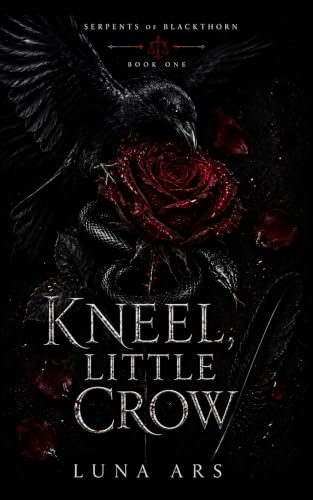
In the Order of Blackthorn, the Reaper rules. His word is law. His Serpents are deadly weapons. And every debt is paid in blood. Magdalene Santoro is his. She remembers no promise, only the man who arrives on her doorstep with a blood-red rose and a claim she refuses to accept. He expects obedience. She gives him defiance. And in Blackthorn, defiance always has a price.
Plot Summary (spoiler-free)
Maggie Santoro spends her days sketching crows in a Brooklyn cemetery, nursing her dying father, and dodging her mother’s attempts to marry her off to a priest’s son. Then, on the night her mother tries to force an engagement dinner, a massive, tattooed stranger shows up on the doorstep and announces Maggie was promised to him before she was even born. He takes her. I won’t pretend the setup isn’t a lot, debts older than the people paying them, an underworld order called the Serpents, a code of law even its own leader can’t break, but the book earns it by the end. Maggie spends the back half learning that the family and the fate she thought she understood were both built on a lie far uglier than a kidnapping.
Character Development
Maggie is the reason to read this book. She starts as a sharp-tongued survivor getting through an impossible home life on sarcasm and small rebellions, and by the end she’s endured real loss, been pushed into violence far beyond anything she imagined herself capable of, and learned her whole identity was built on someone else’s cruelty. Then she makes a deliberate, self-destructive choice to grab power on her own terms instead of letting any of the men around her protect her. That last choice is the best piece of writing in the book. It could’ve read as pure victimhood. Instead it’s the clearest thing Maggie does for herself the entire story.
Lucian, the Reaper, is a familiar dark-romance shape: obsessive, violent, a traumatic backstory doing the work of an excuse. I’ve read this hero a dozen times before, but Luna Ars commits to him hard enough that his final scene actually costs him something, real conflict between what he wants and what his own law demands. Zayn is warmer, funnier, mostly there to soften Lucian by comparison, and his arc never quite stands on its own the way Maggie’s or Lucian’s does. Alister is the one I wanted more of. Lucian’s controlled, precise right hand drops just enough about his own hidden loyalties in the last chapters that it reads like a real hook for book two, not a loose thread someone forgot to tie off.
Themes
The sharpest thing this book does is go after religion as a tool of control. Maggie’s mother wields Catholicism like a weapon for most of the novel, and the reveal of exactly how far that went is the most unsettling stretch in the whole book. Set against that is the Serpents’ own brutal, self-consistent code, and there’s something genuinely sharp about organized crime reading as more honest than organized religion here, even if it asks you to accept a pretty convenient hierarchy of which crimes the story is willing to forgive.
The fate-versus-choice thread is messier. Maggie is pulled between two men, one representing inherited obligation, one representing a love she actually chose, and the book resolves that, for now, not by picking a man but by having Maggie force the world’s rules to bend around her instead. I liked that subversion a lot. What it doesn’t touch is the discomfort baked into Lucian having quietly watched over Maggie since she was a child, years before any romantic claim existed. The book treats that as tragic and fated. It never asks what it means that a grown man’s obsession with his future bride started while she was still a little girl.
Writing Style and Effectiveness
The novel rotates first-person present tense between Maggie, Lucian, and Zayn, clearly labeled, and it suits a love triangle: tense scenes land with real dramatic irony because you often know more than any one narrator does. The voice leans hard on modern, profanity-heavy banter, especially between Maggie and Zayn, and it sits in genuine tension with the gothic mafia mythology around it. It works for comic relief. It occasionally undercuts the tragic register the book is reaching for right when it matters most.
The biggest structural swing is a single extended confrontation where almost every major revelation about Maggie’s parentage, her mother’s crimes, and the order’s history lands at once. It’s shocking in the moment. It also reads more like an information dump than revelations earned gradually. The prose itself has real rough edges, consistent with the author’s own admission of self-editing, and I noticed the typos and grammar slips more than once. Against all that, the courtroom sequence in the final two chapters is the best sustained writing in the book, using ritualized, repeated language to build real dread and actually earning its own climax.
Conclusion
Kneel, Little Crow is an ambitious opener for a dark mafia-romance duology. Maggie’s arc, from a powerless daughter to a woman who bends an entire criminal order’s law to her will, is genuinely satisfying to watch, and it’s the kind of transformation I wish more dark romance heroines got. It reminded me of the better Rina Kent books, that same willingness to let the heroine’s power grab be the actual climax instead of a side effect of the romance. It stumbles in the density of its big reveal scene and in prose that needed another editing pass, and it leaves the central romantic question completely unresolved by design; this is unmistakably half a story, not a whole one. If you’re willing to accept a morally selective premise and wait for the second half, the payoff in these final chapters is real.
Evaluation
Overall Rating: ★★★★☆ (4/5)
Writing Style: ★★★☆☆ (3/5): an effective rotating-POV structure and a genuinely strong final act, undercut by noticeable prose roughness and a single overloaded revelation scene
Characters: ★★★★☆ (4/5): a well-earned heroine’s arc and an intriguing secondary character in Alister, set against a familiar villain-hero archetype and a love interest who mostly orbits the heroine
World-Building: ★★★☆☆ (3/5): an inventive inherited-crime-order mythology with a genuinely strong court/ritual sequence, though its central legal loophole feels engineered for the plot rather than organically established
Spice Rating: ★★★★★ (5/5): frequent, explicit scenes involving both love interests across a large share of the book
Recommended for readers who want a dark, morally gray mafia romance with a heroine who claims real power by the story’s end, a genuinely effective final-act courtroom sequence, and a love triangle they’re prepared to see left open for a sequel. Less recommended for readers who want tightly polished prose or a story that fully reckons with the discomfort of its hero’s history with its heroine.
Trigger warnings, per the book’s own content page: abduction and captivity, drugging, coercion and controlling behavior, dubious consent, power imbalance, obsessive and possessive behavior, stalking, explicit sexual content, physical and graphic violence, blood and gore, torture, corporal punishment and whipping, death and grief, murder, organized crime, human and drug trafficking references, weapons, religious trauma and abuse, emotional and verbal abuse, parental abuse, kidnapping of a child, forced engagement and marriage themes, and morally corrupt characters.