The Last Immortal by Natalie Gibson | Book Review
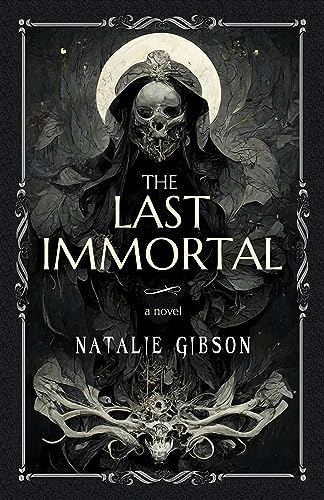
Fantasy and horror meld in Natalie Gibson's striking novel, a story full of sexuality and psychological warfare. Ramillia is a passionate and dangerous heroine who has been broken by her own incredible powers. She wakes in a Victorian asylum, questioning what part she played in the violent past her doctors reveal to her, and fighting a maze of internal and external battles with multiple personas who want her power.
Exploring those powers with her betrothed, Julian, takes her through a reimagined Victorian London where some can inhabit the bodies of others and the line between the scientific and the superstitious has blurred. When Julian inducts her into a society of bloodthirsty, cruel immortals, she is forced to join them and accept their way of life. Armed with talents she does not know she has, Ramillia must break free of a prison she cannot see, kill an enemy who cannot die, and find a daughter she cannot remember, all with the help of an ally she does not know.
Plot Summary (spoiler-free)
Lady Ramillia Winmoore is twelve years old when she wakes strapped to a table in a Victorian asylum for the criminally insane, told she butchered her own parents and has no memory of it. What actually happened to her, and what she is, unspools slowly and never comfortably: she is a “Carrier,” one of a hidden bloodline of the nearly unkillable, and her freedom from that asylum comes at the price of a marriage arranged since before she was born, to a man who has been shaping her whole existence from the shadows.
What follows refuses to stay a single story. A rescue becomes a trap, a trap becomes a education in exactly how deep the rot of immortality goes, and a mother’s fight to protect her children becomes something far larger and far darker: a reckoning that eventually spans continents, empires, and centuries, carried by a narrator whose own mind has splintered into pieces just to survive what was done to her.
Character Development
Ramillia. The book is her own journal, written in full knowledge of how it ends, and that framing does real work: every warmth and every horror in these pages comes filtered through a woman who already knows what she became and isn’t asking to be forgiven for it. Her arc doesn’t move in a straight line from victim to hero. It moves from a girl who doesn’t know her own strength, to a bride who mistakes control for love, to a woman who slowly, book by book, comes to understand that surviving what was done to her required becoming something capable of doing worse. By the final pages she names herself the monster plainly, without flinching and without excuse, and the book is brave enough to let that stand as the actual ending rather than walking it back.
Sally, and the others. This is the novel’s most genuinely original move: Ramillia’s dissociation isn’t a metaphor, it’s the book’s actual magic system. Each fractured personality is born at the death of a specific family member and carries a specific emotional inheritance: Sally is the one who lives in the pain so Ramillia doesn’t have to, Jo is freedom and godhood, Effie is love and lust, Mary Martha is a mother’s rage, Marge is the ache of being small and unseen, Dierdre is pure paranoia, Ruth is guilt with nowhere to go. Watching them argue, protect each other, betray each other, and slowly learn how to seize control of a shared body is stranger and more moving than a straightforward split-personality device has any right to be, and the late revelation of exactly why and how they’re born reframes everything that came before it.
Dawn. Ramillia’s daughter is the book’s tragic center. Raised in secrecy by a mother who cannot even touch her safely, carrying trauma and power in equal measure, Dawn’s descent mirrors her mother’s own but with none of Sally’s restraint to slow it down. Her arc is genuinely upsetting to watch precisely because the book never lets her be simply a monster or simply a victim; she is a child who was failed, repeatedly, by every adult who claimed to protect her, and the story makes Ramillia sit in that failure rather than excusing it.
Julian and Leon. Ramillia’s two husbands are drawn as real opposites rather than a villain and a prize. Julian is a predator who spent centuries engineering her birth and never once stops treating her as property, even at his most affectionate. Leon is the book’s argument that decency is possible even inside a monstrous system, a man who treats his Carriers as allies rather than chattel and gives Ramillia the first intimacy in her life untouched by coercion. What happens to him is one of the book’s most devastating turns precisely because he’s earned better.
Paetus, Xia, and Ed. Paetus is jealous, petty, and genuinely capable of horror, but the book never lets him be a simple monster either: his grief for Julian, carried across millennia, is rendered with real feeling even as his cruelty is never softened for it. Xia, introduced late, functions as a mirror and a warning: proof that even an Incola who starts from better instincts than Julian or Paetus is corrupted by enough centuries of unchecked power. Ed, the tinkerer who tore out his own eyes rather than become a Carrier’s plaything, is the book’s one genuinely uncorrupted companion, and the quiet, platonic trust between him and Ramillia is some of the novel’s warmest material.
Themes
The book’s real subject is what unchecked power does to intimacy, and it refuses every easy answer. Julian’s love is indistinguishable from ownership. Leon’s love is real precisely because he gives up ownership. Xia’s isolation shows what centuries of being worshipped does even to someone who starts out trying to do less harm than the men around her. Running underneath all of it is the question of what trauma actually does to a mind forced to survive the unsurvivable: the others aren’t a gimmick, they’re the book’s real argument that dissociation is a form of architecture, built person by person, death by death, to keep someone alive long enough to keep fighting. And the ending refuses the easiest exit of all: that becoming powerful enough to end the monsters might require becoming one, and that there might be no way back from that bargain once it’s made.
Writing Style and Effectiveness
Gibson commits fully to the confessional-journal frame, and it’s the book’s strongest formal choice: Ramillia is writing on the literal eve of her own death, which means every scene carries a kind of doubled weight, lived in the moment and already mourned in the telling. The Victorian voice is sustained convincingly across a genuinely enormous span, real research sits under the asylum scenes, the courtship rituals, the etiquette, the period technology, without ever reading like a history lecture. The body horror is handled without blinking, and the choice to let the “others” argue in real time, sometimes mid-scene, gives even quiet moments a charge most single-POV narrators can’t manage.
The one place the craft loosens is pacing: once the story leaves London for America and then Asia, the canvas widens fast, and a few threads (Robbie, the Chinese mythology material, Xia’s own history) arrive late and don’t fully knit back into the central spine before the book has to resolve everything at once. It never breaks the story, but the back third asks for more patience than the tightly wound first two-thirds.
Conclusion
The Last Immortal is the rare dark fantasy that actually earns its darkness rather than performing it. Its greatest strength is refusing to let Ramillia’s suffering resolve into a clean redemption: she becomes exactly as monstrous as the story needed her to be, and the book trusts its reader to sit with that rather than soften it in the final pages. The “others” device does what dissociation-as-magic ought to do and rarely does this well: it makes an abstract psychological survival mechanism feel like a cast of real, distinct people, each carrying a piece of a life too much for one mind to hold alone. Where it loosens, it’s in scope rather than nerve: the back third’s global tour trades some of the earlier chapters’ tight, claustrophobic intensity for breadth, and a few late arrivals don’t get the space to fully pay off. Against other Victorian-set dark fantasy, it distinguishes itself by refusing a hero’s ending in favor of an honest one: not everyone gets saved, not everything gets fixed, and the last immortal in the title is exactly who the book has been building toward the whole time.
Evaluation
- Overall Rating: ★★★★★ (5/5)
- Writing Style: ★★★★★ (5/5): a sustained, convincing Victorian confessional voice with real historical texture, undercut only by a sprawling final act
- Characters: ★★★★★ (5/5): the “others” system alone makes Ramillia one of the more genuinely original narrators in the genre, and Dawn’s tragedy is never let off the hook
- World-Building: ★★★★★ (5/5): a real, internally consistent Carrier/Incola mythology carried convincingly from Victorian London to Gilded Age America to Qing-era China
Trigger warnings: childhood sexual abuse (referenced and shown in memory), incest, self-harm and ritualized violence/BDSM content, graphic torture and body horror, animal death, death of children, suicide and execution, opium and alcohol use, and sustained themes of coercive control and psychological abuse.
Recommended for readers who want their dark fantasy to actually reckon with what it costs to survive trauma and wield real power, anyone drawn to Victorian gothic horror with real historical grounding, and readers who’d rather sit with an honest, unresolved darkness than have it smoothed over by a tidy ending.