All Your Bloody Lies by M. L. Burns | Book Review
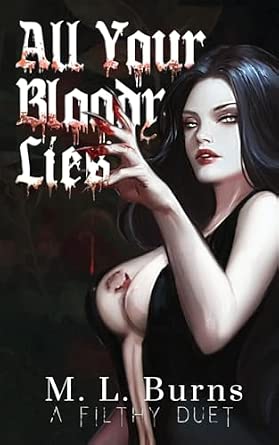
Told in dual POV: Xeraphine, a succubus, and Kairhyse Monroe, a vampire. After being tortured, abused, and buried alive, Xeraphine lived, and now she is taking revenge by any means necessary on the men who defiled her and thought they had killed her. As dead shifters start turning up around town, Kairhyse is ordered to find whoever is responsible, and does not expect to become obsessed with the very person he is hunting. While Xeraphine claims her vengeance, Kairhyse works in the background to keep his boss off her trail, because if he loses Xera, the world will burn. A dark paranormal romance, with the emphasis on dark.
Plot Summary (spoiler-free)
Xeraphine has spent ten years hunting the five men who abducted, tortured, and buried her alive a decade ago, using the seductive, life-draining power of her Succubus nature (an ability she calls her Amoro) to track and kill anyone connected to them. Kairhyse, a Vampire enforcer assigned to stop a string of high-profile murders traced back to her, catches her mid-kill and becomes obsessed rather than turning her in, choosing instead to shield her from his own employer while chasing her, sleeping with her, and slowly becoming genuinely entangled in her life and her revenge.
What follows is a slow-burn, extremely explicit romance built on constant push-and-pull: Xeraphine’s refusal to be claimed, owned, or loved standing directly against Kairhyse’s total, possessive devotion, while she works her way methodically through the remaining men responsible for her captivity. Her best friend Sydni and an old ally named Tyson round out the found family orbiting her, even as the killings draw the attention of rival supernatural power structures who have their own reasons to want Xeraphine found, controlled, or silenced. The book builds toward a final confrontation that recontextualizes who has actually been hunting her all along, and ends with no resolution in sight.
Character Development
Xeraphine is written with a real, specific psychology underneath the vulgar, unbothered exterior she performs for everyone around her: her PTSD, her claustrophobia, her compulsive need to control every sexual and violent encounter she’s in, and her genuine terror of being loved rather than merely wanted, all read as consistent responses to what was actually done to her rather than generic “damaged heroine” dressing. Her chosen safe word, tied directly to Kairhyse’s scent, becomes a real piece of characterization rather than a gimmick: it marks the exact moment her body starts trusting him before her mind is willing to. Where the book is less patient is in how often that psychology gets stated directly rather than shown, particularly in the back third, where her internal monologue repeatedly explains what she’s feeling and why in almost clinical terms rather than trusting the reader to infer it from action.
Kairhyse avoids the flattest version of the possessive-alpha-vampire archetype by being given real interiority: his restraint (physically pulling his own blood from her mouth before she can overfeed, checking himself before pushing her to talk about her trauma) reads as a genuine, active choice rather than incidental gentleness, and his growing loyalty to Sydni and grudging respect for Tyson round him out as someone capable of caring about more than one person. His repeated, almost compulsive assertion that Xeraphine “isn’t glass” is a real character detail, a man consciously overriding his instinct to treat trauma survivors as fragile because he’s learned that isn’t what she needs. The device wears thin by sheer repetition, though: nearly every chapter restates his devotion in close to the same vocabulary (“little demon,” “fucking Vayl above,” “she isn’t glass”), so his arc register barely changes shape scene to scene even as the stakes escalate around him.
Sydni is the book’s clearest source of warmth and genuine comic relief, and her competence (tracking phones, reading crime-scene evidence, hacking a laptop) keeps her from being a pure damsel despite her bubbly exterior; her willingness to risk herself to find Xeraphine, and the quiet confirmation that she loves her best friend without needing it reciprocated the same way, gives the book real emotional ballast outside the central romance. Tyson, a Mundane man tied to Xeraphine’s rescue from her own burial, gets a real, sad backstory (his murdered family, his complicated non-romantic history with Xeraphine) but functions mostly as a plot convenience and a source of Kairhyse’s jealousy rather than a fully developed presence in his own right.
The men Xeraphine hunts down (the Bastilla twins, Clay, Zade, Daigo, and a Vampire named Molly) are each given one distinguishing trait or scene, but functionally read as a rotating cast of interchangeable brutal predators rather than individually memorable antagonists; Molly is the partial exception, since her genuinely surprising choice near the book’s climax gives her more depth in one scene than the others get across several. Achille and his son Marcos, the Hause politics Kairhyse answers to, exist mostly to generate plot obstacles until the book’s final chapters, where their real function reveals itself in a twist worth encountering without it spoiled here.
Themes
The book’s clearest and most consistently developed theme is mercy as a form of power rather than weakness: Xeraphine repeatedly chooses who to spare based on the color and weight of their aura rather than convenience, and that discernment, not her violence, is what the narrative treats as her defining trait. Bound up with that is a theme about control and consent inverted through the Amoro itself: Xeraphine’s ability to command bodies and wills with her blood becomes a direct answer to the total loss of control she suffered during her captivity, and the book is fairly explicit that her hyper-controlling approach to sex and violence alike is a trauma response, not just a kink. A third thread, love as something that requires being fed rather than starved, runs through both the literal feeding mechanic and the emotional one: Xeraphine’s inability to let herself be loved is treated as the same wound as her inability to trust anyone with her actual name.
Writing Style and Effectiveness
The dual first-person POV (Xeraphine and Kairhyse, alternating chapters) is the book’s strongest structural choice, and it mostly succeeds: Kairhyse’s chapters lean into a distinct, more possessive and predatory internal register than Xeraphine’s more sarcastic, deflecting voice, and the device lets the reader see both halves of their obsessive dynamic land differently on each side. The book’s biggest craft weakness is vocabulary and phrase repetition at the sentence level: certain exclamations (“Fucking Vayl above,” “Fucking Beyond,” “Fucking Belial himself”) and pet names (“little demon”) recur so often, sometimes multiple times per chapter, that they stop registering as voice and start reading as filler. The sheer density and frequency of explicit sexual content, which appears in nearly every chapter and often runs for several pages at a stretch, gives the book real momentum in its first third but crowds out plot movement through the middle, where entire chapters pass with almost no advancement of the revenge plot beyond another encounter between the two leads. As an Advanced Reader Copy, the text carries some rough patches consistent with its own front-matter disclaimer (occasional dropped words, a few unclosed quotation marks), which is worth naming honestly rather than pretending the copy read as fully polished. The book’s real strength shows in its action sequences, particularly Xeraphine’s escape and revenge on her captors in the back third, where the hemokinesis power set is used with real creativity and the pacing tightens considerably.
Conclusion
All Your Bloody Lies is a book that knows exactly what it’s building, a revenge-driven Succubus and the Vampire who falls for her instead of turning her in, and executes the emotional core of that premise with real conviction: Xeraphine’s arc from a woman who can’t let herself be cared for to one who admits, even only to herself, that she wants to be Kairhyse’s, is genuinely earned rather than declared. Its clearest strength is that emotional throughline, carried by a dual-POV structure that gives both halves of the romance real interiority. Its clearest weaknesses are a prose style that leans on the same handful of phrases far too often, and a middle stretch where the sheer volume of explicit content outpaces the plot’s own momentum. Set against other dark paranormal romances built on a captor-turned-hunter dynamic, it distinguishes itself with a genuinely thoughtful handling of trauma and consent as the actual subject rather than set dressing, and with an ending confident enough to blow up its own status quo rather than deliver a tidy happily-ever-after a book early. That confidence comes at a real cost, though: the book stops mid-crisis rather than closing any of its threads, and readers who want even partial resolution within a single volume should know that going in.
Evaluation
- Overall Rating: ★★★☆☆ (3/5)
- Writing Style: ★★☆☆☆ (2/5): an effective dual-POV structure undercut by heavy repetition of the same phrases and pet names across nearly every chapter
- Characters: ★★★☆☆ (3/5): Xeraphine, Kairhyse, and Sydni are genuinely well-drawn; most of the antagonists and Tyson function more as plot utility than fully realized people
- World-Building: ★★☆☆☆ (2/5): the Amoro/hemokinesis mechanic and the book’s own glossary show real thought, but the wider Hause/Dylox political structure stays mostly surface-level
- Spice Rating: ★★★★★ (5/5): explicit sexual content in nearly every chapter, frequently for pages at a stretch, covering a wide range of kink content the book names openly in its own front matter
Trigger warnings: foul language; graphic murder and death; blood and gore; graphic violence; forced cannibalism; torture; stalking; drugging; kidnapping; captivity; human trafficking (mention); rape and sexual assault (not involving the two leads); manipulation; suicide (mention, graphic); drug and alcohol use; mental health topics; claustrophobia; drowning; panic attacks and PTSD; racism and prejudice; forced incest (not involving the two leads); child abuse and child sexual assault (both mentioned); gun violence; and suffocation. Sexual content includes anal, dubious consent, consensual non-consent, double penetration, praise, breath play, orgasm denial, blood play, impact play, and primal play.
Recommended for readers who want their dark romance genuinely dark, with a revenge plot that isn’t softened for the sake of the romance, a possessive love interest whose devotion is backed by real restraint rather than just declared, and explicit content that leans into trauma and power rather than treating them as separate from the heat. Less recommended for anyone who wants a complete emotional arc within one book: this is the first half of a duet, and it ends on an open, unresolved crisis with no indication of how or when it resolves.