Desperate Run by C. J. Riggs, M. L. Burns | Book Review
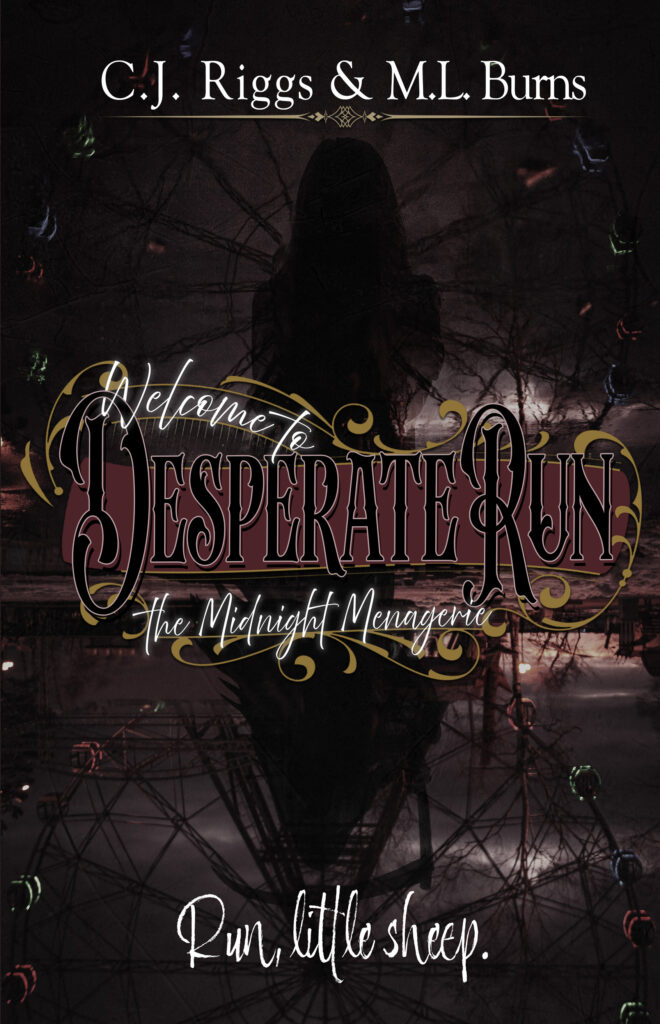
Max is a med student with a buried past, one NDA, and a family who sold her out. When she and her friend group win free tickets to the Midnight Menagerie, a travelling horror-carnival where paying guests can be legally hunted across a weekend of escalating mazes, she is claimed almost at once by Grim, the carnival's tallest and most feared Hunter. What starts as a game turns into something neither of them expected, as her reasons for being there and his reasons for staying start to look like two halves of the same wound. An erotic-horror dark romance.
Plot Summary (spoiler-free)
Max is a med student with a past she’s buried under sarcasm, one NDA, and a family who sold her out. When she and her friend group win free tickets to the Midnight Menagerie, a traveling horror-carnival where paying guests can be legally “hunted” through a weekend of escalating mazes, she’s claimed almost immediately by Grim, the carnival’s tallest, quietest, and most feared Hunter. What starts as a game becomes something neither of them expected: Grim, whose real name is Draven, is carrying his own seven-year-old grief, and the deeper Max pushes into the carnival’s trials, the more her reasons for being there and his reasons for staying start to look like two halves of the same wound.
The weekend builds through a series of increasingly dangerous mazes, each one testing something different in Max, physically, psychologically, and morally, while Draven’s own past and the carnival’s own rot come to a head around her. What she’s really hunting, and what it will actually cost her to get it, is worth discovering without it spoiled here.
Character Development
Max carries the book, and her voice does real work: the constant jokes, the deflection, the refusal to look fragile even mid-crisis, all read as a specific coping strategy rather than generic sass. Her actual trauma (a coordinated assault at eighteen, orchestrated by her own father to clear a gambling debt, followed by a forced NDA and years of silence) is handled with real weight when it finally surfaces, and the book is careful to let her rage stay hers: she’s given the choice, more than once, to do her own killing rather than have it done for her, and the story treats that agency as the actual point. Where the book undercuts its own theme is in how often Draven simply overrides her anyway, physically removing her from danger, making decisions about her safety without her consent, even locking her out of a fatal choice at the story’s climax. The book frames this as devotion, and Max is furious about it in the moment, but the narrative itself never quite reckons with the contradiction: a story about reclaiming control keeps getting rescued by a man who won’t let its heroine have any.
Draven is a genuinely well-conceived counterpart rather than a stock possessive-alpha figure, mostly because his backstory is doing real thematic work rather than sitting there as flavor. His sister Alyson was raped by a boyfriend at sixteen, gaslit into silence, and died by suicide soon after; Draven’s seven years at the Menagerie were spent trying (and failing) to buy her back from a coma with the winnings from its final maze. That his and Max’s timelines line up almost exactly is a real structural choice, not a coincidence the book treats lightly, and it gives his obsessive, violent devotion to her an actual emotional foundation instead of just kink-adjacent set dressing. His repeated killings on her behalf escalate in genuinely disturbing detail, and the book is honest that this is who he is, not a beast tamed by love, which is more interesting than the alternative.
Sasha is the book’s real source of warmth, competent and protective rather than a pure damsel, and her arc from bystander to willing participant in the story’s final chapters gives the found-family thread real follow-through. Troy, the carnival’s leprechaun-masked comic relief, does more narrative work than his jokes suggest: his loyalty to Draven, and his own quiet romance with Sasha, keep the book’s tone from collapsing entirely into brutality. Ben, Max’s supposed childhood friend, is the book’s best-executed slow reveal: what looks like garden-variety unrequited-crush jealousy for most of the book curdles into something much darker once his actual complicity in Max’s original assault comes out, and the reveal recontextualizes every earlier scene with him without feeling like a cheat.
The other named Hunters (Marcella, Po, Oscar, Gabe, Jun) each get one defining trait and one real scene, but mostly function as a rotating gauntlet of escalating cruelty rather than as people in their own right; Marcella and Po, who get the most page time, are the exceptions, and their individual confrontations with Max are the book’s strongest set pieces precisely because they’re allowed real menace rather than just serving the plot’s pacing.
Themes
The book’s clearest theme is that reclaiming power after violation requires actually taking it, not being handed it, which is why Max’s insistence on doing her own killing (even when Draven offers, repeatedly, to do it for her) matters as much as it does. Running directly underneath that is a theme about parallel grief: Draven’s failure to save his sister and Max’s own near-death are treated as the same wound wearing two different faces, and the book’s real emotional center is two people recognizing that shape in each other before either says so out loud. A third thread, control and consent as something that can be inverted rather than simply survived, runs through both the mazes’ literal power dynamics and the leads’ sexual relationship, where painful, controlling acts are framed as healing specifically because Max is the one steering them. The book is less successful at noticing when that same framework breaks down between the two leads themselves, since Draven’s protectiveness repeatedly crosses from consensual power exchange into simply not letting Max choose, and the story never quite clocks the difference.
Writing Style and Effectiveness
The dual first-person, present-tense structure (Max and Draven alternating chapters) is the book’s strongest formal choice, and it’s used well here: seeing the same weekend from inside two people who are both, in very different registers, obsessed with each other gives the central romance a charge a single POV wouldn’t manage, and Draven’s clipped, French-and-Spanish-inflected internal voice is genuinely distinct from Max’s rapid-fire, joke-first narration. The maze structure gives the book real mechanical propulsion, each trial built around a different psychological or physical threat, tied to a specific Hunter’s specialty, with a hard midnight deadline driving the back half. That structure is well-conceived enough to carry a book this long and this explicit without losing its shape.
The prose leans on the same handful of phrases so often they stop reading as voice and start reading as filler: “fucking Hell itself,” Draven’s repeated “Satan himself” and “Petit Mouton,” Max’s constant self-directed asides, all recur so frequently per chapter that a reader will register the pattern well before the book is done using it. The volume and frequency of both extremely graphic violence and extremely graphic sex, often in the same scene, is clearly the book’s core appeal to its intended readership, and it’s executed with real craft in the maze set pieces specifically, less so in the connective tissue between them, where entire stretches exist mainly to get the two leads back into bed. The glossary, cast page, and dual character playlists in the front matter show real care in how the book is packaged, even if they add little to the reading experience itself.
Conclusion
Desperate Run is an ambitious, structurally confident piece of extreme erotic horror that earns its emotional stakes rather than just performing them: the parallel-grief backbone between Max and Draven gives a book built on graphic violence and explicit sex a real reason to care what happens to either of them. Its clearest strength is that structural ambition, the maze-by-maze escalation, the countdown clock, the dual-POV device that lets both halves of the obsession land. Its clearest weakness is that the book never notices the tension it creates between its own stated theme (Max reclaiming her agency) and its actual mechanics (Draven repeatedly taking that agency away from her “for her own good”), alongside prose that leans on the same handful of phrases too often across a long book. Set against other extreme dark-romance/horror hybrids built on a hunter-and-prey premise, and specifically against Burns’s own solo book All Your Bloody Lies, this one distinguishes itself with a tighter structure and an actual, earned resolution rather than an open cliffhanger, even if it shares that book’s tendency toward vocabulary repetition and a rotating cast of interchangeable antagonists.
Evaluation
- Overall Rating: ★★★★☆ (4/5)
- Writing Style: ★★★★☆ (4/5): a genuinely well-built maze structure and effective dual-POV device, undercut by heavy repetition of the same phrases across a long book
- Characters: ★★★★☆ (4/5): Max and Draven’s parallel-grief backstory gives them real depth; most of the other Hunters function as an escalating gauntlet rather than as people
- World-Building: ★★★★☆ (3/5): the Midnight Menagerie’s rules, hierarchy, and maze mythology are specific and internally consistent, backed by real front-matter packaging (glossary, cast list, playlists)
- Spice Rating: ★★★★★ (5/5): explicit sexual content in nearly every chapter, escalating to a foursome in the extended epilogue, frequently intercut with graphic violence rather than kept separate from it
Trigger warnings: blood and gore, graphic depictions of murder, grief and loss, drugging, waterboarding, whipping, cutting, graphic acts of violence, trauma, rape and sexual assault (mentioned, not depicted on the page involving the two leads), manipulation, amputation, stabbing, eye gouging, castration, decapitation, extensive use of a Gigli saw, skinning, flaying, jaw and tongue removal, scalping, broken bones, and gun violence. Sexual content includes praise, anal, primal, choking, dub-con, throat-fucking, toe-sucking, double vaginal penetration, voyeurism, sharing, punishment, free use, spitting, exhibitionism, knife play, blood play, punishment stocks, spanking, and rough sex.
Recommended for readers who want their erotic horror genuinely extreme, unapologetic about pairing graphic violence with graphic sex, and grounded in real emotional stakes rather than shock for its own sake, fans of Burns’s All Your Bloody Lies looking for a tighter standalone with an actual resolution, and anyone who likes a hunter/prey dark romance where the heroine does her own reclaiming. Less recommended for readers sensitive to sexual assault as backstory, even when it stays off the page for the two leads, or for anyone who wants a possessive love interest whose protectiveness never crosses into overriding the heroine’s own choices.