Love INFAMOUS by Astrid Ares Wise | Book Review
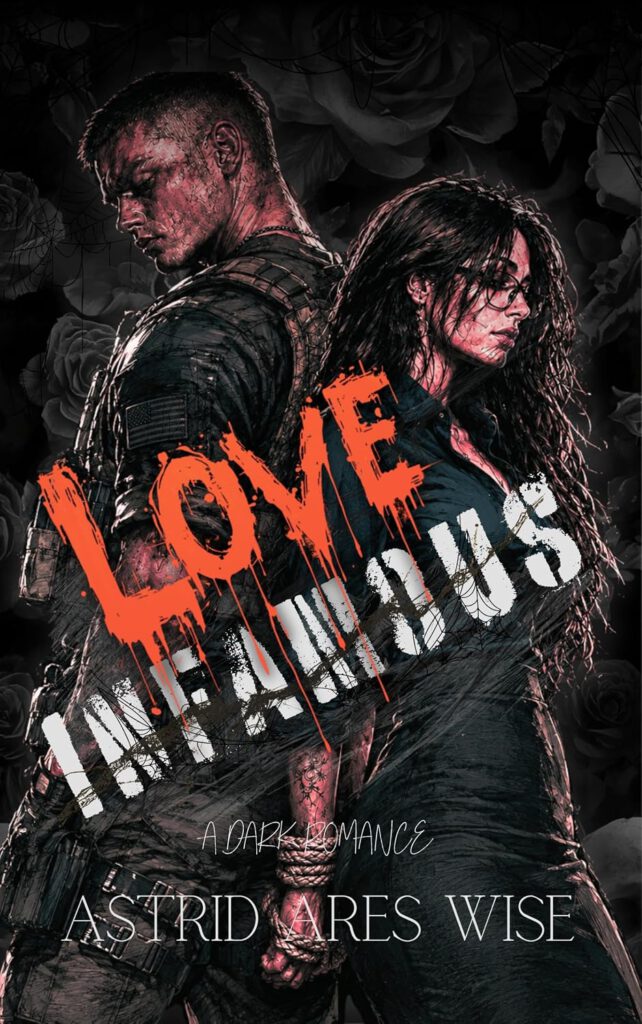
Dean Harper is finally behind bars. That doesn't mean Willow is free of him. Dean was never supposed to become the most important person in Willow Miller's life. He was her stalker, her tormentor, and the monster responsible for turning Helena into a hunting ground. He was also the first person who ever made her feel completely alive. Now Dean is locked away, facing the consequences of everything he's done, while Willow is left to build a future from the wreckage. She should forget him. She should be grateful she survived. Instead, she finds herself unable to let go of the one person everyone else believes she should hate. But prison doesn't make monsters disappear. It only teaches them new ways to survive. As the years pass, Dean and Willow are pulled down separate paths shaped by violence, grief, obsession, and secrets neither of them fully understands. The world keeps trying to tear them apart, but some bonds refuse to break, and theirs was never built to be safe. Because Dean Harper has already lost Willow once. He has no intention of losing her forever. Dark, obsessive, violent, and emotionally unhinged, LOVE INFAMOUS is the conclusion to Dean and Willow's story. It must be read after LOVE NEFARIOUS.
Plot Summary (spoiler-free)
Love INFAMOUS picks up right where Love Nefarious stopped, so if you haven’t read the first book, stop here. This one makes no sense cold.
Dean Harper is sitting in a Helena detention center waiting on a trial he knows he can’t win. Willow Miller is back at school, refusing to talk to a court-ordered therapist, refusing to help the FBI, and refusing to say a single thing that could make life worse for either of them. An agent named Tamara Harris has decided she wants something from both of them, and she doesn’t much care how she gets it.
After that the book jumps. Every chapter is headed with a narrator, a month and a year, and the years go by faster than I expected. It opens in January 2017 and the later chapters sit in the early 2020s. Dean and Willow spend a big stretch of that time apart, living very different lives, and neither one knows everything about what the other has been through. The trafficking ring from the first book never really went away either. It still wants things from both of them.
So the question the book asks is simple. Do they find each other again, and what’s left of them when they do?
Character Development
In Love Nefarious Dean narrated his killings like a man doing his taxes. Here he mostly gets hurt, and the book takes its time showing what that does to him. Early on he does something deliberately cruel to Willow because he thinks it’s the only way to keep her safe, and I’ll admit that scene got to me. It’s the one time he acts out of something other than wanting. Everything after it is a man being used, by people with more power than he has, and trying to hold on to the single thing that’s his. He’s still possessive. The book never sands that down and I’m glad. But he’s not the cold, calculating Dean from the first book, and his chapters are better for it.
Willow is harder to pin down. She studies psychology because she wants to understand him, which is either a clever move or a punchline depending on the page. Her sensory overwhelm and her watchfulness are still there, and she’s quick and funny when she’s angry. But I came away knowing less about what she actually wants than I did about Dean. She forgives him for a lot, fast, and the book treats that forgiveness as a given instead of something she has to work for. One scene around the middle shows exactly what I mean. It’s violent, the narration itself calls it violence, and within a chapter it’s smoothed over with a joke and a reconciliation. I found that hard to swallow.
I also liked how small Dean’s wants get this time. He doesn’t dream of an empire or a body count. He dreams of a house, kids running around a yard, a wife, the kind of ordinary life he sneered at when he was eighteen. The book is clear that he knows he ruined his shot at it, and there’s a bitterness in that which the first book never gave him room for. It makes him easier to root for and, oddly, harder to forgive. I kept going back and forth between wanting him to get it and wanting someone to tell him he doesn’t deserve it.
Willow hits him. She yells. She calls him a sick fuck to his face and means it, and those scenes crackle because she isn’t the girl who’s afraid of him anymore, and the book briefly remembers that a woman with her history would have opinions. Then the heat comes back up and the anger goes away too easily, which is the pattern that wore me down by the end.
The power imbalance is the real engine here, and it runs in more than one direction. Dean holds it over Willow through size, history, and the things he knows. Harris holds it over Dean through his case and his future. She uses it in ways the book plays for a smirk, and I did not smirk. It’s a dark joke that keeps getting repeated long after it stops being funny, and it flattens a character who could have been properly menacing.
The rest of the cast is thin on purpose, I think. Milo, Dean’s best friend, gets a few sharp scenes and I wanted more of him. Kade is the brother who turns up whenever someone needs to be a problem. Ava and Ray are the sweet couple who exist to be sweet. Everyone else is a clause.
Themes
The theme that runs through all of it is watching. Watching as love, watching as control, watching as the only way a person knows how to care. A camera, a file, a phone call that says nothing. Dean calls it protection. Willow calls it stalking and then, a few chapters later, lets it slide. The book wants both things to be true at once, and sometimes it manages that. More often it picks the romantic reading and keeps moving.
A concrete example, without giving anything away. Early in the book Dean ends things with Willow in a visiting room where every word is being recorded, and he does it by being as cruel as he can. She understands what he’s doing. He knows she understands. They both say the lines anyway, because the room is listening. It’s a good scene about what people say when someone else is watching, and it sets up what the rest of the book keeps circling.
The second theme is inheritance, picked up from the first book. Dean’s father made him, and the question of whether he can be anything else sits under every scene. This time the book adds a second question, which is whether a person can change if everyone around them is invested in keeping them exactly what they are. I liked that. It gets only a few real moments before the plot takes over.
There’s also a smaller idea about what a person owes the people who got hurt next to them. The scenes at the Harper ranch are quiet and a little sad in a way I didn’t expect from this series. I wanted a hundred more pages of those. It’s the one place the book lets a quiet moment sit without something exploding.
Consent is the theme the book raises most and answers least. It’s there in the content warnings, and it’s there on the page in scenes where a yes is missing, drugged, forced, or negotiated under threat. It’s especially there inside the central relationship, where the book asks you to hold a lot of harm and a lot of desire in the same hand and doesn’t help you do it. I think it wants the discomfort to be the point. I just don’t think it stays in that discomfort long enough to earn it.
Writing Style and Effectiveness
The two-narrator, present-tense structure from the first book comes back unchanged, and it still does most of the work. Dean’s chapters have the stronger voice. They’re sharp, bitter and funny in a mean way, and they have a rhythm Willow’s chapters don’t always match. Hers tend to tell you what she’s feeling instead of letting you feel it.
The month-and-year headings are a smart choice for a book that covers years. They make the time jumps clear and give each stretch a small clock. The pacing still lurches. The first third is slow and watchful, the middle is a long run of near misses and close quarters, and the last act tidies up its biggest threat faster than the book earned. I would have traded some of the middle for more time there.
A word on how it sounds in the ear. Dean’s narration has a deadpan cruelty that works because it’s specific. When he’s done being angry he goes quiet and the sentences get short. Willow’s chapters reach for the same bite and miss it more often than not, especially when she’s explaining her own feelings. There are places where one line of dialogue would have said what a paragraph of thinking says, and I wanted to reach into the book and cut.
The prose itself is foul-mouthed, pop-culture-heavy and extremely repetitive. Nearly every line has a swear in it, and the same descriptions of the same bodies come around again and again. I stopped noticing the playlist references around the halfway mark, which probably says something. The gore is committed and doesn’t look away. The sex is frequent, graphic, and often set in the middle of real danger, and a couple of scenes are written almost as comedy. That tonal whiplash is the part I wanted gone.
Conclusion
Love INFAMOUS does what a second book in a dark duology is supposed to do. It makes the first book’s romance cost something, and it gives both leads a reason to want a life they can’t quite have. Dean’s chapters carry that. The structure, the time jumps, and the willingness to be ugly all work.
What doesn’t work is the part after the ugly. One of the biggest scenes is handled with a shrug. A recurring joke about sexual coercion lands wrong. The villains are lightly drawn, the final threat is dealt with quickly, and the ending settles into a quiet domestic stretch that reads sweeter than anything before it earned. Compared to the genre’s best, the books that make you stay in the discomfort with the characters, this one blinks.
It also leaves a question unanswered on the page. These two have a history built on harm, and the book wants you to accept a calm, happy version of them without ever showing the work it took to get there. I wanted the repair scenes. I got the family photo.
I’m rating it a 3 overall even though I score the writing, the characters and the world-building a 2, because I got more out of reading it than those craft scores alone suggest. The ugly parts frustrated me and I still wanted to know where it ended. If you loved the first book, you’ll probably want to see where it ends. Just go in knowing the sequel leans harder on spectacle and softer on consequences.
Evaluation
Overall Rating: ★★★☆☆ (3/5): enjoyment holds it above the craft scores below
Writing Style: ★★☆☆☆ (2/5): two distinct voices and a clear time-jump structure, held back by constant swearing, repeated descriptions and sex scenes played against real danger
Characters: ★★☆☆☆ (2/5): Dean gets real shape and cost this time, Willow’s wants stay vague and her forgiveness comes too fast, and the villains are thin
World-Building: ★★☆☆☆ (2/5): the trafficking ring and the government outfit are sketched rather than built out
Spice Rating: ★★★★★ (5/5): frequent, graphic and often set in the middle of danger, including scenes with missing or coerced consent
Recommended for readers who finished Love Nefarious and want to see the whole story through, and anyone who likes dual-POV dark romance with a villain narrator who is allowed to stay a little villainous. If you want a tightly plotted thriller, a heroine with her own clear goals, or a book that sits with the harm it shows, this probably isn’t the one.
Trigger warnings: graphic violence and gore, sexual violence including non-consensual acts, coercion and threats, psychological trauma including stalking, abduction and extreme manipulation, dubious consent, drug use and abuse, strong language, dark romantic themes pushed to an extreme, and abortion.