Kingdom of Ash & Bone by Raven Storm | Book Review
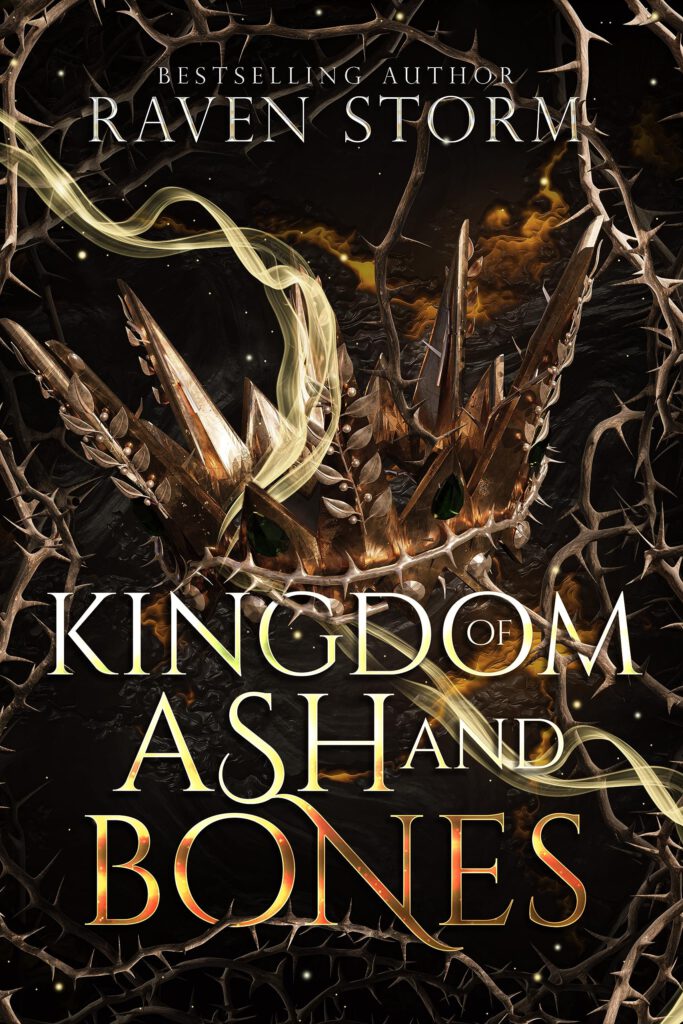
The princes have lied, and the queen controls everything, including the dragons. Marigold Mudthrice wanted to save her people in the mud quarter, but she cannot do it alone. Regrouping to go back and free everyone from the dragon's curse, she learns that to beat this evil she has to embrace the darkness herself, which means a journey into the abandoned mines on the edge of the kingdom, where the demons are waiting. Book two of a why-choose dragon-shifter fantasy romance.
Plot Summary (spoiler-free)
Mari is a mud quarter girl who was reaped into the Seat, the isolated royal enclave ruling over a caste-divided kingdom, and bonded to twin dragon princes, Zion and Zariah, as their mate. Book two picks up with that bond intact but the larger problem still very much alive: the queen who cursed her own bloodline into dragons, and cursed the Noble class into demons as punishment for generations of enslaving Mari’s people, is not going to give up her throne quietly.
What follows is a kingdom in open collapse: a refugee camp full of people who’ve lost everything, a half-brother running an underground refuge for the ones slowly turning into demons, and a mother-queen willing to burn her own city to the ground rather than lose control of it. Mari spends the book trying to hold together a found family that keeps growing even as the people around her keep dying, while the truth about the curse, the queen, and what’s actually still alive underneath the ruined mud quarter gets pulled further into the light with every chapter.
Character Development
Mari. Mari’s defining trait is that she has never once been allowed to stop fighting for someone, first her mother, then the mud quarter, now an entire displaced population and two dragon princes who’d burn down a kingdom for her. That history is what makes her hardest scenes land: she buries a father she barely knew and a childhood friend she’d been estranged from within the same afternoon, then gets up and organizes a refugee camp because there’s no one else to do it. Her arc in this book isn’t really about growing braver; she was already fearless in book one. It’s about learning that she’s allowed to want something for herself, a life, a family, a home, after a lifetime of only being permitted to want survival for other people.
Zion and Zariah. The twins are written as genuinely different men rather than a matched set wearing two faces. Zariah is the blunt, protective one who’d rather act first and apologize never, prone to jealousy and physically dominant in a way the book is careful to keep grounded in consent (Mari repeatedly asserts control over both of them, and the story backs her up when she does). Zion is gentler and more publicly diplomatic, but his arc carries the book’s sharpest cost: a wing injury that may permanently ground him, and his quiet refusal to take blood from Mari or Zariah rather than pull resources from people who need them more, which reads less like stubbornness and more like a man trying to prove his own worth hasn’t shrunk along with his ability to fly. Their shared telepathic mate-bond becomes a genuinely useful storytelling device rather than a gimmick: it lets three people argue, coordinate, and comfort each other in real time, mid-crisis, without slowing the plot down for a conversation.
Zephyr. The bastard half-brother is the book’s most interesting person by a wide margin. He tortures captured Fireguards and refuses to mercy-kill the turning Nobles under his care, and the book never softens either fact into something more palatable. But it also refuses to let him be a cartoon: he genuinely believes he’s protecting people no one else will, he’s read every scrap of information he can find on witches and curses because he’s desperate for a way out of his own transformation, and his jealousy over Shava is petty and human in a way that makes his cruelty elsewhere harder to dismiss. The power imbalance running underneath all of it, a man with no formal claim to the throne trying to carve out authority any way he can, is named directly rather than glossed as simple villainy.
Ell and Mari’s mother. Ell, Mari’s Fireguard father, gets one real chapter to be a person, a reconciliation, an old memory of falling in love with Mari’s mother, before the book takes him from her, and the abruptness of his death is part of the point: nothing in this kingdom gets to end on anyone’s terms but the queen’s, until it doesn’t. Mari’s mother’s late reveal, that she deliberately worsened Mari’s childhood illness to keep her out of the reaping, recasts a woman who’d read as simply broken into someone who’d been quietly fighting for her daughter the entire time, and the story gives her exactly one scene of being truly seen before she dies. It’s a hard double gut-punch delivered back to back, and the book doesn’t apologize for it.
Shava. Mari’s former mentor and closest friend, estranged over her blind loyalty to Zephyr, dies off-page and is found mutilated in a way the book refuses to look away from. The estrangement never gets to resolve, which is the more honest choice than a deathbed reconciliation would have been, but it also means Shava’s death lands as much on the reader’s guilt over the fight that was never fixed as it does on grief for her specifically.
Ess, Leilani, and Freesia. Ess, Mari’s craven, self-serving brother, gets the book’s most satisfying small arc: from hiding behind status to standing in front of the queen’s Fireguards and refusing an order, a moment of real spine that costs him nothing he isn’t ready to lose. Leilani, sweet and conflict-averse in book one, spends this book quietly transforming into a genuine caretaker, and her confession of guilt over a fiancé she couldn’t save is one of the book’s more honest looks at what survivor’s guilt actually feels like from the inside. Freesia, sharp-tongued and dismissed as merely clever, ends up running an entire evacuation logistics operation and gets floated, gently, as a woman who might actually be fit to rule.
Sabrathan. The fourth dragon arrives with no introduction and immediately upends what the book has told the reader about dragon mate-bonds, curses, and what happens to a dragon who loses one. He’s abrupt to the point of rudeness, and the found family absorbs him anyway, not because he’s owed kindness but because Mari makes room for it. His arrival does real work expanding the book’s dragon lore past the original curse, and gives the ending its most tender image.
Themes
The book’s central argument is that oppression curdles people rather than simply defeating them: the mud quarter’s generations of enslavement produced both a revolution and a man like Zephyr, someone genuinely capable of cruelty and genuinely convinced he’s the only one willing to do what’s necessary. Nothing in the book lets vengeance and justice stay cleanly separated. Running alongside it is a real interest in consent versus command: the queen’s magic works by literally forcing obedience on her sons, and the book sets that in deliberate contrast with the mate-bond between Mari, Zion, and Zariah, which only functions because all three of them keep actively choosing each other, out loud, under pressure, instead of being compelled to. Found family is the book’s warmest thread, expanding book by book (Sabrathan and his daughter folding into the group by the end) rather than staying fixed to blood relation, and grief throughout is handled less as something characters sit with and more as something they act through: burying the dead, feeding the living, building the next house, because stopping to fully feel it isn’t a luxury anyone in this kingdom has been allowed.
Writing Style and Effectiveness
Storm writes in first-person past tense from Mari’s point of view for nearly the entire book, with the mate-bond’s telepathic dialogue rendered in bold, a small formatting choice that does real work letting three-way conversations stay readable in the middle of chaos. The pacing is relentless: sieges, a mutiny, a citywide collapse, two funerals, a birth, and a relocation across a continent all happen inside nineteen chapters, and the momentum is genuinely gripping, the kind of book that’s easy to keep reading past a reasonable bedtime.
That speed is also the book’s biggest craft cost. Major deaths get processed in a page or two before the plot moves on to the next crisis, which sometimes reads as emotional efficiency and sometimes as emotional whiplash, particularly when grief is followed almost immediately by a graphic sex scene clearly meant to read as characters seeking comfort in each other, but which can land as tonally abrupt depending on the reader. Several worldbuilding threads (the “first blood” duel convention that ends up mattering enormously, the Hoveria homeland the king asks Mari to investigate, the witch coven system) get introduced and then set aside rather than developed, reading more like seeds for future books than payoffs in this one. The prose itself is breezy and functional rather than lyrical, built for momentum over atmosphere, and the banter between the brothers provides real warmth even in the book’s darkest stretches.
Conclusion
Kingdom of Ash & Bone is a genuinely fun, fast-moving reverse harem fantasy that earns its found-family warmth honestly: nobody in this kingdom, not the villain, not the found family’s newest and most reluctant member, gets treated as simple, and the mate-bond device does real emotional and structural work rather than sitting there as a fantasy-romance formality. Its real strength is refusing to let vengeance and justice occupy separate categories, following Zephyr’s cruelty and the queen’s tyranny to the same root cause without excusing either. Where it’s thinner: the sheer density of plot compresses grief into a page or two per loss more often than the story’s stakes deserve, and several intriguing pieces of lore get set up without being paid off inside this volume. Against other reverse harem dragon-shifter fantasy, it distinguishes itself by giving its heroine real agency even once she’s pregnant and grounded, by building its mate-bond around active, repeated consent rather than possessive compulsion, and by handling the queen’s actual defeat with a twist that subverts the expected fight to the death entirely.
Evaluation
- Overall Rating: ★★★☆☆ (3/5)
- Writing Style: ★★★☆☆ (3/5): breezy, momentum-driven prose that keeps the pages turning, undercut by emotional beats that get compressed almost as fast as they land
- Characters: ★★★★☆ (4/5): Zephyr and Sabrathan alone make this a stronger character book than its pace suggests, and the side cast (Ess, Leilani, Freesia) each gets a real, specific arc
- World-Building: ★★★☆☆ (3/5): the mate-bond and curse mechanics are genuinely well thought out, but several lore threads (Hoveria, the witch coven, the “first blood” duel rule) are introduced and then left for later books
Trigger warnings: graphic violence and torture, mutilation of a corpse, mass death and destruction of a city, death of a parent and of a parent figure, death in childbirth, explicit sexual content including blood-drinking and painplay elements as part of the mate-bond, themes of enslavement and caste-based oppression, and grief throughout.
Recommended for readers who want their reverse harem fantasy to actually build real mate-bond mechanics instead of leaving the “why-choose” structure unexplained, fans of Jennifer L. Armentrout-style dragon-shifter romance who don’t mind a caste-revolution plot running underneath the romance, and anyone who wants a morally complicated almost-villain instead of a cartoon one.