Kingdom of the Two Moons by Alexandra Thomashoff | Book Review
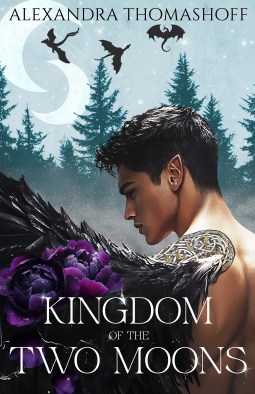
In a world where destiny is a cruel captor, Melody has never known freedom. Her life has been a prison, shackled by a ruthless magic harvester hungry for her rare gifts. She has been a pawn in a game she cannot win, until one fateful night, when she manages to escape. But her fragile hope is shattered when the mesmerizingly beautiful fae warrior, Riven, captures her and drags her into the shadowy Court of the Two Moons, ruled by the Dark Lord Caryan, a fallen angel cloaked in icy cruelty. Enslaved, with her fate now in Caryan's unforgiving hands, Melody begins to unravel the harrowing truths behind her captivity.
She is ensnared in a treacherous web of lies and longing, caught between her deep, rippling attraction toward Riven and the otherworldly allure of Caryan, whose very essence is everything she fears and desires. When her own slumbering powers awaken, they bind Melody helplessly to Caryan's unholy magic, and to a sinister prophecy that cleaves her soul into pieces. Only a silver elf can kill an immortal angel. And Melody just happens to be the last.
Plot Summary (spoiler-free)
Kingdom of the Two Moons opens with a girl on a cliff deciding not to jump, and it never really lets go of that image. Melody has spent her whole life as property: raised by a fae fixer named Lyrian in the human world, beaten into obedience, and forced to use her strange talent for tracking people down to hunt her own kind for him. The real hook is not the world it builds, though there is a lot of it. It is what happens once Melody gets taken from one owner and handed straight to a bigger one, and has to work out whether anything about that trade actually counts as freedom.
The plot moves fast in its first half. Lyrian’s true nature comes apart almost at once when Riven, a high lord serving the fae world’s Dark Lord, Caryan, arrives to collect Melody on his king’s orders. Caryan has been looking for her for twenty years. She is named in an old prophecy as the one who will end the blight, and Caryan, an immortal angel who absorbed a genocidal witch queen’s power to escape her, has every reason to think that blight is himself. Melody is pulled into his court as a slave in the fullest sense, caught between his obsessive, controlling fixation on her and Riven’s quieter, genuinely protective devotion, while a splinter faction of winged assassins hunts her to keep Caryan from using her talent to find three lost artifacts. A second thread follows Blair, a disgraced witch sent to retrieve or kill Melody, whose chapters carry a much older and much sadder story about what it costs to survive a genuinely evil ruler.
Character Development
Melody is written with real attention to what actual trauma does to a person rather than the softened, cinematic version of it: her panic attacks, her instinct to keep her face blank under threat, her compulsive need to run even when running gets her hurt, all read as specific and earned rather than generic backstory. Her defining trait, and the book’s best idea, is that she keeps sparing people who’d kill her without a second thought (Blair, a court full of fauns marked for execution, even Caryan’s own guilt), and everyone around her treats that mercy as either foolishness or a weapon, because in this world it genuinely is one. Where the book is less honest with itself is in how it handles her attraction to Caryan. Other characters explicitly name what he does to her as abuse (the near-rape framing of the forced-magic scene, the collar illusion, the “I could break you and you’d let me” dynamic Caryan states outright), and the narrative wants credit for that honesty, but it also keeps staging those same scenes as erotically charged rather than fully reckoning with the coercion underneath them. That tension never gets resolved by the book’s end. It’s worth naming directly rather than glossing over, since it’s the single biggest thing a reader’s mileage will vary on.
Caryan is a genuinely well-built antagonist-love-interest: cold by design, explicitly claiming he has “no human heart,” and the book slowly undercuts that claim through small, specific cracks (he’s been secretly visiting her dreams for years, he chose not to sacrifice her for a relic, jealousy he can’t fully hide) rather than a sudden personality change. His power over Melody is total and literal, not metaphorical: he can conjure a collar with a thought, force his blood and magic into her body against her will, and openly states that her fragility is what makes her a liability to him rather than a person. The oracle’s late-book reveal, that Caryan’s fixation on Melody stems from an ancient, unconsented mating bond he never chose and resents bitterly, is the most interesting turn in the whole book, because it forces Caryan to feel, for the first time, exactly what he’s been doing to her all along, without the narrative ever quite drawing that parallel out loud.
Riven carries the book’s real emotional throughline. A former slave and torture victim himself (branded with a lifelong magical contract by a cruel king), his devotion to Melody is quieter and more consistently earned than Caryan’s, built scene by scene rather than through sudden reveals. His arc closes on real heartbreak: the oracle confirms Melody is fated to Caryan, not him, and Caryan breaks his ribs for helping her run. It’s the one relationship in the book that never gets to resolve, which makes it land harder than either of the ones that do.
Blair is the strongest-written character in the book by a real margin. Her introduction is brutal (a slow, deliberate torture scene that doesn’t flinch from her cruelty), but the flashback chapters trace exactly how a genocidal aunt-queen built her into that person, and her present-day arc, sent to kill Melody and instead risking everything to help her escape, gives the book its most genuine redemption thread. Her guilt over standing by while her aunt was murdered, and the secret love affair with Caryan that Gatilla never knew about, give her more psychological texture than either of the two men vying for Melody’s attention.
Kyrith and Ronin, the two remaining high lords, are less evenly handled. Kyrith starts as pure antagonist, cruel to Melody because she resembles the woman who nearly killed Caryan, then gets a genuinely surprising, humanizing scene with Riven that recontextualizes his loyalty as its own trauma response rather than simple brutality. Ronin stays mostly a watchful presence; his stated talent, for always being where he’s needed, is told rather than shown with much specificity, and he never gets a scene as substantial as Kyrith’s turn.
Themes
Thematically, the book keeps circling the same question from every angle: is a bond forced on you ever really yours, or does calling it fate just make the forcing easier to live with. Nearly every side character (the siren Nidaw, the forest queen Calianthe, a half-starved seer in a cave) delivers some version of “nothing is written in stone, it’s all choice,” repeated often enough that it reads as the book’s actual thesis rather than incidental wisdom. Cycles of inherited cruelty run underneath that: Gatilla shaped Caryan, Caryan is in the process of shaping Melody the same way, and Blair keeps catching herself repeating the very cruelty she hated in her aunt. The book is more interested in staging that cycle than fully breaking it by its own final page.
Writing Style and Effectiveness
The prose leans ornate and ostentatious, especially in its physical descriptions: nearly every fae character gets the same catalog of moon-white skin, ageless beauty, and unearthly grace, enough times that the effect flattens rather than dazzles. The multi-POV structure (Melody in first person present tense, Riven and Blair in third person, Blair’s chapters split between present-day and a two-years-before timeline) is more ambitious than most books in this genre attempt, and Blair’s flashbacks in particular do real work explaining a political history that would otherwise be pure info-dump. But the sheer amount of invented terminology (witches, wyverns, high lords, Nefarians, silver elves, a nine-page glossary before the story even starts) puts real weight on exposition-heavy dialogue to keep a reader oriented, and it shows: entire conversations exist mainly to explain how the world works rather than to move a scene forward. The book’s real strength is its handling of interiority under duress. When Melody is forced to relive Caryan’s memories firsthand late in the book, the sequence is genuinely disorienting and well-built, never sliding into the generic.
Conclusion
Kingdom of the Two Moons is a book that’s more comfortable staging its central tension than resolving it. Its clearest strength is character work: Blair’s arc, built from a slow-burn torture scene through to a genuine, costly attempt at redemption, is genuinely the best-drawn thread in the book, and Riven’s unrequited devotion gives it real emotional stakes that don’t depend on the main romance landing cleanly. The oracle’s mating-bond reveal is a real, well-placed twist that recontextualizes Caryan without excusing him. Its clearest weakness is that the book wants credit for naming Melody and Caryan’s dynamic as coercive while still filming those same scenes as if they’re purely erotic, and it never fully closes that gap. Set against other multi-POV fae courts built on forced bonds (Armentrout’s Blood and Ash, Parks’ Omnis trilogy already reviewed this same session), it distinguishes itself with a genuinely inventive dissociation-adjacent power system in Blair’s magic and a dual-timeline structure most books in the genre don’t attempt, but it leans harder on invented terminology and exposition than either comparison title, and it ends the book stopped mid-scene rather than resolved, a legitimate choice for a series opener but one that leaves this particular volume feeling incomplete on its own.
Evaluation
- Overall Rating: ★★★☆☆ (3/5)
- Writing Style: ★★★☆☆ (3/5): ambitious multi-POV and dual-timeline structure, undercut by repetitive physical description and heavy exposition-via-dialogue
- Characters: ★★★★☆ (4/5): Blair and Riven are genuinely well-drawn; Melody and Caryan are compelling but the book never fully reckons with the coercion at the center of their bond
- World-Building: ★★★☆☆ (3/5): inventive touches (talking door-guardians, shapeshifting dragon-demons, the equinox rite) but a nine-page front-matter glossary is doing work the prose itself hasn’t fully absorbed
- Spice Rating: ★★★☆☆ (3/5): frequent and often explicit, especially a multi-character equinox scene, but stops short of full on-page penetrative sex by the book’s end
Trigger warnings: sexual assault, graphic violence, domestic abuse, mental illness, suicide, kidnapping, manipulation, and dubious consent, plus torture, slavery, forced magical bodily violation, panic attacks, and animal death.
Recommended for readers who like dark fantasy romance with genuinely messy, non-softened power dynamics, a fae court full of political intrigue, and a possessive, morally compromised love interest set against a quieter, more devoted one, in the vein of Jennifer L. Armentrout’s Blood and Ash series or M. M. Parks’ Omnis trilogy. Not recommended for anyone wanting a complete story in one sitting: this is book one of a series, and it ends on an open cliffhanger with no resolution in sight.