New Moon Rising by Cassandra Featherstone, Serenity Rayne | Book Review
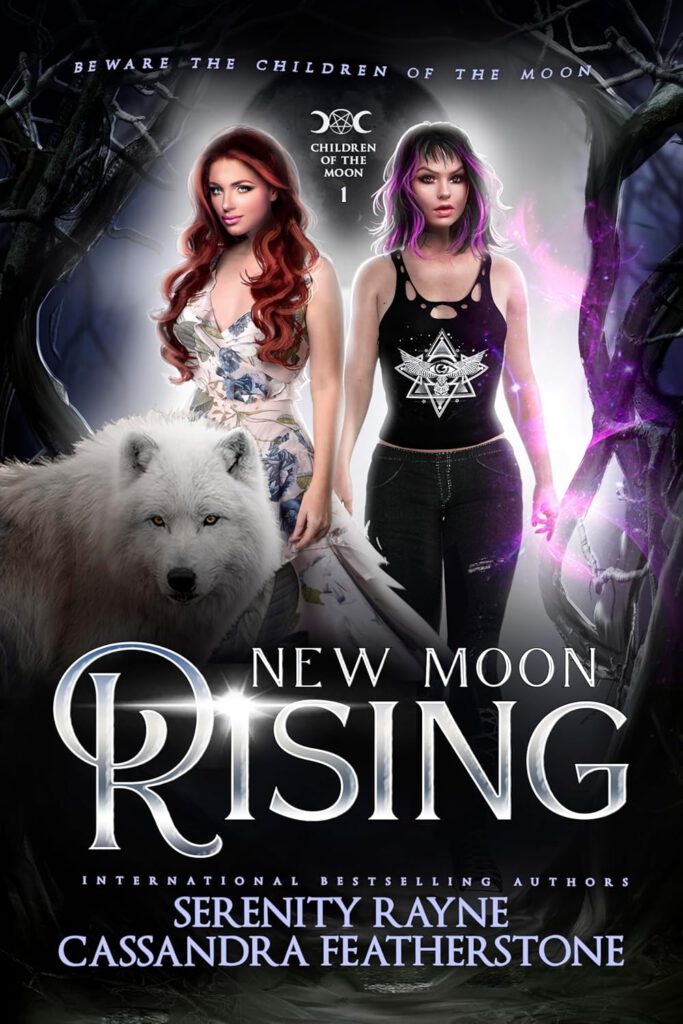
Book one of the Children of the Moon series. Two sisters step into the Ascension circle expecting the magic that will finally let them chase the truth about one sister's past, and instead learn that one of them is a powerless witch and the other is not a witch at all but a wolf. The High Mage declares them worthless, no mates and no power, and while they are being shamed in front of the whole community, someone leaves an ominous threat in the ashes of their burned-down home. A steamy paranormal reverse-harem romance, the first of a planned six books.
Plot Summary (spoiler-free)
Twin sisters Fiadh and Feray Morgenstern have spent their whole lives believing they’re both witches, with Fiadh the gifted one and Feray the family “dud” who can’t cast a single spell. At their Ascension ceremony, the ritual where every young witch in the city of Briarvale is supposed to receive her full power and meet her fated mate, everything goes wrong in public and at once: Fiadh’s magic doesn’t manifest as promised, Feray turns out to be a wolf shifter and not a witch at all, and neither of them appears to have a mate. The city’s High Mage seizes the moment to declare them worthless in front of the entire community, and the sisters are shunned on the spot. That same night, the bar and apartment belonging to Philly, the satyr who’s been their found-family father figure since their parents’ deaths, burns to the ground.
Cast out of witch society and homeless, Fiadh and Feray take jobs at a vampire-owned BDSM nightclub and slowly rebuild, only to discover the Ascension lied to them twice over: they do have mates, several each, who simply weren’t present at the ceremony because witches and shifters and Fae don’t all attend the same rites. As the sisters settle into new poly households with their respective partners, they start pulling on a thread that runs from a mysterious symbol carved into Philly’s back after a second attack, back to their parents’ unsolved, deeply suspicious deaths three years earlier, and into a prophecy that names the sisters the “Children of the Moon,” destined for a battle neither of them understands yet.
Character Development
Fiadh. The elder-by-minutes twin and the one raised to believe she was the “real” witch, Fiadh’s entire personality is built around control: brass knuckles in her pocket, a scowl as a first response, and a bone-deep refusal to let anyone see her as anything but self-sufficient. Her rage isn’t random; it’s a direct trauma response to a childhood defined by being bullied for having no money or connections, compounded by watching her parents die in an accident she’s never fully believed was one. Her arc is a slow, grudging surrender of control: to a mate bond she can’t logic her way out of, to a family unit that keeps insisting on paying for things, to the idea that trusting people doesn’t automatically mean losing them. Her magic, once it finally arrives, is explicitly tied to her emotional state rather than her will, which is a clever bit of character design: the more she tries to white-knuckle her way through a crisis, the less control she actually has over what she’s throwing around the room.
Feray. The book’s true emotional center. Raised believing she was a magically disabled witch, Feray discovers on the same catastrophic night that she’s a wolf shifter, and by the book’s midpoint, that she isn’t even Fiadh’s biological sister at all: she was smuggled out of a nursery as an infant, her wolf magically suppressed by an amulet, after her actual parents (whose names she only learns near the end) were slaughtered by something powerful enough to leave no evidence behind. Where Fiadh copes with anger, Feray copes by nurturing: baking, hosting, decorating, mothering everyone in range, including her own sister. The book is honest that this is also a trauma response, not just a sweet personality trait, and it pays off in a genuinely moving late reveal that Feray is a “Luna,” a rare, naturally dominant bloodline that can override an Alpha’s command by will alone, which recontextualizes her whole “soft one” identity without erasing it.
The mates. This is where the book does its most interesting work, because eight distinct men (soon likely nine) end up courting the two sisters, and remarkably few of them blur together. Tiernan (a snow leopard bodyguard) and Torben (a Kodiak bear contractor) are the first mates for Fiadh and Feray respectively, and both are written as patient educators, guiding the sisters through everything the witches’ insular, propaganda-laden schooling never taught them about the rest of supernatural society. Prince Revelin, the Fae rockstar heir Fiadh mates with, uses performance and a manufactured bad-boy persona to survive an abusive, controlling father, and the book lets that vulnerability show through the glitter. Twin basilisks Khol and Khal Bedia split the courtship duties, with gentle Khal falling for Feray while volatile, casually vicious Khol pursues Fiadh; Khol in particular is genuinely disturbing in his day job running torture sessions for a drug cartel, and the book’s tonal choice to play those scenes for dark comedy sits uneasily against the romance being built around him in the very same chapters. Dezi, the centuries-old vampire club owner, is the most psychologically guarded of the group, resisting the bond because of a past companion’s overdose and kidnapping disaster that cost him his anonymity once before; his slow thaw is one of the book’s better-earned arcs. Diaval the dragon banker and Dr. Easton Bennu the phoenix doctor round out the group as Feray’s remaining mates, both written as emotionally armored men whose centuries or professional decorum crack specifically because Feray refuses to let them hide behind status.
Side characters earn their space, too: Philly, the satyr who took the girls in as teenagers and remains the emotional anchor of their old life even from a hospital bed; Dezi’s doorman Louie, whose grudging thaw from bigoted jerk to genuine friend tracks in real time across the book; and the wolf elders (Roman, Marcus, the archivist Thoth) who supply Feray’s origin-story reveals without ever feeling like exposition machines on their own.
Themes
The book’s central theme is the gap between institutional lies and lived truth. The witches’ Ascension ceremony, the sisters’ entire education, even the small daily assumptions they were raised with, all turn out to be a system deliberately built to keep bloodlines “pure” and its subjects ignorant enough not to ask questions, and the book is explicit that this is a form of control, not an accident of tradition. Running alongside it is a found-family theme made literal: Fiadh and Feray aren’t biologically related at all, which means the sisterhood the whole book is emotionally built on was a choice from the very people (their parents) who also chose to lie to them, and the same pattern repeats with every mate who chooses the sisters over blood, status, or the safer path. Bullying and social hierarchy recur constantly, from the Ascension humiliation to a recurring mean-girl antagonist, and the book is clearly invested in the idea that cruelty dressed up as tradition or status is still cruelty. The one theme the book handles less confidently is consent and possessiveness within its own polyamorous structure: it repeatedly names “jealousy” and “possessive alpha holes” as content warnings and plays territorial marking, claiming, and public dominance displays as romantic wins, without much interrogation of what that means for a heroine whose entire character arc is supposedly about reclaiming control over her own life.
Writing Style and Effectiveness
The book alternates first-person POV between the sisters chapter by chapter, and the two voices are genuinely distinct: Fiadh’s chapters are profane, fast, and driven by internal one-liners, while Feray’s are softer, more sensory, and quicker to name her own feelings. The dual-author collaboration (Rayne and Featherstone write different POV characters) holds together well; nothing in the prose signals which author wrote which section. The comedic voice is a major asset and does most of the heavy lifting for the book’s pacing, leaning on internet-native humor (memes, pop culture references, running gags about glitter and “craft herpes” from Fiadh’s out-of-control magic) that lands more often than not, though it occasionally deflates scenes that are trying to be tense or frightening.
The book’s biggest structural weakness is pacing against plot. An enormous amount of page space goes to domestic and courtship beats: shopping trips, a teddy bear picnic, multiple breakfast scenes, house renovation details, page after page of the mates competing to spoil the sisters. Meanwhile the actual inciting mystery (who murdered the sisters’ parents, what the symbol means, what “Children of the Moon” and “when the eight are sealed” actually refer to) is introduced early and then mostly held in place rather than developed, with real movement on it confined to a handful of chapters near the very end. World-building is genuinely large and imaginative (four distinct Fae courts, dragon hoarding culture, basilisk physiology, phoenix mating customs) but it’s delivered almost entirely through characters explaining things to each other in dialogue rather than being dramatized on the page. The spice content is frequent, explicit, and handled with real creative specificity for non-human anatomy, but some of the most sexually charged scenes arrive in the middle of scenes that are supposed to be building danger or grief, which blunts both.
Conclusion
New Moon Rising is, first and foremost, a courtship serial dressed in urban fantasy clothing: it spends the overwhelming majority of its considerable length establishing eight distinct romantic bonds and a blended found-family household, and it does that specific job well. No two mates read as interchangeable ab-havers, each courtship answers a different emotional need for whichever sister they’re paired with, and the found-family theme has real teeth once the biological-sister twist lands. Where it falls short is the mystery/urban-fantasy half of its own premise: a murdered-parents conspiracy, a hidden prophecy, and a genuine threat are all set up in the opening chapters and then largely parked for four hundred pages of domestic bliss before the book ends on a hard, unresolved cliffhanger. Set against other whychoose/reverse-harem paranormal romance, it distinguishes itself by actually differentiating its enormous cast rather than treating the harem as a numbers game, but it reads much closer to a soap-opera relationship serial than the mystery-driven fantasy its prologue promises, and readers hoping for the latter will need to wait for book two.
Evaluation
- Overall Rating: ★★★☆☆ (3/5)
- Writing Style: ★★★☆☆ (3/5): genuinely funny, well-differentiated dual POV voices, weakened by heavy dialogue-exposition and tonal whiplash between played-for-laughs banter and genuinely dark material
- Characters: ★★★★☆ (4/5): a rare feat in this genre, an eight-plus-person mate cast that’s actually distinguishable, paired with real psychological depth in both sisters’ trauma responses
- World-Building: ★★★☆☆ (3/5): imaginative and expansive across multiple supernatural societies, but delivered through dialogue dumps rather than dramatized, and the book’s own central mystery is left almost entirely undeveloped by the end of book one
- Spice Rating: ★★★★★ (5/5): frequent, explicit, and graphic content throughout, including significant creative specificity around non-human anatomy across multiple partners
Trigger warnings: BDSM, violence and bullying outside the main family group, PTSD, body dysmorphia, impact play, body modification (piercings, tattoos, brands), casual sex, mention of self-harm, masturbation, voyeurism, bondage, shifted sex, rough sex, biting, marking, mating, orgasm control, submission, blood play, death (outside the family group), drug and alcohol use, primal play, knotting, parental death, unusual genitalia, multiple partners and harems, threats of violence, injury to a main character’s friend, jealousy and possessive dynamics, murder, graphic torture, magical sex, talk of heat cycles, emotionally abusive relatives, and strong language throughout.
Recommended for readers who love an expansive, everyone-gets-a-soulmate whychoose ensemble and want to ship a large cast rather than watch a tight single couple; fans of found-family paranormal romance where blood ties get replaced by chosen ones; readers who want their heroines armed and mouthy rather than passive; and anyone who enjoys heavy banter and humor woven through their spice, more than readers looking for a tightly plotted mystery to resolve in book one.