A Tale Told By Traitors by Renee Dugan | Book Review
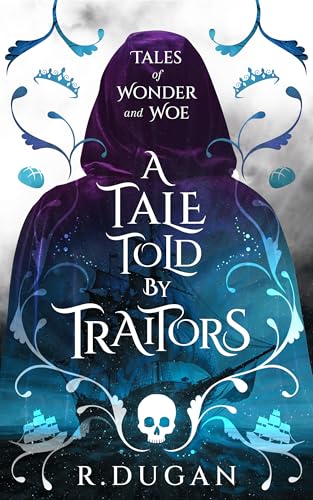
TALES OF WONDER AND WOE is a series of sequential standalones, each a new romantic fantasy adventure. In book two, Lionyra Vara is a humble immigrant baker hiding a bitter secret: she is the sole inheritor of the ruling regime in the neighbouring country of Amere-Del. Against her will, Lio is going back to the land of her worst fears, and she will not be going alone. The life of her oldest friend hangs in the same cruel balance.
Ryker Kassian is a man caught between desperation and redemption, a legendary pirate swimming in insurmountable debt who sees only one way to slip the noose for himself and his crew: by offering the runaway heir as ransom for a lofty sum. But when Lio offers him something more, a chance to help her hunt down her missing friend first, Ryker seizes it. As their search takes them to hidden pirate cities, sinister port towns, and the treacherous heart of a country on the edge of civil war, all of their secrets and schemes collide, along with a rising attraction they both deny.
Plot Summary (spoiler-free)
Lionyra Vara has spent years building a quiet life as a baker in the port city of Krylan, and hiding, badly enough that it finally catches up with her: the woman hunting her is Lucretzia Nore, the Del’s Own Blade, and the truth Lucretzia drags to the surface is that “Lionyra” is really Alyona Graven, the long-lost heir to the throne of Amere-Del, being hauled home to be married off to a dissident leader as a political peace offering. Aboard the ship carrying her back, she strikes up an easy, unplanned friendship with a deckhand named Bastyan, who turns out to be Ryker Kassian, a pirate captain sailing under a false name specifically to claim her as ransom. What follows is a bargain struck between captor and captive: Lionyra will help Ryker double his payday if he helps her first find Tristah, the decoy and true sister-in-arms she left behind years ago, before Lucretzia can use her as leverage instead.
The search for Tristah pulls both of them through a pirate stronghold built on debt and cruelty, a city simmering with a rebellion led by a masked figure called the Incendiary, and eventually into open war with the Old Salts who profit from misery on every side of Amere-Del’s civil unrest. Loyalties shift, disguises come apart, and by the time the trail leads back to the throne itself, the question isn’t only whether Lionyra can save the people she’s come to love. It’s whether the woman she used to be, and the throne she was born into, will let her go.
Character Development
Lionyra/Alyona carries the book’s whole emotional architecture, and the book earns that weight. Her governing mantra, repeated at every real turning point (“eyes wide open, take power where you can”), is Lucretzia’s own training turned back against her, and that inversion is the character’s real engine: everything Alyona was beaten into being, the composure, the calculation, the willingness to act, becomes the toolkit Lionyra uses to save the people Alyona never got to choose for herself. Her arc from soft-spoken baker to a woman willing to poison a tyrant and swallow the same poison as cover is not softened at the edges. She grieves every death her choices cause, including the ones she causes directly, and the book lets that grief sit rather than resolving it neatly.
Ryker Kassian, introduced as the deckhand Bastyan before the reveal that he’s Captain Blackhand, gets the book’s second full POV, and it’s the right call. Seeing the same deception from inside his own head, a boy sold into slavery by his parents who built himself into a pirate captain out of sheer necessity rather than appetite, keeps him from reading as a stock morally-gray love interest. His real conflict isn’t whether he loves Lionyra; it’s whether he can stop treating people, including her, as debts to be managed rather than as people to be chosen. The moment he actually chooses her over the ransom is earned in stages, not delivered all at once, and his late realization that he’s spent the whole book becoming someone his own crew respects more than they ever respected Blackhand is one of the book’s most honest character beats.
Tristah Levanthya, Lionyra’s childhood decoy, is the book’s most interesting structural choice. For most of the novel she’s presented, and believed by nearly everyone including her own spymaster, to be the real Delina, and the reveal that she was always the decoy recontextualizes every scene she’s had. Her fury at Lionyra for endangering her cause reads as real and earned rather than a manufactured obstacle, and her eventual choice to become Amere-Del’s actual ruler, with Lionyra’s blessing and Lionyra’s staged death clearing the way, gives the book’s central sisterhood a genuinely bittersweet, non-romantic ending that most books in this genre wouldn’t have the patience for.
Killian Brax (“Ember”), Tristah’s spymaster and a Storycrafter whose magic went dark years before the story starts, is drawn with real specificity: a man defined by confinement-phobia and controlled fury who only lets himself feel in front of Tristah. His power’s sudden return, tied directly to endings and the stories he tells himself to survive, is thematically tidy without feeling cheap, and his blunt, prickly rapport with Ryker (each openly needling the other while clearly respecting what the other’s willing to do for the women they love) is some of the book’s best comic relief.
Lucretzia Nore, the Pale Viper, is a genuinely frightening antagonist precisely because her cruelty is procedural rather than theatrical. She doesn’t relish violence for its own sake; she treats it as a tool for shaping people, and the book is careful to show exactly how that shaping produced both Lionyra’s and Tristah’s reflexes for violence, which makes her death at Tristah’s hands land as reclamation rather than simple revenge.
Siu and Gydeon Nassar, the Singer’s First Mate and healer, anchor the crew’s emotional core. Their courtship story, told twice, once as banter and once, devastatingly, as the truth of Siu’s abuse under a previous crew and Gydeon’s vengeance on her behalf, is one of the book’s most effective uses of a “we thought we knew this couple” reveal. Wilkes, a former militar man turned quartermaster, and Klement, Kato, and Kory Drace, three siblings raised by each other after their mother’s death, round out a crew that reads as a real found family rather than a roster of quirky sidekicks, which makes Kory’s death partway through genuinely painful rather than a plot beat. Camden, the crew’s youngest, gives the book its clearest lens on what this life costs even the survivors.
Themes
The book’s clearest theme is that identity is something you build, not something you’re handed: Lionyra, Alyona, Bastyan, Ryker, and Blackhand are treated as genuinely different people wearing the same body, and the story’s real climax isn’t a battle, it’s Lionyra choosing which of those names to keep. Tied tightly to that is a theme about inherited cruelty and whether it can be redirected rather than simply repeated: Lucretzia’s training methods live on in both Lionyra and Tristah’s fighting instincts, and the book is honest that neither woman fully escapes that inheritance, only learns to aim it somewhere she’s chosen. A third thread, less flashy but genuinely well-developed, is the economics of exploitation: Korsa’s pirate debt system and the human trafficking dressed up as crew recruitment give the book’s political stakes real texture, connecting Ryker’s personal history directly to the systemic cruelty Tristah is trying to dismantle as the Incendiary. Found family versus blood runs under all of it, most explicitly in Tristah and Lionyra’s chosen sisterhood, but it’s the Drace siblings and the Singer’s crew, not just the central pair, who carry that theme through the book’s back half.
Writing Style and Effectiveness
Dugan’s dual first-person structure, alternating Lionyra’s chapters with Ryker’s, is the book’s strongest formal choice: it lets the central deception land twice, once as betrayal and once as regret, and it means the romance’s slow thaw is never one-sided on the page. Ryker’s chapters lean into a distinct, salt-cured vernacular (“‘ay,” “depths,” “sweetheart”) that’s consistently voiced and genuinely differentiates his sections from Lionyra’s more introspective, simile-heavy prose. That said, the baking metaphor that defines Lionyra’s voice (kneading, folding, batter, dough standing in for nearly every emotional beat she has) is leaned on so constantly that it starts to blunt itself well before the halfway mark; a reader will know exactly what “I pressed my grief into the dough” means the fifth time and the fiftieth. The action sequences, particularly the ship’s passage through the Spear Teeth and the multi-front siege on Shadewyle Castle, are genuinely well-choreographed, with clear stakes and legible geography even across a large cast. The book’s real structural weakness is its middle third: the extended search through Bashir’s gambling dens and safehouses, while thematically purposeful, repeats its own beats (another lead, another dead end, another day of waiting) enough times that momentum stalls before Tristah’s reveal reignites it. The sheer number of named side characters who die in quick succession during the Bashir and Korsa sequences (Rhea, Wyst, Kory, Willy, Julas, Frixia, Cook, Henriet, and more) lands as a genuine gut-punch in aggregate, but a few of those deaths happen to characters the book hadn’t yet given enough page time to earn the full weight it’s asking for.
Conclusion
A Tale Told By Traitors is an ambitious, largely successful epic fantasy romance that trusts its readers with real political stakes, a genuinely earned non-romantic sisterhood at its emotional center, and a dual-POV structure that makes its central romance feel lived-in rather than performed. Its clearest strength is refusing easy answers about identity and inherited violence: Lionyra’s path to poisoning a tyrant and Tristah’s path to the throne both cost something real, and the book lets both women carry that cost rather than absolving them of it. Its clearest weaknesses are a metaphor that wears out its welcome and a middle section that repeats itself before the plot’s second half finds its footing again. Set against other multi-POV epic fantasy romances built around found-family pirate crews and hidden royal identities, it distinguishes itself with a genuinely thoughtful class critique (Korsa’s debt economy, the trafficking of orphans and debtors alike) that most books in this exact subgenre don’t bother building in, and with an ending confident enough to let its heroine walk away from the throne entirely rather than claim it. It runs long, and it asks for patience through its baggiest stretch, but the payoff at Shadewyle Castle and in the quiet epilogue that follows genuinely earns the length.
Evaluation
- Overall Rating: ★★★☆☆ (3/5)
- Writing Style: ★★★☆☆ (3/5): a well-executed dual-POV structure and genuinely strong action set pieces, undercut by an overused central metaphor and a baggy middle third
- Characters: ★★★★☆ (4/5): Lionyra, Ryker, Tristah, and Killian are all genuinely well-drawn with real psychological throughlines; the Drace siblings and the Singer’s crew read as a real found family rather than filler
- World-Building: ★★★★☆ (4/5): Korsa’s debt economy, the Everreach’s civil-war stakes, and the Storycraft system give the political backdrop real texture, even where the sheer volume of named cities and factions asks a lot of the reader
- Spice Rating: ★★☆☆☆ (2/5): real romantic and physical tension throughout, but the book fades to black before anything explicit; a few passionate scenes, nothing graphic
Trigger warnings: child abuse and forced combat training, graphic torture (including a deliberate finger amputation and repeated whipping), kidnapping, forced/arranged marriage, child trafficking and slavery, execution and mass character death, and a staged public hanging.
Recommended for readers who want their found-family pirate crew fantasy paired with a real political backbone rather than pure escapism, anyone who likes a slow-burn romance told from both sides of the deception, and fans of hidden-royal-identity stories willing to sit with a long, patient middle in exchange for a genuinely earned ending. Less recommended for readers who want their epic fantasy tightly paced throughout; this one asks for real patience through its Bashir stretch before the plot’s second half rewards it.