The Arcane God by M.M. Parks | Book Review
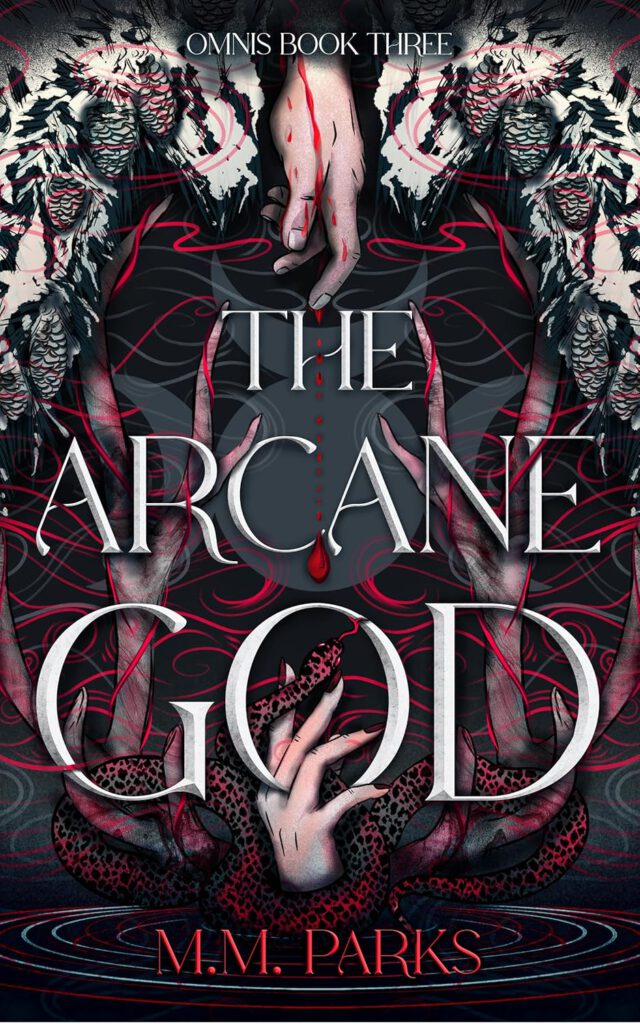
The finale of the Omnis trilogy. Picking up right after The Unknown Daemon, a pregnant Ena, her husband Ty, and their friend Turner are crossing the brutal, unmapped Chasm Mountains, sent by a seer's warning to find Ty's long-estranged mother and a group who worship a god called Omnis before a foretold danger catches up with them. A river crossing goes wrong early and splits the party, and what begins as a survival trek becomes something larger: real answers about who Ty's mother is, a discovery about Ena's own bloodline, and, back in the Underworld, the long-building reckoning with King Cole. A witchy romantasy conclusion for readers of The Knowing Witch and The Unknown Daemon.
Plot Summary (spoiler-free)
The book opens immediately after The Unknown Daemon: a pregnant Ena, her husband Ty, and their friend Turner are crossing the brutal, unmapped Chasm Mountains, sent by a seer’s warning to find Ty’s long-estranged mother and a group of “Omnis” worshippers before a foretold danger catches up to them. A river crossing goes wrong early on, and the search for what happened splits the party’s fortunes for weeks, forcing Ena and Turner to keep moving without answers while grief and a string of strange new symptoms take hold of Ena. What starts as a survival trek turns into something bigger once they reach the other side of the mountains: real answers about who Ty’s mother is, why she left, and a discovery about Ena’s own bloodline that reframes her cravings, her Gift, and her marriage to Ty all at once.
Back underground, the Underworld hasn’t stood still. King Cole’s grip on power is fraying, and the people who love Ty and Ena are working, at real personal risk, to make sure there’s still something worth returning to. The back half of the book pulls every thread home: the political and blood-debt reckoning with Cole that’s been building since book one, and a multi-party negotiation that has to invent, from scratch, a place in this world for a family, and a people, that fit none of its existing rules.
Character Development
Ena spends this book discovering she isn’t only what she’s always believed herself to be. A hidden third bloodline surfaces through an escalating, genuinely frightening set of blood cravings, and the horror of it isn’t abstract: the sharpest early scene in the book is Ena catching herself mid-intrusive-thought, calculating how she could hurt someone she loves to get more blood. That fear of turning into a danger to the people, and eventually the child, she loves most runs under everything else she does this book. Her resolution doesn’t crown her queen; daemonic succession structurally has no room for a witch on the throne, and rather than let that be a defeat, the book has her invent an entirely new role for herself, one built on the actual skill she’s spent three books demonstrating: standing between people who don’t trust each other and making them listen anyway.
Ty spends most of the book physically apart from the story’s center of gravity, and that separation does real character work rather than just plot work: it forces both him and Ena to prove they can function, and grieve, without each other before the book will let them reunite. When he does return, his arc closes on a more honest reason for his lifelong reluctance to be king than simple protectiveness of Ena. He admits, plainly, that kingship has always meant suppressing the witch half of himself the Underworld never wanted to see, and that the exhaustion of hiding that, not just fear for his family’s safety, is what’s kept him running from the throne. Learning the real, ugly truth about how his father died gives him closure without pretending grief resolves cleanly just because the facts finally arrived.
Turner gets the most genuine expansion of anyone in the cast. He’s spent two books as comic relief and loyal third wheel, and this book finally gives him his own stakes: a real, unplanned relationship with a stryx woman that catches even him off guard, and an insecurity underneath his easy humor that he says out loud almost as an aside, that he doesn’t expect anyone to actually choose him. His claiming by his mate isn’t played as a punchline for long before the book lets him be honestly scared of it, and honestly happy too.
Kaya, Ty’s estranged mother, could easily have been either a saint or a plot device explaining her own absence away. Instead she’s someone visibly still working through the guilt of the choice she made decades ago, offering real help without demanding forgiveness for it, and the book lets Ty’s anger at her sit unresolved for a long stretch rather than rushing a tidy reconciliation.
Max, the stryx elder and Kaya’s own mate, functions as both the book’s exposition engine for stryx culture and a quiet mirror for Ena and Ty’s situation: his own decades-old bloodmatch bond to Kaya is the lived precedent that makes Ena’s diagnosis legible, and his patience in explaining an entire foreign belief system to strangers without condescension is one of the book’s warmer running notes.
Xena, Ty’s half-sister, is blunt to the point of rudeness for most of the book, and that bluntness turns out to be a genuine character trait rather than a flaw to be softened; she claims Turner as her mate on her own terms and defends the choice in a room full of daemons without flinching. Steig and Lara, a married daemon couple caught directly under Cole’s thumb, carry a real subplot of divided loyalty and quiet sabotage: Steig is sent to hunt Ena and Ty and instead chooses to become their spy at real risk to his own family, and Lara turns out to be the sharpest political mind in the room once the book reaches its negotiating table, engineering the compromise that lets Ena stay without breaking daemonic law. Zak, previously a flat loyalist enforcer, gets a real complication when it’s revealed he followed Cole more out of fear than actual belief, and that he was, once, a decent uncle to Ty before Cole’s reign hardened him. Nial, an elder daemon freed from his collar, becomes the negotiation’s institutional memory, and Mel, the Occidens seer, closes the book with a piece of prophecy about Ena and Ty’s son that’s unsettling enough to leave real tension hanging into whatever the series does next.
Themes
The book’s central argument is that survival sometimes means becoming something you didn’t choose to be, and that the right response to that isn’t to force it back into an old shape but to build a new one. Ena’s stryx heritage, Ty’s mixed daemon-witch nature, and the book’s eventual political solution are all versions of the same idea: existing categories (witch or daemon, queen or nothing) fail these characters, and the honest answer is to invent a category that actually fits, rather than making a person smaller to fit an old one.
Running underneath that is a real interrogation of inherited harm and what’s owed for it. Kaya’s absence from Ty’s life, Cole’s decades of cruelty, the blood spilled in the opening Ascension attack: none of it gets waved away with an easy apology. The book insists that reckoning with the past and building a livable future aren’t the same task, and it refuses to let one substitute for the other. And running through both of those is the trilogy’s closing argument about power itself: that lasting peace between historically hostile groups comes from pragmatic, patient negotiation, not from a single decisive battle or a marriage fixing everything by itself.
Writing Style and Effectiveness
The book’s real technical achievement is its handling of point of view. This isn’t the dual Ena/Ty structure the earlier volumes used; a full read shows the story rotating through at least five perspectives, Ena, Ty, Turner, Steig, and Greya, sometimes jumping backward in time with an explicit “X weeks ago” marker to reveal what was happening underground while the mountain party had no way of knowing. That’s a genuinely harder structure to pull off than a simple dual-POV alternation, and for most of the book it works: the reader gets to feel the dramatic irony of Steig’s compromised loyalty, or Greya’s political bind as new matriarch, while Ena and Ty remain in the dark about it, which raises the stakes of their eventual reunion with information they don’t have.
The prose itself stays in the same plain, functional, dialogue-forward register the series has used from book one, with banter still doing a lot of the emotional heavy lifting between explicit scenes. Where the book earns real craft credit is in its willingness to sit inside body horror without flinching; the stryx Change sequences in particular are rendered with a level of physical specificity that makes an inherently strange piece of worldbuilding feel visceral rather than merely described. The dialogue-heavy method of delivering worldbuilding (long stretches of Max or Kaya explaining stryx custom to Ena and Turner) is efficient but occasionally tips into information dump, especially in the middle third when several major revelations (bloodmatch, stryx heritage, the Aquilo-seer legend all being literally true) land back to back in the same handful of scenes.
Conclusion
The Arcane God closes its trilogy by refusing the easiest version of its own ending. It could have handed Ena a crown; instead it makes her build a role that’s never existed before, and that choice is the book’s real thesis in miniature: that surviving impossible circumstances sometimes means inventing new structures rather than squeezing into old ones. The five-way rotating POV is the book’s most genuine formal achievement, letting the Underworld’s slow-motion political collapse run in parallel with the mountain survival story without ever losing the thread of either, and the side-cast finally gets room to be more than furniture, particularly Turner, whose fear of being unloved gives the book’s lightest character real weight, and Zak, whose loyalty gets a real, human explanation instead of a villain’s shrug.
Where it’s weaker is in how quickly some of its heaviest stakes get resolved once the plot needs them to. The bloodlust subplot spends real time building the horror of Ena possibly losing her mind and hurting someone she loves, then resolves cleanly the moment Ty returns and offers his blood, which softens tension that had been built up as potentially fatal. The stryx culture itself, while rendered with real physical detail, leans more on familiar shifter-and-blood-bond genre furniture (mates for life, a partner’s blood as literal sustenance) than the daemon Underworld’s more inventive social structure managed in book two. And as a trilogy closer, it leans hard on two books’ worth of continuity; a reader arriving without them would be lost inside the first few chapters. Set against other dark fantasy romance trilogy closers, what distinguishes this one is its refusal to end on a battle: the climax is a negotiating table, not a sword fight, and the book’s real accomplishment is making that table feel as high-stakes as any fight scene would have.
Evaluation
- Overall Rating: ★★★★☆ (4/5)
- Writing Style: ★★★★☆ (4/5): the five-way rotating POV structure is genuinely ambitious and mostly lands; still plain, commercial prose overall, with some information-dump stretches in the middle third
- Characters: ★★★★★ (5/5): real growth for Ena, Ty, Turner, Zak, and Lara, closing with a genuinely non-formulaic resolution instead of a predictable crowning
- World-Building: ★★★★☆ (4/5): the stryx culture is textured but leans on familiar genre tropes; the political payoff across all three peoples lands well here
- Spice Rating: ★★★★☆ (4/5): frequent, explicit scenes across the book, including some kink content, comparable to book two rather than book one’s lighter touch.
Trigger warnings: profanity, violence, death, animal death/dismemberment, grief/loss, pregnancy, childbirth, mental health issues (including anxiety, panic attacks, and postpartum depression), and explicit sexual content.
Recommended for readers who’ve already read The Knowing Witch and The Unknown Daemon and want the trilogy’s central tension resolved in a genuinely inventive way rather than a predictable crowning; readers who enjoy a dark fantasy romance closer built on negotiated political change instead of a final battle; readers who want an ensemble cast where the side characters get real arcs, not just support roles; not a good entry point for new readers, since this book assumes full familiarity with the first two.