Remnants of Riley by A.M. Wagner | Book Review
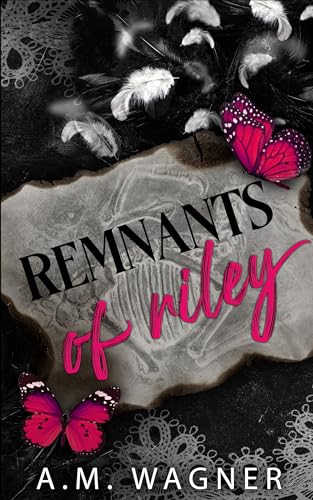
Emmett Raythorne is everything I shouldn't want. Chance brought us together, a temporary business relationship, yet he's insisted on staying, taking over, and driving me mad. The worst part? I'm finding it hard to deny him, as if I've learned nothing from my past. I'm trying to start over, to build a path for myself and slowly heal from the nightmare of my former life. But Emmett won't stop. He won't leave me alone. And his sinful gaze has me caving, giving in to all the things I said I never wanted again. I just hope there's something left of me in the end.
Overview
Remnants of Riley is A. M. Wagner’s debut, the first book in the Fractured Souls series, self-published in May 2024. It’s a contemporary dark romance with a stalker at the centre and a kidnap-and-recovery arc that fills the whole back half. It’s told in first person, present tense, alternating every chapter between the two leads, with a couple of extra points of view held back for the epilogues. Wagner’s own content-warning page up front is long and specific, and she means all of it.
Plot Summary (spoiler-free)
Riley Miles is a secretary in her mid-twenties who moved back to the DC area to start over after leaving an abusive ex. Her best friend Tracy, a luxury realtor, has just helped her buy a tiny cabin on ten wooded acres, the first thing that’s felt like hers in years. Emmett Raythorne steps in to cover the closing while Tracy is out of the country. He’s a New York real-estate shark who launders money for people you don’t say no to, and the moment he meets Riley he decides she belongs to him.
What follows is not a courtship. Emmett copies her keys, tracks her phone, puts cameras in her house, sells her car, and muscles her boss into a deal that only closes if Riley comes to work for him. She fights him at every turn and keeps losing ground, partly because some buried part of her wants to. They fall into something real, or real enough.
Then the notes start. Flowers with no card, a word left where she’ll find it, small violations that build into something much worse. Someone has been watching Riley for months, and it isn’t Emmett. When that person finally moves, the book turns into a survival story, and then into a long, patient account of what’s left to put back together afterward. Book one ends with the couple standing, and with two more threads pulled tight for the sequels.
Character Development
Riley is the reason to read this. Her chapters live inside her head, and Wagner is good at that head: the finger-tapping ritual she uses to talk herself down, the way she narrates her own habit of running from anything hard, the specific shame of realising she likes being controlled in bed after a man nearly killed her doing a twisted version of the same thing. Tracy says the useful thing out loud, that dominance and abuse are not the same, and the book lets Riley take a long time to believe it. Her arc runs from the woman who hides in the corner and waits for the danger to pass to a woman who can say what she wants and mean it, and the last third earns that shift instead of just announcing it.
Emmett is a type, and it’s executed well without much more done to it. He’s obsessive, possessive, casually criminal, and secretly soft for exactly one person. His chapters are mostly him explaining to himself why the stalking is love. The book knows this is a problem. Trevor, the ex, says it flat out during the worst scene in the book: we’re the same, you and I. Emmett carries that line for the rest of the story, and it clearly eats at him. What the book never quite does is answer it. The resolution amounts to Emmett loving her when the other man didn’t, and Emmett telling her about the cameras now instead of hiding them. The surveillance gets reframed as devotion rather than given up.
The supporting cast is thin. Tracy is warm and funny and holds her scenes. Trevor is a monster with no inside to him at all, which makes him easy to hate and hard to find frightening the way a more human villain would be. Jax and Blake are mostly there to set up the next two books.
Themes
Control is the whole engine. Who has it, who takes it, what it costs to hand it over. Riley’s history with Trevor was control stripped away by force. Her relationship with Emmett asks whether choosing to give some of it up can be a different thing, and the book’s honest answer is a shrug: it depends entirely on the man, and you won’t know until it’s too late to matter. Wagner sits in that discomfort more than she resolves it, which I respected even when I wanted her to push harder.
Under that is a quieter idea about property. Emmett’s whole philosophy is that whoever owns the land owns the people on it, and the plot keeps proving him right, from Riley’s fake mortgage to the buildings he strips for parts. It’s a sharper spine than most books in this lane bother with.
Then there’s recovery, which gets more page time than either the romance or the thriller. Riley’s PTSD is on the page in detail, the panic attacks and the intrusive thoughts and the therapy that helps unevenly. The scar-camouflage tattoo scene late in the book, where the entire point is that Riley gets to decide what to do with her own body, is the clearest statement the book makes, and it’s a good one.
Writing Style and Effectiveness
The prose is clean and quick and keeps you turning pages. The alternating present tense suits a story this claustrophobic. Where it wears thin is repetition. Certain phrases come back so often they stop meaning anything, and the sentences fall into the same rhythm over and over, especially in Emmett’s chapters, where every declaration of love arrives as a stack of three short lines. The sex is frequent and explicit and built almost identically each time.
The two halves of the book are not equal. The captivity and recovery chapters are specific and unflinching and clearly where Wagner’s attention is. The rescue plot that connects them runs on luck: one traffic camera, a friend who can hack anything, a hitman who vanishes for five weeks and then walks in with the answer. It moves the couple where they need to be without ever feeling earned.
Conclusion
Remnants of Riley is a solid entry in extreme dark romance, and it’s better than its plot. Riley is what makes it work. The book takes her interior life seriously, and her recovery even more so, refusing to rush it or tidy it into something neat. The weaker parts are around her: a hero who never once surprised me, a villain with nothing inside him, a rescue that runs on coincidence, and prose that keeps reaching for the same handful of moves. It raises a genuinely uneasy question about whether devotion and possession can be told apart, and it earns some credit for not pretending it has a clean answer. If the far end of the genre is where you live and the content list doesn’t stop you, this is worth your time. It’s a first book, and the ambition is real.
Evaluation
- Overall Rating: ★★★★☆ (4/5)
- Writing Style: ★★★☆☆ (3/5): clean, fast, and well suited to the claustrophobic present-tense format, but heavy on repeated phrases and a repetitive three-beat rhythm, especially in Emmett’s chapters.
- Characters: ★★★☆☆ (3/5): Riley’s interior life and her recovery arc carry the book; Emmett is a competent archetype who never surprises, and Trevor is a villain with no interior at all.
- World-Building: ★★★☆☆ (3/5): the contemporary DC setting and the “own the land, own the people” theme give it a sharper spine than most in the lane, but the money-laundering layer is sketchy and the prison-smuggling conspiracy strains belief.
- Spice Rating: ★★★★★ (5/5): frequent, graphic, and escalating, with impact play, degradation, praise kink, and a consent dynamic that stays deliberately blurred.
Trigger warnings: graphic on-page rape (vaginal, anal, forced oral), domestic violence, captivity and starvation, torture and mutilation including a word carved into the heroine’s back and a man tortured and burned alive, stalking and total non-consensual surveillance, dubious and non-consent, on-page suicidal ideation and intrusive suicidal thoughts, parental suicide and overdose in backstory, graphic killing of pet animals, graphic violence and gore, murder, kidnapping, financial coercion and control, impact play, degradation, and a severe power imbalance between the leads.
Recommendation: for readers who want the hard end of dark romance, an obsessive criminal hero, a stalker plot that becomes a captivity-and-recovery story, and a heroine whose healing gets as much room as her ordeal. Good fit if you got on with the darker Cat and Mouse Duet register but want something more grounded and contemporary. Read the content list carefully first, because every item on it is on the page. Skip it if you want a softer romance, a hero with clear boundaries, or a book that resolves the question it raises about him.