The Wolf’s Time by Oskar Östlund | Book Review
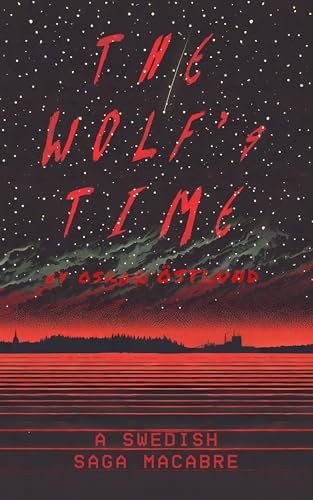
In the tranquil Swedish coastal town of Skutskar, the summer of 2004 turns into a nightmarish apocalyptic fever dream. Inspired by the atmospheric tension of Stranger Things, the visceral horror of the Alien trilogy and the relentless brutality of Koushun Takami's Battle Royale, The Wolf's Time is a raw, unforgiving, and macabre tale of friendship, love and brutal survival. As the sun sets and darkness creeps in, the once familiar surroundings of their hometown become a battleground. The friends' summer plans of LAN parties, mopeds and youthful rebellion are shattered by an unknown enemy that descends upon them with merciless ferocity.
Plot Summary (spoiler-free)
In the quiet Swedish coastal town of Skutskär, the summer of 2004 curdles into a nightmarish, apocalyptic fever dream. Erik and his close circle of friends had plans for the season, LAN parties, mopeds, the usual youthful rebellion, and instead their familiar hometown turns into a battleground when an unknown enemy descends on it with merciless ferocity.
The book follows Erik and his friends through what turns out to be the summer that defines them, moving between ordinary teenage trials and a growing supernatural dread that has fixed on the group. The community, the ancient forests, the Baltic Sea, and Erik’s own private demons all serve as backdrop to a Norse-inflected saga where old myths and old gods are woven into the mounting horror, and something primeval seems to be stirring around them.
Character Development
Erik is the quiet, introspective centre of the book, repeatedly pushed past what he thinks he can take. He feels a great deal and says very little, and his psychology is drawn in fine detail, caught between the innocence of a boy and a hard-won self-awareness. His relationship with Sandra, an older girl who both fascinates and frightens him, is where the book does its most careful work on first love, self-doubt, and the power imbalance between them.
Sandra is magnetic and opaque, fierce and brittle at once, and the attraction she represents for Erik is thrilling specifically because it is dangerous. She is deeply caring and emotionally elusive in the same breath, which makes her a strong force pushing Erik toward self-discovery and toward confronting his own fears. The supporting friends, Oscar and Johan among them, are the load-bearing structure of Erik’s world, Johan bringing charisma and lightness, Oscar an acute sensitivity, and the shared history and fierce loyalty between them capture the bittersweetness of young friendship. As the book goes on, friendship moves from background condition to the foreground of Erik’s life.
Themes
Friendship and its give-and-take of strengths and insecurities is the book’s real subject. Place matters too: the untamed beauty of the forest set against the industrial shadows over Skutskär gives the setting an almost elemental charge, and the tension between human progress and the primal natural world runs through it. The Norse mythology pushes the book toward fate, death, and transformation, and the mounting presence of the wolves keeps suggesting that some forces are closer than anyone wants to believe. Underneath, this is a coming-of-age story about the move from childhood into an uncertain young manhood, carrying young love, painful shifts in identity, and a longing for acceptance, and Östlund handles all of it with enough care that the reader stays in deep sympathy with the characters.
Writing Style and Effectiveness
Östlund’s language is ornate and disturbingly beautiful, and it holds onto the mythic roots of the story. The prose is lush and atmospheric, the forests around Skutskär, the smoky townscape, the near-tangible presence of the Baltic, all rendered vividly, and the heavy use of metaphor gives Erik’s world a quality close to magical realism. The pacing is deliberate, drifting from contemplative stretches into sudden bursts of action, which mirrors Erik’s turbulent emotions and rising fear. The third-person-limited point of view stays fixed on Erik and pulls the reader deep into his interior, so that even quiet scenes carry tension.
Conclusion
The Wolf’s Time is a haunting trip into the darkness in myth and in the human heart, braiding a coming-of-age story with dense layers of folklore, youth, and existential unease. Its strengths are its complex characters, its world-building, and the blend of horror and myth. It is genuinely slow in places, though the pace fits the atmospheric tension it is building. Intimate and epic at once, it is a coming-of-age horror in the same family as John Ajvide Lindqvist’s Let the Right One In, where an ordinary setting collides with the supernatural in ways that are both disturbing and revealing.
Evaluation
- Overall Rating: ★★★★★ (5/5)
- Writing Style: ★★★★★ (5/5): evocative and richly textured.
- Characters: ★★★★☆ (4/5): compelling, though Sandra could use more room.
- World-Building: ★★★★★ (5/5): the setting is meticulously built and deeply atmospheric.
- Spice Rating: ★★☆☆☆ (2/5): first love and desire are present, but the book is horror and coming-of-age first.
Trigger warnings: graphic horror and violence, brutal survival scenarios, body horror, a power imbalance in a teenage relationship, personal trauma and grief, animal threat.
Recommendation: for readers who want dark, atmospheric fiction that blends mythology with a coming-of-age story, and who do not mind a slow burn. Fans of Scandinavian horror and mythological fiction, and of John Ajvide Lindqvist in particular, should pick it up.