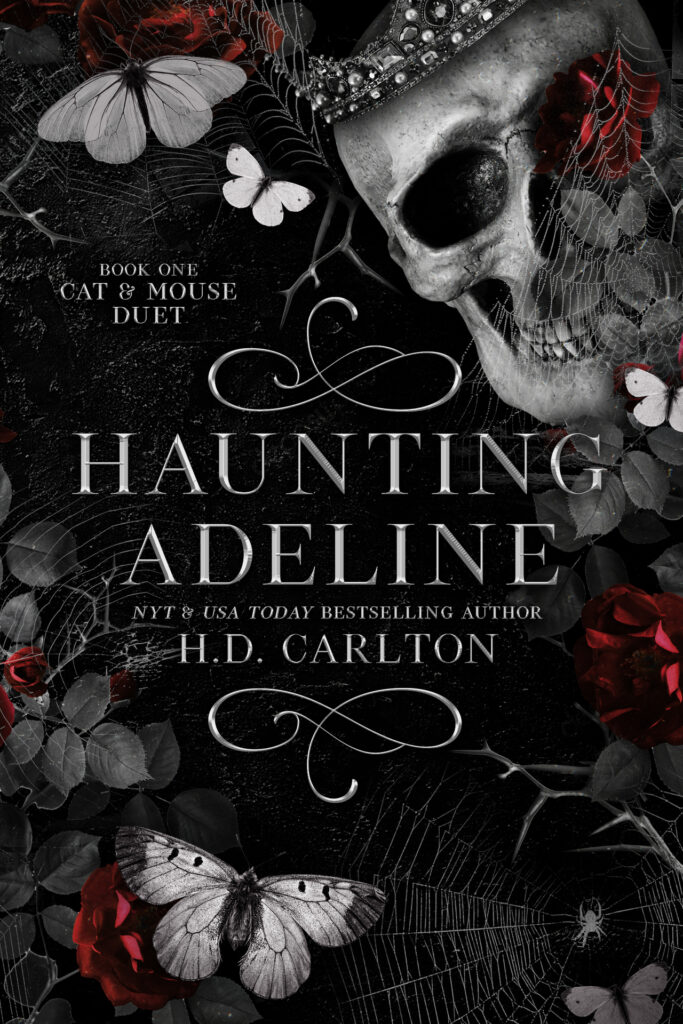
Haunting Adeline by H.D. Carlton | Book Review
The Manipulator
I can manipulate the emotions of anyone who lets me. I will make you hurt, make you cry, make you laugh and sigh. But my words don't affect him. Nothing about me does. Except my ability to make him feel again.
The Shadow
I didn't mean to fall in love. But now that I have, I can't stay away. I'm mesmerized by her smile, by her eyes, and the way she moves...
Overview
Haunting Adeline by H. D. Carlton is book one of the Cat and Mouse Duet, self-published in its second edition in August 2021, with Hunting Adeline finishing the story. It runs about 629 pages. Call it adult dark romance with a heavy streak of erotic horror, built on top of a romantic-suspense plot and a murder that has gone cold since the 1940s. It’s told in first person, present tense, switching between the two leads every chapter. Adeline’s chapters are headed “The Manipulator.” Zade’s are headed “The Shadow.”
Plot Summary (spoiler-free)
Adeline “Addie” Reilly is twenty-six, an indie author of dark, horror-leaning fiction, a wreck in a crowd and perfectly comfortable with anything grim. She moves back into Parsons Manor, the crumbling gothic Victorian on a Seattle cliffside that her grandmother left her. She’s barely unpacked when the stalking starts. Roses with the thorns snipped off turn up inside a locked house. Her grandfather’s whiskey gets drunk while she sleeps upstairs. Notes come addressed to “little mouse.” She files police reports and nothing happens.
The man doing it is Zade. He runs an off-grid organisation that pulls people out of trafficking rings and kills the ones profiting from them, and he saw Addie once at a book signing and decided she belonged to him. He has no interest in courting her like a normal person. He wants her to see the worst of him first, because to his mind a love built on a lie is worth nothing.
Two more stories run next to that one. Addie finds her great-grandmother Genevieve’s hidden diaries and learns Gigi was murdered inside this house decades ago, the case never solved, and that Gigi had a “visitor” of her own that she fell for. Addie starts digging, half of it to prove to herself that loving a stalker only ends one way. Meanwhile Zade is closing in on a shadow network that sacrifices children in occult rituals, and Addie gets dragged into his cover work whether she likes it or not. The last page is a cliffhanger with the safety off. Don’t pick this one up unless the sequel is already on the shelf.
Character Development
Addie is the voice you’re living inside, and she’s funny and filthy even mid-panic, an overthinker who keeps arguing with a god she doesn’t believe in, an adrenaline junkie who has spent her whole life being told there’s something wrong with her for loving fear the way she does. Her arc is a moral line she built her identity on, slowly wearing away. To her credit, she never lies about it. She calls the early encounters assault and doesn’t dress it up, and her own wanting is left in the frame instead of quietly cut out. Where she thins out is anywhere the relationship isn’t. Her career, her writing, her past, all of it gets less room than the pull between her and Zade. Her mother Sarina is cold and cutting, and that wound is real, and it’s part of why Addie is so alone out on that cliff in the first place.
Zade is the reason it holds together. He isn’t a switch flipping between menace and devotion, he has an actual internal logic, and his refusal to win her with a nice lie fits everything else about him. His backstory is deliberately unremarkable, loving parents and a car accident and a grown man’s choice, which unsettled me more than a revenge origin ever would have. The night a rescue goes wrong and he falls apart is the most human writing in the book, and it’s the moment Addie’s feelings actually turn. It’s never offered as an excuse. He stalks, he records, he coerces, and the book says so out loud, over and over.
The power between them is completely one-sided and nobody pretends otherwise. Zade holds every practical card and plays all of them. What the whole thing runs on is that Addie’s fear and her desire fire at the same instant, and Zade has shaped his entire approach around knowing that.
Daya, Addie’s best friend and, it turns out, a hacker inside Zade’s own organisation, is the warmth here and the sane one in the room. She tells Addie flat out that this isn’t healthy, and she sticks around anyway. Sibby, the “broken doll,” is genuinely unnerving, a young woman with untreated psychosis and a body count, and she gets more sympathy on the page than you’d expect. Next to her the senators and society men are cartoons, which sort of proves that evil can be that petty and also drains every scene they’re in. The 1940s thread comes with its own people, Gigi and her husband John and the detective Frank Williams and the “visitor” Ronaldo, and where that lands recasts Addie’s grandmother in a way that hurts.
Themes
Fear as appetite is the thing at the centre. You keep circling the same question Addie does: what does it mean that terror turns her on, and does that make her a victim, a participant, or both at once. Consent is the harder one, and it never gets tied off. Non-consent and dubious consent are right there on the page, Zade narrates that he knows it’s wrong and does it anyway, and you’re never handed a clean way to feel about any of it. Whether that reads as honesty or as an alibi is going to come down to the reader, and the book seems to know that too.
History repeating is what stitches the two timelines together. Gigi and her stalker, Addie and hers, the same house, and the open question of whether the older story was a tragedy the stalker caused or one caused by everyone standing around him. Underneath it all is the law failing: stalking reports vanish, traffickers walk free, and the answer the book offers is a man who wrote his own code and kills by it. It’s a revenge fantasy and it’s honest about being one. Storytelling runs through the whole thing, which fits a heroine who’s a novelist and whose chapters are named for what she does to her readers, in a book that keeps folding a mystery inside a romance inside a conspiracy.
Writing Style and Effectiveness
The alternating first-person present tense is the right call for this story, and Addie’s narration is why you keep turning pages. It’s quick, crude, referential, self-mocking, and it moves. It’s also the biggest problem with the book. The jokes never let up, not even in scenes that need a second to breathe, and all that deflection works against the dread the gothic setup spends so much effort building. When the narrator undercuts her own terror with a punchline every few lines, the terror stops landing.
Parsons Manor is the best thing on the page. The rotting Victorian, the attic that feels like it wants you gone, the cliff, the ghosts that nudge instead of rattling chains, all of that atmosphere is good and it earns its place. The plot piled on top is too much. Three books are running at once, a contemporary stalker romance, a 1940s cold case, and a trafficking-cabal thriller, and they fight each other for room instead of feeding each other. The historical mystery gets solved on a neat chain of evidence that all shows up in the last stretch. The conspiracy layer is lurid and half-built, more mood than structure. What never goes slack is the momentum. Short chapters, cliffhanger beats, and it’s hard to stop at one. The explicit content is frequent and it escalates, and a few of the set pieces are built to disturb at least as much as to turn you on. If that framing isn’t for you, this book won’t win the argument.
Conclusion
There’s a lot working here. A love interest who stays magnetic and stays consistent, a house worth every page it takes up, and a hook that doesn’t let go once it has you. The costs are just as real. Addie mostly exists in relation to the man across from her, the plot carries more than its frame can hold, the cold case resolves in a rush, and the villains never stop being cartoons. Against other stalker dark romance this sits at the harder, more transgressive end, and it’s swinging for more than most by trying to be three genres at once, even when that’s exactly what strains it. It also, more than most books in the genre, refuses to let you feel comfortable about what you’re enjoying, and doing that on purpose counts for something.
One honest note on the score. This is one of my all-time favourites, and the overall rating says that as much as it says anything about the craft. Judged cold, on the page, the marks below are more mixed, and I’ve kept both of those things true in this review.
Evaluation
- Overall Rating: ★★★★★ (5/5)
- Writing Style: ★★★☆☆ (3/5): fast and carried by a strong voice, but the wall-to-wall quipping fights the tension the gothic setup builds, and the three braided plots crowd each other out.
- Characters: ★★★★☆ (4/5): Zade is a well-drawn, internally consistent morally grey lead and Daya keeps the book grounded, but Addie is vivid in voice and underwritten outside the central relationship, and the villains are cartoons.
- World-Building: ★★★☆☆ (3/5): the gothic manor is excellent and carries most of the atmosphere; the secret-society conspiracy around it never gets past lurid set dressing.
- Spice Rating: ★★★★★ (5/5): frequent, escalating, and explicit, with several scenes built to unsettle as much as to arouse.
Trigger warnings: non-consent and dubious consent between the main characters, stalking, graphic violence, torture, murder and dismemberment, human trafficking, child trafficking, child sacrifice and child death, kidnapping, gun play, somnophilia, bondage, degradation, breeding kink, choking and breath play, cult and ritual abuse, references to suicide, a severe power imbalance.
Recommendation: for readers who want the hard, transgressive end of stalker dark romance wrapped in gothic suspense, with a novelist heroine, a love interest the book keeps frightening even after she stops running, and the sequel already on the shelf for the cliffhanger. If you found the genre through this book in the first place, or you love H. D. Carlton at her darkest, you’ll be right at home. Skip it if you want a soft romance, a shared power dynamic, or a clear conscience about the content.